Remembering Roemerville by Jasmine Gordon

Posted by Joyce Rhyne on 19 Dec 13 - 0 Comments

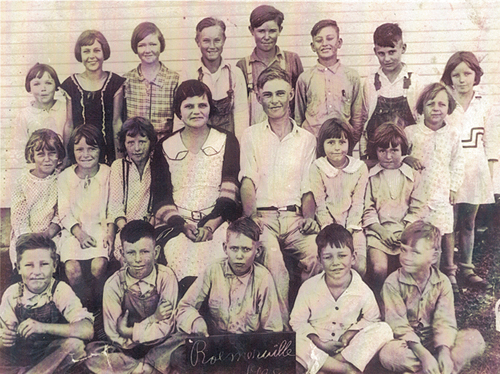
Roemerville School - Top row: Pearl Wilburn, Violet Williams, Lee Ella Wilburn, Raymon Watson, Alpha Lee Scott, Farton Queen, Lone Fuller, Beatrice Scott; Fern Williams, Pearl Scott, Opal Scott, Mrs. Bieman, Clinton Williams, Lois Helms, Dorothy Helms and Katherine Helms; 3rd row: Stoney Matson, Alba Helms, Queen, Billy While, Arthur Wilburn


As I followed Dorothy’s directions down the winding road I was eager to see her again. It seemed like yesterday since I’d met her at the library in Seadrift to talk about one of Seadrift’s first publications, Seadrift Success. In actuality, it had been about two years! Following last month’s article where I inquired about Roemerville; she had called and suggested I meet with her and Joyce Raby as they both  were born in Roemerville. So there I was, headed to Dorothy’s house which is just outside of Seadrift.

Before I knew it, two hours had gone by! I learned a lot about the families that made up Roemerville in the early 30s.
Dorothy Geraldine Williams Wilson was born on November 29, 1929 on the Oscar Roemer Farm. Joyce Helms Raby was born in Roemerville on June 18th, 1929.

Dorothy remembers her brother, J.D Williams who was six years older than she, attended school in Roemerville. She didn’t, as her family moved to Seadrift where her father became the city’s milk cow herder. Joyce remembers attending school in both Roemerville and Seadrift. Her family moved back and forth for several years to the small farming community. Both of their dads, Bill Helms and Dave Williams, worked as tenant farmers in Roemerville. They met in second grade when Joyce’s family moved to Seadrift.

Joyce’s teacher was Charlotte Roemer. She remembers Charlotte would bring the kids food as it was during the depression and the families didn’t have much.

Joyce is one of eleven siblings; Cecil, Gene, Bobby, Don, Patsy, Carnell, Billy Jo, Dale, Alice Fern and Johnny. They had only the basics like flour and coffee; it was a luxury when the girls had peanut butter or syrup on a biscuit. Cabbage heads were five cents. Dorothy remembers how much she loved the color of beets. “I daydreamed all the time,” she said. “I would daydream that I had a dress that color.”

As they spent the afternoon reminiscing, they told me about other families who also lived in Roemerville. Oscar and Bell Roemer, Emma and Scrapp Helms, Leo Blevins, the Watsons, the Marlows, Virginia Gaines and a handful of others. Joyce now lives in Port O’Connor with husband, Owen Dan who she married in December of 1945.

Then Joyce started singing a song her father would sing to her.

“Rye whiskey rye whiskey
Rye whiskey I cry
If you don’t give me rye whiskey
I surely will die

If the ocean was whiskey
And I was a duck
I’d dive to the bottom
And never come up”

I laughed as they sang various songs from their childhood. “She’ll be comin’ round the mountain,” they sang in unison.

Thanks to both ladies for bringing me one step closer to Roemerville. I greatly enjoyed spending the afternoon chatting, laughing and singing.
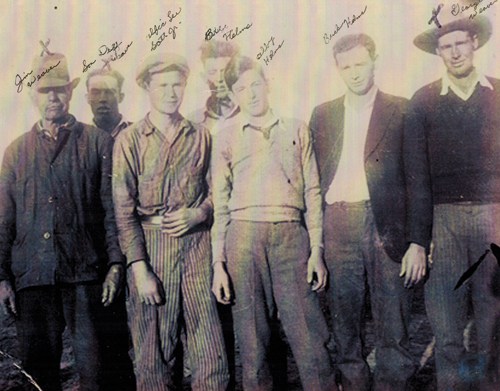
from Joyce Raby’s family album: Uncle Jim Weaver, Duff Weaver, Alfie Lee Scott, Bill Helms, Alby Helms, Buck Helms and George Weaver
Port O’Connor, A Perfect Place for a Farming Revolution by Amanda Raby

Archived in the category: General Info
Posted by Joyce Rhyne on 19 Dec 13 - 2 Comments

Turns out there’s a farming revolution going on! Within the last 10 years, biologists and designers have brought ancient organic farming practices back to light in an effort to rehabilitate our land and seas. The result and heart of this movement is known as permaculture – a sustainable design science, rooted in nature.

In a nutshell, permaculture mimics naturally occurring systems, methods, and materials to create an environmentally friendly, eco-conscious mode of living. Therein, we not only halt the damage we’ve done, but actively work to undo it.

Fortunately we don’t have to wholly give up our current ways of life. The first principle of permaculture asks that we carefully and quietly observe. Nature guides us in the development of farming technologies. Central to permaculture are the three ethics: care for the earth, care for people and share the surplus. As an unincorporated community, Port O’Connor has a unique opportunity to collectively cultivate nature’s own technologies that allow us to retain our standard of living. It can be done in an environmentally harmonious, responsible manner, all the while eliminating pollution and food supply contamination. Say gourmet!

Where do we begin? We can start by getting a good feel for our local wild edibles. Most of us have wild canopies of Muscadine grapes trailing through the mesquite mottes. And there’s certainly not a shortage of seasonal blackberries. But what is that mushroom in the yard? What’s that bee sipping on? How many times has that soil been tilled? Does it have earthworms? Are these seeds genetically modified? Educational community field walks, wild food forest trails and botanical art classes could give us an upper-hand.

Speaking of botanical art, wildcrafting, a facet of permaculture, is the art of responsibly foraging wild edibles and transplanting them into a home garden in a similar fashion to its original location. So you may plant seeds from a wild plum along with grasses that grew by the mother tree. If you want to try wildcrafting on your own, be sure to leave more than 2/3 of a wild plant population to avoid overharvesting… and save those seeds! True heirlooms are becoming more scarce than ever due to corporate patenting. Should this be legal?

Diversity is key to permaculture, just as nature intends. Case in point: The great potato blight of Ireland. The Irish brought a few potato varieties home from Peru and had great success for a several generations, until the bugs adapted and wiped out all the crops, leaving thousands to starve to death. Now we see the same thing happening with the russet potatoes in Idaho, except nowadays, farmers are government subsidized to spend millions on pesticides to treat the bugs. The native Peruvians, Incas, had it right though. They grew over 200 varieties of potatoes, all on one mountain top – some on the north side, some on the south. No pesticides. Just potatoes, sprouts, beans and a few other symbiotic herbs.

Surprisingly, permaculture requires less work too! The “no-till” technique of lasagna layering compost and turned crops with decomposers like mushrooms and earthworms slowly creates a micro-climate in the soil, leaving it impervious to diseases and invasive “weeds.” Another amazing permaculture design technique is the floating garden, also known as the Aztec Chinampas. Floating clumps of water hyacinths lay the foundation for beds of compost. Water is wicked into the soil through the river water. The hyacinths clean the water and when the rivers flood, the gardens float! Maybe we can apply the same gardening technique to our estuaries to naturally remove pesticides from upstream water sheds. As for the hyacinth – one man’s weed is another man’s gold.

There is much to discover as a community. If there is a collective shared interest, we could grow food forests and make the bays even more hospitable to the magnificent wildlife that makes Port O’Connor what she is, the fluttering heart of the Texas coast.

If you’d like to get involved or learn more, search for “Wiv Luv Natural Farm Collective – Port O’Connor, Texas” on Facebook, email bloom@wivluv.org or call Amanda Raby at 214-316-0441. Popular interest and support could result in a community garden, community food forest nature trail, farm coop or a community supported agriculture (CSA) food delivery program! Do we have harvest jubilees in our future!?

-Amanda Raby is a 4th generation Port O’Connor native. She is the chief and founder of Wiv Luv-Humanitarian Entertainment, a non profit that utilizes digital media, music and circus arts to educate rural communities about sustainability and heart-based living.

Leaving Home and Going Home by Joyce Rhyne

Archived in the category: General Info
Posted by Joyce Rhyne on 19 Dec 13 - 0 Comments

Jane and Dick Chislett

How can someone pack up and move after 32 ½ years in one spot? Well, it is not an easy task, either physically or emotionally, as Jane Chislett can attest. The Chisletts made their home at 8th and Olive in Port O’Connor shortly after arriving in Calhoun County in 1981. Jane and Richard (Dick) moved from LaGrand, Oregon when Dick was transferred to Port Lavaca by his employer, GTE telephone company. The hot, humid weather of Port Lavaca was not a pleasant change from Oregon. “It smelled ‘fishy’,” Jane said. They couldn’t find a suitable place to rent so, they ventured out a little further and found Port O’Connor. Finding a trailer home to rent, they were able to purchase it and Dick subsequently made a lot of improvements to it.

Dick continued working for GTE until his retirement in 1996. Meanwhile Jane found work as a cook. She worked at The Fishing Center and at the old Strykers, and lastly at Harbor Inn in Seadrift, until her retirement in 1997. “I still remember people around here by their food orders, “ Jane said, “how they liked their eggs fixed, and things like that.”

Jane was known around Port O’Connor for her affinity for stray cats. Known by many as ‘The Cat Lady’, she at one time took care of 47 cats, all having been named and ‘fixed’. She would bring strays home from The Fishing Center where people often dropped them off and has raised many kittens by hand. She remembers once walking down the street and turning to see 17 cats following after her.

Currently her brood of cats numbers about 25. Having to leave them is not easy, and Jane thought it would be more kind to turn them over to the Humane Society. “At least they will have a chance of finding a home,” she said.

With the help of their friends Pam and Hardy Mills of Seadrift, Dick and Jane have now moved to be near their daughter Linda and family In Pickton, Texas. Moving to Pickton is sort of like ‘going home’ says Jane. Pickton, which is about 100 miles east of Dallas, is only 40 miles east of Jane’s birthplace in Titus County. Pickton is also a small community, so it won’t be so different from Port O’Connor.

Jane was looking forward to being with her daughter for Thanksgiving and her daughter’s 62nd birthday, to being with her only grandchild, Laura, and her two great granddaughters. “We are embarking on a life-changing experience,” she said. “We plan on purchasing a mobile home and setting it up on my daughter’s 19 acre home site. We will be within hollerin’ distance of each other,” she said.

After living here so long, Dick and Jane have met a lot of folks, “and we enjoyed knowing most all of them,” Jane said. “I will especially miss my church family and friends. My one regret is that I didn’t get to cook more fried chicken for Pastor Erny.”

Songs of the Season

Archived in the category: General Info
Posted by Joyce Rhyne on 19 Dec 13 - 0 Comments

Songs of the Season The Seadrift Community Choir, Nancy Childress, director

-Photo by Kristine Metcalfe

-Photos by Kelly Hataway

Part X: Special Holiday Edition

As we all know, ‘tis the Season, so to speak. Every year, beginning at Halloween and ending sometime after Christmas, Americans celebrate a truly glorious and important time period in which we experience the True Meaning of Christmas.

In times past, the True Meaning of Christmas centered around the long ago birth date of a genuinely virtuous man who inspired a new religion centered around what was to become an enormous and powerful institution that provided guidelines for the people so they would know how to correctly live their lives. In short, this enormous and powerful institution realized the people required instruction in how to be good, as opposed to bad, so that they would be rewarded, as opposed to punished.

Although El Hyena is not himself a particularly religious person, he definitely does not disparage religion. El Hyena does not wish to step on any toes, nor does he seek to make War on Christmas. El Hyena just wants to make that clear, in case there are any doubts.

Anyway, as time passed the True Meaning of Christmas underwent a few adjustments and modifications. Sometime during the nineteenth century, some English person created Jolly Old Saint Nick, a/k/a Santa Claus, as an addition to the True Meaning of Christmas. This mythical person had the unique ability to spread Joy to the World, all in one single night, by employing genetically modified reindeer, courtesy of Monsanto, thus allowing him to visit every household on the planet and leaving gifts around a special tree installed in front of the fireplace (hopefully not too close). Note: at the home of El Hyena’s nephew, “gifts” does not do it justice; it would be more accurately described as “booty”. Because of this remarkable event, on Christmas morning children everywhere would learn whether they had been naughty or nice. El Hyena always wondered about this aspect of Christmas, as his childhood behavior was not always especially admirable. Not wishing to look a gift horse in the mouth, El Hyena skillfully, if not dubiously, prolonged his reverent belief in Santy Claus (as he’s known in Texas) until he was a senior in high school.

At some point, some ingenious person, probably American, discovered that Santa Claus could sell things, thus ushering in yet another welcome addition to the True Meaning of Christmas. People now realized that Santa Claus preferred certain products, such as soft drinks and electric razors, and he wanted us to enjoy the benefits of these products as well. This important historical development led to the creation of shopping malls and the Internet so that the True Meaning of Christmas could be realized. It became obvious that the people could not understand the True Meaning of Christmas without Black Friday, Cyber Monday, and After Christmas Sale Spectaculars.

Because of this, Thanksgiving has been largely incorporated into the True Meaning of Christmas. The Thanksgiving morning newspaper, for example, became the heaviest and most voluminous edition of the entire year. Local newscasts now feature riots at Walmart and helicopter video of crowded parking lots. E-mail inboxes are crammed with announcements of Exclusive Offers and Special Events. Retail enterprises offer less pumpkins, pilgrims, and cornucopia, and more Elves on the Shelf and special holiday themed pet costumes. While there may be dogs somewhere that tolerate and appreciate being dressed as Rudolph the Red-Nosed Reindeer or the Grinch, El Hyena strongly suspects that his Faithful Companion, Lobo, is not one of them. Being attired in a red velvet, ermine trimmed, hooded cloak involves being still, which Lobo is not prone to do. But fear not, Lobo can also participate in the True Meaning of Christmas inasmuch as it involves swimming in frigid water and retrieving dead or dying waterfowl, which he dearly loves.

Having considered the above and foregoing, the more astute of El Hyena’s readers will conclude that the True Meaning of Christmas is all about Unfettered Free Market Capitalism. Real Americans know that not only is it the Reason for the Season, but it is our patriotic duty to support our economy by spending heavily and incurring huge oppressive debt. After all, we would not want our investors to be nervous or our consumers to lack confidence, as that might result in lower stock prices and executive compensation. This would detract from the True Meaning of Christmas.

Merry Christmas to All. Ho, ho, ho or, if you prefer, bah humbug. Don’t miss out on these Spectacular Savings.

Untitled Document