Burnett Family Fishing

Archived in the category: Fishing Reports
Posted by Joyce Rhyne on 17 Jan 13 - 0 Comments

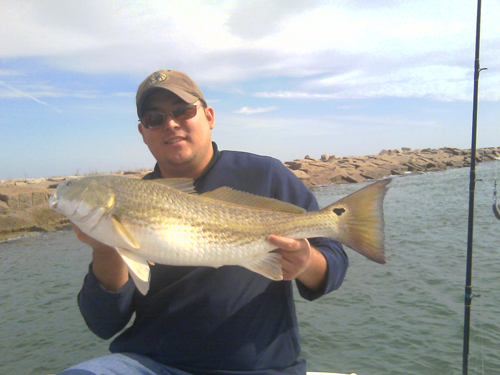
Jonathan Fleming (above) of Austin, along with his fiancé Molly and other members of Mike and Sam Burnett’s family, on his first fishing trip to Port O’Connor. Jonathan caught his first redfish (a 28-incher) at the big jetties.

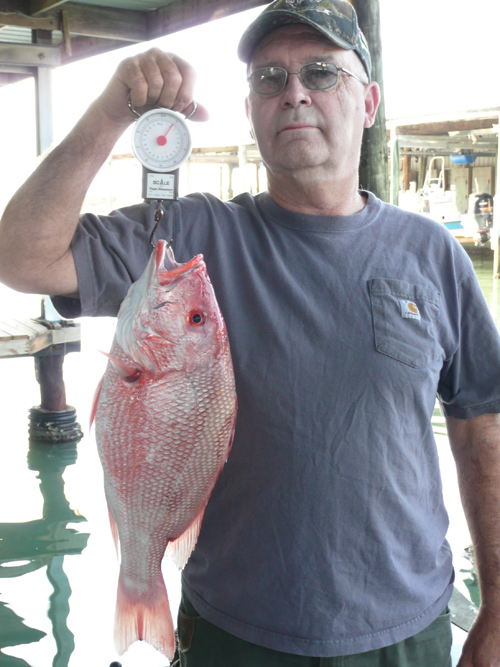
On the same fishing trip, Tom Hoke (Molly’s dad/Jonathan’s future father-in-law) caught a 5-pound red snapper at the big jetties. (photo below)

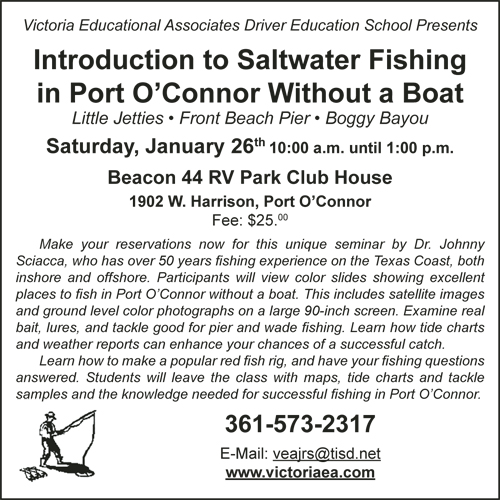
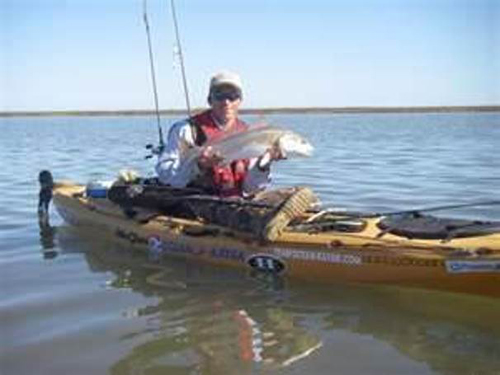
Saltwater Fishing Without A Boat

Archived in the category: Fishing Reports
Posted by Joyce Rhyne on 17 Jan 13 - 0 Comments

PT Boat-Building On A Rainy Day by Larry Wegeman

Archived in the category: Fishing Reports, General Info
Posted by Joyce Rhyne on 17 Jan 13 - 0 Comments

Cold weather is not the best weather for working with epoxy, and rain weather makes it all but impossible. The PT Boat project is now beginning the ninth year and has recently drawn friendly, neighborly comments like, “Why has the project stopped?” But the project has not stopped. On the contrary, there is much work to do, even on an inclement day. Under the boat for example, six stations need to be built to support docking cleats. The best time to do this is while the boat is upside down — it is easier; other things are too. Certain areas need sanding and bulkhead stringers need filling. And on a rainy day, there is always time to think about the engine installation.

Each diesel engine will rest on two stringers; stringers to be eight by eight inches by 34 feet long of treated yellow pine. One end of each stringer will butt into the transom and the other end into the beam frame. The stringers will rest on floors –across nine frames that are spaced one meter apart. But what about athwart ship spacing between stringers and the distance each pair of stringers makes between the keel and outer bulkhead? Where these stringers are placed is very important. This positioning will determine propeller spacing. The distance forward and aft that the engines are installed determines the drive shaft angle. (And even though the entire stringer length will support the engine weight, it is desirable that the engines rest equally over the three reinforced supporting frames.) Once propeller positioning is approximated, the keel and skeg can be accurately tapered, to prevent air from entering under the boat and into the props, which when turning the craft could cause serious cavitation problems.

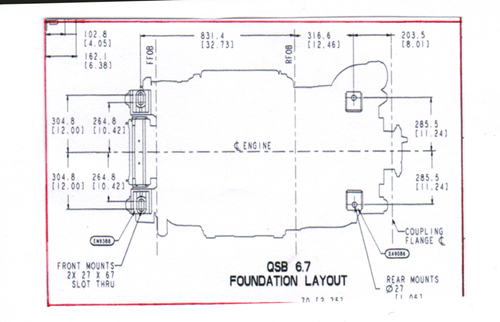
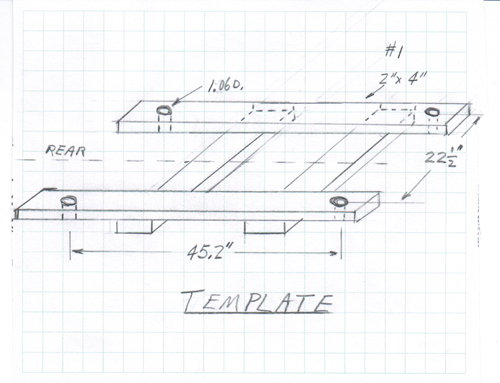
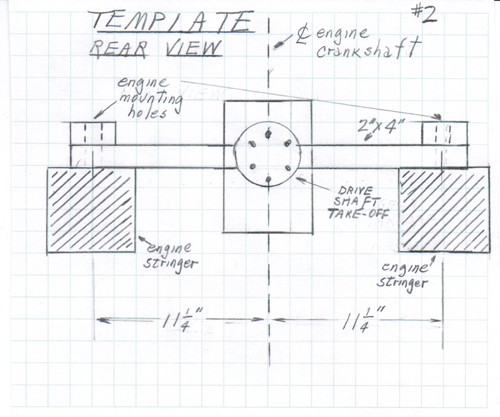
Spacing between stringers is determined by the actual spacing between (engine) mounting holes. Cummins, Inc., in the Foundation Layout, provides these distances regarding the QSB series 6.7-liter diesel engine. According to the Foundation Layout, the distance between the front and rear mounting holes is 45.2 inches and between athwart ship mounting holes 22.5 inches. All holes are in the same plane and parallel to the crankshaft. Hole diameters are 1.06 inches. The weight of each engine with gearbox and oil is 2,000 lbs and will need to be set into the boat with a crane. When the time comes to actually drill the holes in the engine stringers, it seems wise and preferable to first build a template.

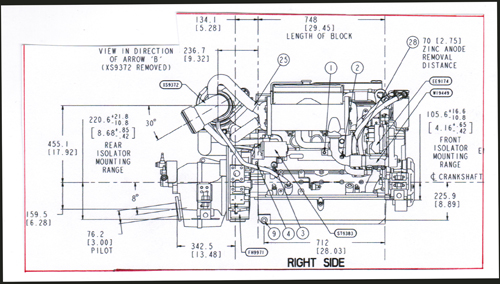
Consider an engine-template and the place where the gearbox “take-off” to the propeller shaft falls, relative to the mounting holes. The Right Side view shows the shaft at an angle of 8 degrees to the engine crankshaft. It may be necessary to increase this angle to within the recommended range of 12-16 degrees. From high school trigonometry, the calculation results in a front engine-mount rise of 3 inches to provide an extra 6 degrees of lift, for a total drive shaft angle of 14 degrees. Cummins provides hard rubber mounts, a capability to raise the front of the engine, and extension ears that allow irregular engine components to fit between stringers. Oil drain plugs (located on the port and starboard lower-ends of the crankcase cover) need to remain unobstructed, as well as the oil heater connection plug. The Rear View sketch now provides enough data to actually make a template. The template will allow the easy positioning of stringers and an awareness of anything the engine might hit, all without actually having an engine, and in plenty of time to make any necessary adjustments.

And so ends another rainy, boat-building day.

Foundation-Layout


The Port O’Connor Paddling Trail is one of the most beautiful and unknown trails along the Texas coast. Fisherman, Bird Watchers and Kayakers out for a day enjoy these waters.

The Port O’Connor Paddling Trail consists of three trails totaling a little more than 25 miles. The Fishpond trail (12.3 miles) begins in Port O’Connor and travels through a number of bayous and cuts along the edge of Espiritu Santo Bay to Saluria Bayou, where it joins the 8.28-mile South Loop trail. From Mule Slough, the Fish Pond and North Loop (4.82 miles) trails continue east toward Sunday Beach on the Gulf of Mexico and to Lighthouse Cove, near the historic Matagorda Island Lighthouse. The scene of fighting during the Civil War (Confederate trench lines still may be seen here), the northern end of Matagorda Island is now managed by TPWD as a Wildlife Management Area. Camping is permitted.

Use of the picnic area near paddling sign #35 is permissible for day-use as long as you stay in the campground area. While there are picnic tables at the site, there is no water or restrooms. If you choose to camp overnight or you want to hike, bike or tour the island for any reason, you must possess either a Limited Public Use Permit or an Annual Public Hunting Permit. The permits can be purchased at any place that sells hunting or fishing licenses. For questions about rules governing use of the island, contact the Texas Parks and Wildlife Department at 979-244-7697.

There are local guides that will take you to the island. Go to portoconnorchamber.org for a listing of guides in the area. The Port O’Connor Chamber of Commerce’s mission is to promote Port O’Connor and its businesses. Port O’Connor is a sleepy little unincorporated community that has a vast array of potential. With the natural beauty of the beaches both bay and gulf (accessible by boat), to wade fishing from the Nature Park at Boggy Bayou and King Fisher Beach, fishing from the King Fisher Beach Pier under the green light at night, to bird watching, fishing, hunting, and kayaking or just relaxing, read a book or take a walk on the beach. Port O’Connor has several motels, Bed & Breakfast and RV parks for accommodations while visiting. There are several local restaurants as well. So visit us in Port O’Connor the “Best Kept Secret on the Coast”.

The small islands that border the trail and Matagorda Island support a wide variety of shore and migratory birds and 19 federally listed threatened or endangered species. The area is known for producing redfish, speckled trout, drum and other popular fish. Trout and large redfish are commonly caught all year long. Adding to the variety, a large heard of whitetail deer can sometimes be seen on Matagorda Island, along with the occasional alligator

While many coastal paddling trails are adjacent to public lands, some are adjacent to private property. Respect private property by not trespassing or littering and keeping noise levels down. Use of private land adjacent to the water without permission of the landowner can be considered trespassing. Under Texas Penal Code (30.05), criminal trespass occurs when one enters property after receiving notice not to enter. Notice includes verbal notice, a fence, sign(s), purple paint on posts or trees, or the visible presence of crops grown for human consumption. Information gathered from the Texas Parks and Wildlife.


“REDiculous New Year” by Capt. Chris Martin

Archived in the category: Fishing Reports
Posted by Joyce Rhyne on 17 Jan 13 - 0 Comments

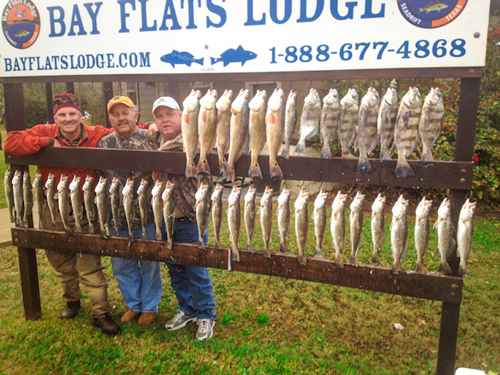
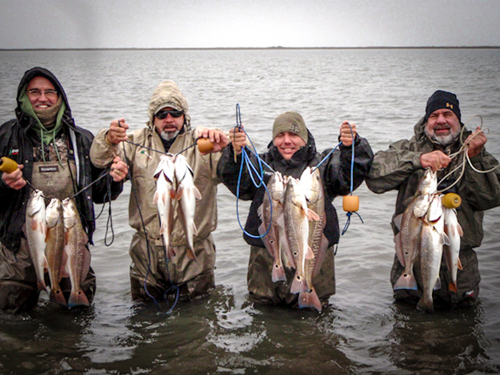
Bay Flats Lodge Capt. Nathan Beabout using lures, picked up reds all day long, “We never got cold because we were always catching.”

I love fishing, and I love cooler weather. Therefore, as a coastal angler, I enjoy January. It’s a month of transition for so many things, so it seems to be anything but a boring month for so many reasons. For one, water temperatures begin to fall drastically, changing from that of cool to that of cold. Because of this, the fish behavior also undergoes change this month as the fish begin acting as though they have stage fright and lockjaw. They suddenly become very selective eaters and can be very hard to entice using the things that worked for me over the past few months when it was warmer. And the places where the fish hangout also changes this month, as the fish begin looking for a steady food supply above mud, or shell, or both, instead of above sand and grass as they did during the summer and fall months. As a result, January generally marks a time of the year in which I, too, am required to change in order to be successful while fishing for cold-water fish.

From a tactical standpoint, there’s a list of things I do differently when fishing during colder months of the year. And things like slowing my retrieve to facilitate lethargic fish, throwing dark-colored lures to provide the preferred silhouette, using fluorocarbon instead of monofilament to enhance casting distance, and performing different styles of rigging to entice a strike are all standard items on the list. But, probably the two biggest changes I make to my fishing habits for the month of January are the species of fish that I like to target, and the structure over which I target them. I’m talking about cold-weather redfish that I find many times in January whenever I’m fishing over shell that’s textured with mud, or a very soft and muddy sand mixture.

Now then, I may need to clarify a couple things here regarding shell before I go any further. When I say the word “shell” in reference to January redfish, I’m not just talking about the large-sized oyster shell that we’re ever so accustomed to finding in the form of reefs, or pads, located at various intervals throughout the bay floor or along shorelines. When hunting these fish in cold water, it has become customary for me to make an effort to pinpoint any kind of shell – pieces of outer-body shells from any other mollusks that are typically found in our bay systems, like that of mussels or clams. This has become an obsession of mine over the years that has allowed me more success than failure when searching for reds once the water has turned really cold.

How do I find these shell-rich locations? The answer is simple, but the effort can prove to be very time consuming – I’ve spent endless hours scouting (and walking) newly exposed bay floor areas during periods of extreme low tide, like the days immediately following the passage of strong wintertime cold fronts. The weather doesn’t always fully cooperate on such days, and you can spend the entire day with freezing hands and cold ears, but the rewards can be astronomical if you’re willing to put in the time and effort to cruise around and mark-up and make notes on one of your favorite hot spot fishing maps.

A lot of area drains leading out of the back lakes and into the main bay system are always good places to start looking for small, submerged oyster shell patches. If I find some of these smaller oyster pads that happen to be situated near the mouth, or opening, where the drain empties into the bay I like to position myself on the bay side within casting distance of the mouth during a somewhat strong falling tide. This allows me to retrieve my bait in a natural fashion while utilizing the flow of the outgoing current to my advantage. I’ve often found these reds to just be sitting idle while hovering over the oyster pads at the drain openings as they simply wait for their food source to be swept within striking range. Depending on how cold the temperature actually is, the strike can sometimes be very minimal, resembling nothing more than your bait rubbing against one of the oyster shells as it slowly moves across the bay bottom. When this is the case, I like to slowly lower my rod tip and reel-in any slack that may be in my line before attempting to set the hook, as it’s very easy to miss these fish when they’re hitting like this.

Some of my favorite wintertime fishing for reds, however, still comes from areas located in the upper end of San Antonio Bay that are adjacent to the lower stretches of the Victoria Barge Canal. It’s an upper bay delta area that historically has been more brackish in nature than that of the vast expanse of San Antonio Bay itself. Although there’s a wide variety of shellfish species found in the neighboring bays and rivers, there are two species in particular that serve as primary food sources in this area for redfish and for trout. One is the eastern oyster that is commonly found in low-salt environs. The other one, the one that’s really popular amongst the redfish, is the rangia clam which is found mostly in brackish surroundings. And as we all know, the redfish can tolerate brackish water quite well, and they have a habit of feeding on mollusks and crabs in very shallow water. But for reasons unknown to me, the redfish love these clams during periods of cold weather. I’ve actually witnessed schools upon schools of redfish feeding in these areas on any given day when the water gets extremely cold beginning in January.

I realize that looking for different types of shell may not require a lot of finesse, and that a lot of anglers may not consider it to be a glamorous task, but doing so can be quite effective. For those of us willing to spend the time, and the effort, to fully grasp this simple technique, the reward can be nothing less than truly amazing when hunting for wintertime redfish in January along our coastal regions. Here’s to hopes of a very prosperous, safe, and Happy New Year for us all…!

Captain Chris and Deb Martin
Owners, Bay Flats Lodge, Inc.
www.BayFlatsLodge.com
BayFlatsLodge@gmail.com

Buy your Fishing or Hunting License before arriving call 1-800-895-4248 or http://www.tpwd.state.tx.us/business/licenses/online_sales/index.phtml
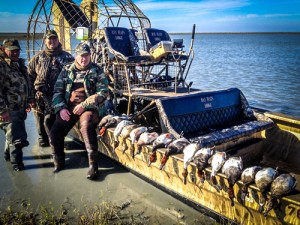
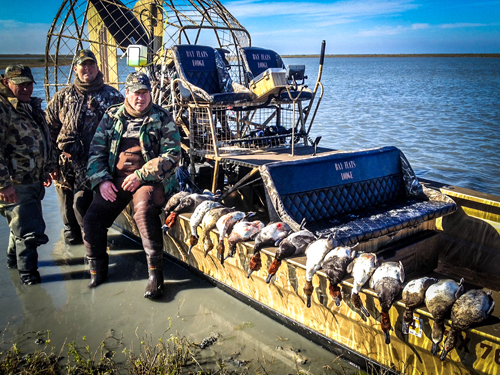
Veteran guide of Bay Flats Lodge, Capt. Harold Dworaczyk, puts Todd C. party on the birds.

For a nice article about duck hutning in Seadrift, Capt. Chris Martin recommends:
http://www.outdoorlife.com/blogs/hunting/2013/01/redhead-paradise-duck-hunting-texas-coast
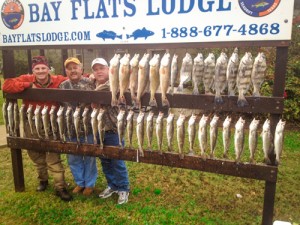
Bay Flats Lodge Captain Rick Hammond; element of surprise, stays out till 5PM, and that extra effort paid off for Mark R. party Jan. 8, 2013 San Antonio Bay with live shrimp
 

Untitled Document