Animal Airways

Archived in the category: General Info
Posted by Joyce Rhyne on 09 Aug 12 - 0 Comments


In April we published an article, Animal Airways, about the program, Pilots N Paws and Great Escape Rescued K9s. Calhoun County Airport manager, Dianna Stanger and local pilot, Michael Solomon flew two dogs to and from Cleburne Regional Airport. They are pleased to find out that one of the dogs, #49 Caspar has found a forever home! The Butler Family has adopted Caspar (we knew him as Buddy). Congratulations! Find out more about the program’s goals at http://pilotsnpaws.org.


-Jasmine Gordon


Dewberry Island Fire

Archived in the category: General Info
Posted by Joyce Rhyne on 09 Aug 12 - 0 Comments

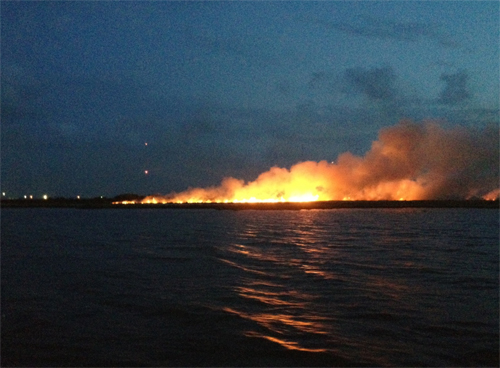
Ron Snider was on his little Jon boat when he took this photo of the Dewberry Island fire Sunday morning, July 22.

Strolling Down Main Street…by Jasmine Gordon

Archived in the category: Featured Writers, General Info
Posted by Joyce Rhyne on 09 Aug 12 - 0 Comments

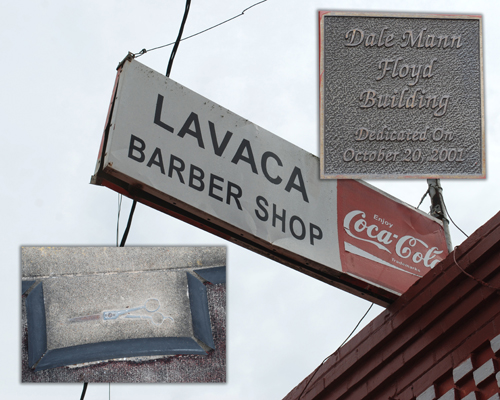
This building is located at 108 South Guadalupe. I found the scissors which were placed in front of the doorstep unique.


History Lesson

Since the last issue, I’ve found myself often strolling down Main Street (otherwise known as US 87) wondering about Port Lavaca’s history. Each stroll I take, I stumble upon another plaque, sign or emblem. It’s difficult for me to understand how the puzzle pieces form this coastal town without a history lesson first.

After several hours and a visit to the Calhoun County Library, I had a better grasp of the fishing community. Read on… I found it interesting that Port Lavaca and Indianola have fought for the county seat for so many years.

Port Lavaca, was founded in the aftermath of the Linnville raid of 1840, a Comanche attack that swept through Victoria. The Linnville raid of 1840 is said to have been one of the most terrifying Comanche attacks. Following the raid, in 1841, the town was named La Vaca, Spanish for the cow, and was laid out by 1842. It was later incorporated on two occasions as Port Lavaca. The town’s economy rests on manufacturing, seafood, agriculture and livestock, construction, mineral extraction, and tourism.

Port Lavaca Timeline

● In 1846, Calhoun County was established, Lavaca became the county seat.
● On September 5, 1850, The San Antonio and Mexican Gulf Railroad was chartered.
● In 1852, with the advantage over Lavaca of a deepwater port at nearby Powderhorn, Indianola became the county seat.
● In 1858, five miles of rail road track were put into operation.
● In 1861, twenty-three additional miles were completed into Victoria.
● On October 31 and November 1, 1862, federal gunboats bombarded the port, but the city, defended by two waterfront batteries, did not surrender, and the gunboats withdrew.
● In December 1863, Lavaca was occupied by Federal troops.
● In April 1864, Lavaca is voted to the county seat.
● In September 1865, after the end of the war, Indianola again became the county seat.
● In November 1886 Lavaca once again became the county seat.
● In 1887, Lavaca’s railroad connection with the track to Victoria was restored.
● About 1887, the community began to be known as Port Lavaca.
● In 1909, Port Lavaca incorporated as a general-law city.
● In 1913, the section of the Gulf Intracoastal Waterway below Galveston was completed.
● In November 1916, the city went bankrupt.
● In November 1919, Port Lavaca incorporated again as a general-law city.
● In 1920 a seawall was completed. The seawall was designed to protect Port Lavaca from high water and erosion.
● In 1928, Port Lavaca’s was leading the nation in the amount of seafood shipped.
● In 1934, natural gas was discovered near Port Lavaca.
● In 1935 passenger train service was discontinued, in addition, oil was discovered.
● In the late 1940s, Aluminum Company of America (Alcoa), Union Carbide, Du Pont, and Formosa in Point Comfort were established.
● In 1961 Hurricane Carla, a Category 4 hurricane struck the Texas coast, becoming one of the most powerful storms to ever strike the United States. The original causeway was seriously damaged.
● In 1965 the Matagorda Ship Channel was completed to Point Comfort.
● In 1985 a celebration marked the 300th anniversary of La Salle’s landing

Population

● In 1850 – white population of 231/slave population of 84
● In 1860 – white population of 526
● In 1870 – white population of 429/”colored” population of 339
● In 1880 – 100
● In 1890 – 365
● In 1900 – 800
● In 1910 – 1,699
● In 1920 – 1,213
● In 1930 – 1,367
● In 1940 – 2,069
● In 1950 – 5,062
● In 1960 – 8,864
● In 1970 – 10,491
● In 1990 – 10,886
● In 2000 – 12,035
● In 2010 – 12,248

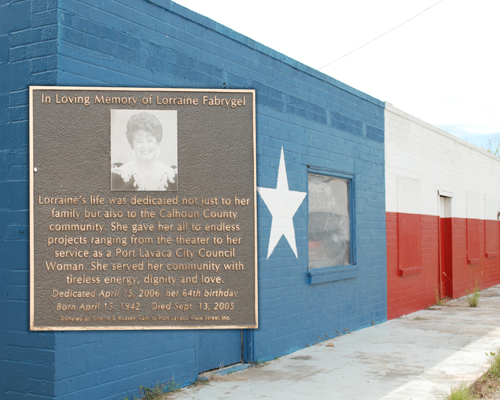
I am on a mission to find out more about the buildings that make up downtown Port Lavaca. I have a slew of questions after exploring the nine blocks surrounding East Main Street. I’ve included photos which I’ve taken during my “Photo Walks”. Till next time!

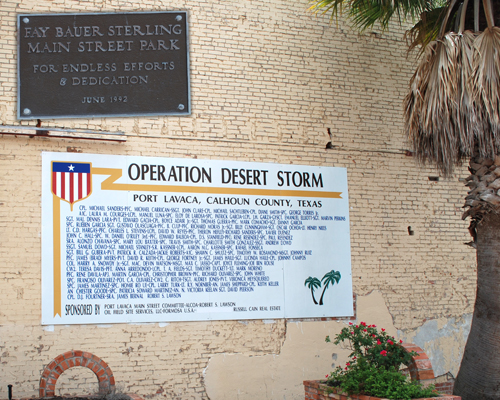
Faye Bauer Sterling Main Street Park is located in between Colorado and Guadalupe Streets on East Main Street.

This building always catches my attention, located on the northern block of Guadalupe and Main Street. It was once a barber shop and restaurant.

A Woman Of Many Gifts: Mary Kay Belter by Geraldine Williams

Archived in the category: General Info
Posted by Joyce Rhyne on 09 Aug 12 - 0 Comments

Like many other retirees, Mary Kay was lured to the Gulf Coast area of SE Texas when she and her husband chose to retire around 2004, even though there were other residential opportunities to consider. Because her husband, Ralph Belter, had recently inherited his parents’ former home in Seadrift, it didn’t take too many moments for them to choose Texas over their other option of staying in Virginia near Washington, D.C., where they had lived for many years, raised their family and Ralph had worked as an Army Judge Advocate General (JAG).

Mary Kay does not intentionally draw attention to herself. Her demeanor is unassuming, and she even volunteered to me when displaying some of her artistry, “I feel like I’m showing off.” Of course, I felt differently, as she is an artist whose art deserves to be shared. Getting to know Mary Kay is a process much like walking through a lovely building. The entrance to her home affords a view of the inspiring San Antonio Bay which can be viewed from a comfortable chair positioned toward her embroidery loom project of Texas Bluebells. She tells me that this is a comfortable place that pulls her in at the end of the day.

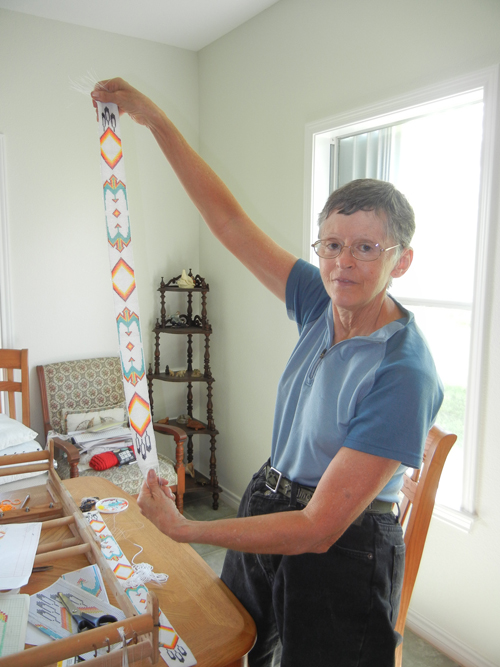
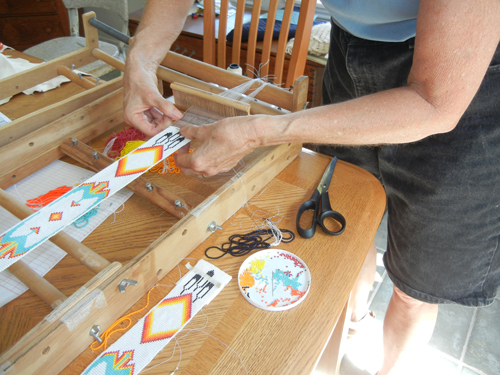
A second room nearby holds a large table which in turn holds a heddle or loom, a device she uses to create bead weaving work. This room is where some of her design and art work are done and is adjacent to her kitchen where she shows me two large mosaic tile trivets she created. Getting to know Mary Kay is like looking at one of her mosaics, which are pieces of art made up of colorful chips from many sources. As with the experience of viewing mosaics, many of Mary Kay’s talents carefully unfold one after another as time is spent in her presence.

When explaining her most recent creative production of bead weaving, she outlined the way a project might evolve. The first step would be designing a pattern on graph paper for a wall banner or a tile mosaic, or a leather work. The second step can be explained by using her bead weaving experience as an adult leader or scouter with Boy Scout troop # 106 in Calhoun County (Council of South Texas). Arranged on her work table would be the tools needed by a beader or weaver: the heddle or loom, bags of colorful small beads (size 11), a needle, nylon thread, a pair of forceps or scissors, and tape.

Mary Kay took on a project with scout member Daniel Cullison who belongs to the Order of Arrow, which is an Honor Society for Boy Scouts. Daniel’s American Indian dance presentation required that he have a special uniform specific to the Plains Indian tribe of Kiowa. As a designer and seamstress, Mary Kay was able to transfer his proposed regalia costume bead weaving design from the visual drafting paper specifications by collecting the appropriate color and number of beads onto her needle and thread and then placing them in rows on her heddle. Working steadily, she has neared completion of a beaded belt, a pair of suspenders and a pair of shirt cuffs for Daniel.

Mary Kay’s rainbow design incorporated a spectrum of dark orange, light orange, yellow, dark red, sea foam green and black beads on a surrounding white beaded background. When the belt, suspenders, and cuffs are completed on this 3-month project, they will be handed over to Daniel who will add his other clothing items which will include a leather neck strap, sweet grass or yarn, bells, etc.

When an incredibly-talented person is observed in one line of work, it is not beyond expectation to imagine her possessing other gifts. For Mary Kay it follows that she is multi-talented in many other areas. With her musical abilities she lends her voice as part of the Seadrift Community choir and the Seadrift Methodist Church choir along with her musical instrument, the flute, which she learned through her west Texas school band beginning in 7th grade. Seasonally, she plays the recorder as part of the church chimes.

Knitting, quilting and embroidery projects are a constant in her life and are a credit to her eye for design and form and her persistence and constancy as a way of life. When she wants to just relax at the end of a day, she picks up some knitting or a piece of embroidery.

Her own physical fitness holds her attention daily, and in an effort to teach its importance to others she leads a walking group at 8:30 each Monday and Friday morning that includes stretching. She also incorporates Tai Chi and running into her personal routine.

Another example of her talent in working with others is a banner project she and Genevieve Bundy designed to be used in the 100-year anniversary in 2012 of the Seadrift First United Methodist Church. Using the symbols of the church’s ministry, she and Genevieve incorporated the needlework forms of appliqué and embroidery, piecing and quilting to portray music, Bible study, Hebrew and Greek lettering, a fish (symbol of Christianity), a chalice and bread (communion), and a sheep (Feed My Sheep food program). She gives credit to Genevieve for doing most of the work involved with the banner’s completion. The banner will be placed inside the church before the 100-year event in the fall of 2012.

Both Mary Kay and Ralph seem to think of themselves as true Texans. Though she was born in Hobart, OK, she was brought to Texas at the age of six months. While at college she met Ralph, they married, and they became parents of a son and a daughter, both of whom continue to live on the east coast where Ralph’s career had taken them. Ralph is also active in Boy Scouting and in many aspects of the church. He has frequently participated as an army veteran at funeral services as the gunner, as an honor guard, a flag presenter, a bugler, and a speaker.
First Annual P.O.C. Classic Car Show

Archived in the category: General Info
Posted by Joyce Rhyne on 09 Aug 12 - 0 Comments


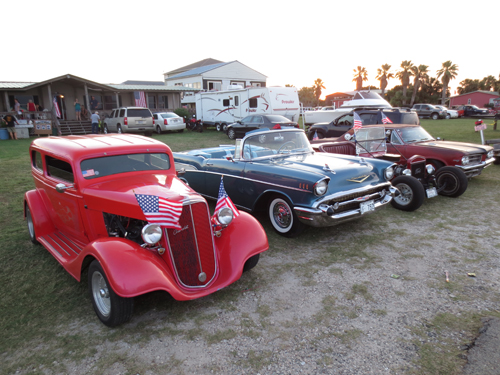
Early spectators of the July 7th fireworks show, were treated to the first ever P.O.C. classic car show.  Displayed on the front beach in front of Donald and Carolyn Goldman’s  home, were five classic cars:   1957 Chevy Convertible owned by Donald Goldman, 1964 Lemans owned by John Clegg, 1950 Jeepster owned by Johnny Holland, 1935 Chevrolet Sudan and a Ford T-Bucket owned by Jay Cohen.  Also shown was Lynne Goldman’s motorized ride-on ice chest.

The founders look forward to expanding  the show next year and extend an invitation to all classic and hot rod owners of POC.  It will be held next year same time, same place on Firework Saturday.

For information contact Jay Cohen in P.O.C.; no phone but he’s around.

Untitled Document