NOAA Fisheries Services announces that the closure date for the Gulf of Mexico recreational red snapper season is being extended six days. The new closure time is 12:01 a.m. local time, July 17, 2012.
NOAA Fisheries Services announces that the closure date for the Gulf of Mexico recreational red snapper season is being extended six days. The new closure time is 12:01 a.m. local time, July 17, 2012.
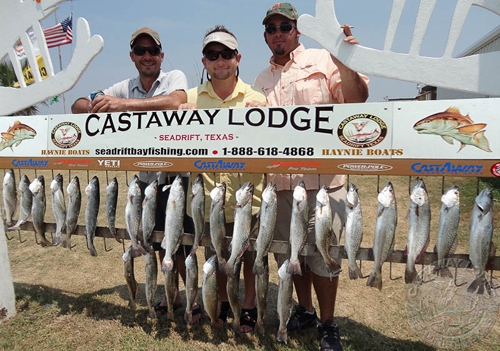
Conditional extremes can produce some “extreme success” and the weather has been at both ends of the pendulum lately. From slick glass with shredded water from strong winds overnight to gusting shredded water during the daytime. Strike timing with one eye on the tide and the other on the horizon has kept us in the fish lately. Redfish action over mud/grass continues working it’s way into the day in day out approach while water is attempting to heal up with some tide movement or diminishing winds.
Trout action has been best on tide movement of any direction as the water settles out from overnight winds. We continue to have a lot of water in the bays which makes this an unusual Summer Season for sure, no complaints. Elevated tides have been making some approaches easier and that has kept the shoreline plays in full gear for wade fishermen. Working shell reefs also benefits from higher water levels as it pulls more of the structure into play right up to the crest of the reefs. This gives an angler more options and some days that’s the extra edge that means the difference between success and limited success. Water levels are the oil that drives the engine, a nice way to contemplate that in relative terms.
From guests of all skill levels to wildly varying bay conditions, our Guides keep executing with patience and professionalism. The staff here at the lodge cannot go without mention as well. Hats off to everyone! We’d also like to thank Mr. John Thompson with the Ft. Worth Star Telegram for his piece on The Lodge.
We hope you are having a great week, come see us when you get a chance!
Capt. Kris Kelley, Castaway Lodge, www.seadriftbayfishing.com
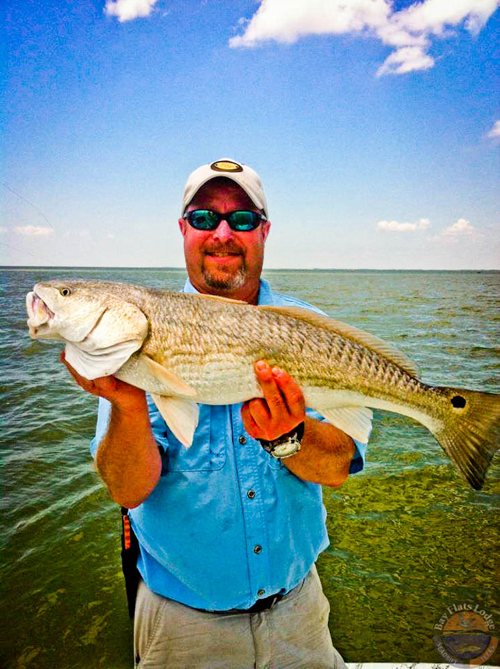
Plumbing Company guests rolling in big reds with Bay Flats Lodge Captain Jonathan Hill using sardines in area lakes, June 2012.
July 11, 2012
I’ve talked a bit in recent Guide Lines about how good fishing among oyster reefs can be during the really hot months of the year. What I haven’t talked a lot about is how I normally go about fishing these reefs. Now then, if you are fortunate enough to have become familiar with San Antonio Bay (SAB) and the Seadrift area, then you already know of all of the open-water shell that’s available to us on a regular basis. This may be the largest, and the finest, accumulation of oyster reefs that the Texas coast has to offer. These reefs are of all different shapes and sizes, and some of them have parts that are exposed above the water’s surface, while others remain completely submerged. All of these reefs are basically like miniature islands out in the middle of the bay, and each one is made-up of several parts – the reef walls, the crest, and what I refer to as the “points”. Because our predominant winds are of a southerly direction for a major portion of the time in our year, the reefs in SAB which stretch from north to south tend to have steeper walls, or sides, than those reefs which run east to west. The north wall on an east-west reef will normally taper gently to the bay floor, whereas the south wall (the side exposed to the wind) will generally slope more steeply down to the bay floor, and it is often referred to as the “drop-off”. The crest of the reef is the highest point of the reef, and in the case of a submerged reef, receives a lot of the force of the bay currents and wave action. The ends of the reef are what I call the “points”, and each may taper slightly, or each may drop-off abruptly depending upon the physical layout of the reef, the winds, and the currents.
At the beginning of the summer when the days aren’t yet as hot as they are in July and August, I don’t tend to focus as much attention on whether I choose a submerged or exposed reef to start my day with. Instead, I concentrate on locating any reef which happens to be offering me the preferred combination of active baitfish, a bit of mud underfoot, and immediate deep water access for the fish. The consolidation of these three key ingredients will generally spell a recipe for success above these reefs. However, once July arrives, you’ll find me making it a point to start my initial morning wade session over a submerged reef before the sun comes up. Why a submerged reef, and why so early in the morning? Well, there are actually a couple reasons for this. The reason I prefer a submerged reef is that the fish tend to swim in the shallowest spots atop submerged reefs during night time hours while they’re looking for a meal, or while they’re seeking shelter from night time predators in deeper water. And the reason for the pre-sunrise endeavor is to allow me to be able to take advantage of the cooler night time water temperatures of the shallowest spot of the submerged reef. Because the daylight hours at this time in the year heat shallow water so rapidly, it is important to beat the heat by advancing upon the reef just as early in the morning as possible.
Upon locating my reef of choice, I like to begin by positioning myself at a spot upon the reef that’s just within casting range of the crest of the reef. In doing this, I’m allowed the ability to experiment within the different levels of the entire water column. I might work a top water lure across the crest and onto the other side of the reef. I’ll place myself so as to be able to overshoot the crest of the reef by several feet, and then work my surface plug slowly across the shallowest point of the reef’s crest. I’ll completely work the area immediately in front of me by making several casts from my 10 o’clock to my 2 o’clock positions. If I don’t experience any results, I’ll then shuffle down the reef about twenty feet in either direction, and then repeat the previous routine. Or, maybe I’ll choose to throw a favored plastic bait from the crest of the reef and back along the downward contour, or perhaps even a crank-bait or a slow-sinker. These are proven practices by which I have historically facilitated the process of pinpointing the bite above these reefs. If, or when, I determine that the bite is coming from deeper water that is located away from the crest of the reef, I prefer to begin examining the effects of some of the more popular suspending plastic and hard baits. I’m usually not able to cover as much water at the same rate of speed with these baits as I am when I use my standard plastic baits, but once I’ve located the bite, there’s little else that compares to the excitement.
SAB is a popular place when the wind lays down during the warmest months of the year, but with more than two-hundred square miles of surface area to play in there’s plenty of space for everyone to have a good time. So, next time you’re out on the water, be smart, be safe, and be courteous. Remember to practice CPR, “Catch, Photo, and Release”, whenever possible on trophy Trout and Reds…Guide Chris Martin, Port O’Connor/Seadrift region…www.BayFlatsLodge.com…1-888-677-4868
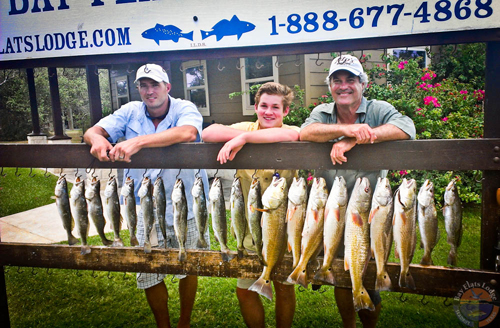
Owner of Tito’s Vodka - Tito Beverage, son and guests enjoying a fun day at Bay Flats Lodge using live croaker, Espiritu Santo Bay, 6/12.
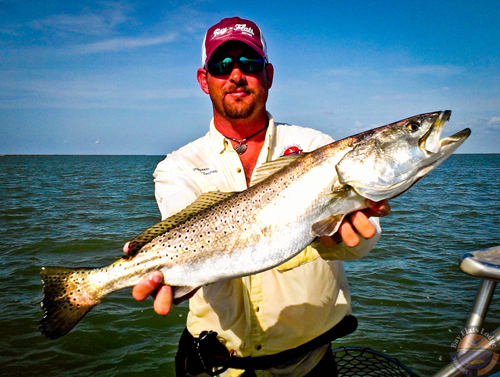
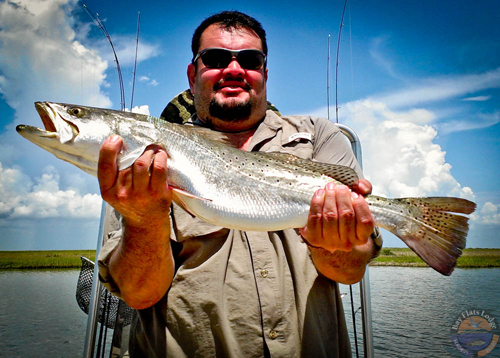
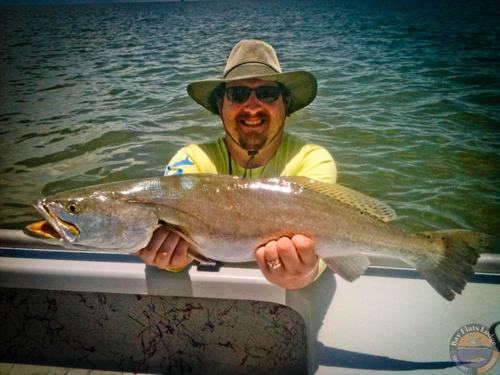
Catch a Big One?
Share your photo with our readers.
Send in jpg, highest possible resolution to: dolphin1@tisd.net
AUSTIN — The Gulf of Mexico commercial shrimp season for both state and federal waters will open 30 minutes after sunset Sunday, July 15, 2012. The opening date is based on an evaluation of the biological, social and economic information to maximize the benefits to the industry and the public.
In making its determination, the Texas Parks and Wildlife Department Coastal Fisheries Division used the best available scientific information including samples collected by using trawls and bag seines in TPWD routine data collection.
The purpose of the closed Gulf season is to protect brown shrimp during their major period of emigration from the bays to the Gulf of Mexico until they reach a larger, more valuable size before harvest and to prevent waste caused by the discarding of smaller individuals.
Federal waters (from 9 to 200 nautical miles offshore) will open at the same time that state waters will open. The National Marine Fisheries Service chose to adopt rules compatible with those adopted by Texas.
| Search |
 |
