Condolences – Alberta May Lewis

Archived in the category: General Info, Obituaries
Posted by Joyce Rhyne on 26 Jan 12 - 0 Comments

Alberta May Lewis, 79, of Point Comfort, passed away Friday, January 13, 2012. She was born December 5, 1932, in Oregon City, Oregon, to the late Albert Taylor and Evaline Taylor.

She is survived by her husband, Coy E. Lewis of Point Comfort; daughter, Betty Godfrey and husband Jerry of Port Lavaca; son, Roger Lewis of Port Lavaca; brothers, Dan Davis of Oregon City, Oregon and Rayond Davis of Rio Del, California; grandchildren, Belinda Ward and husband Rowdy of Port Lavaca and Troy Godfrey and wife Jennifer of Washington, New Jersey; and great-grandchildren, Christopher Renshaw and Rowdy Ward of Port Lavaca and Naomi Godfrey of Washington, New Jersey.

Funeral service was held Wednesday, January 18, 2012 at Alamo Heights Baptist Church, with Pastor Tim Smith officiating. Interment followed at Greenlawn Gardens.

Pallbearers: Rowdy Ward, Troy Godfrey, David Chamrad, Byron Carr, Jeff Underwood, and Joe Uresti.

Words of comfort may be shared with the family at: www.richardsoncolonial.com


Industrial Training Classes Begin at VC’s Calhoun Center

Archived in the category: General Info
Posted by Joyce Rhyne on 26 Jan 12 - 0 Comments

Starting next month, Victoria College will begin several craft training courses offered at the Calhoun County Center and the VC Wilkins Industrial Trade Center.

Welding I and II classes begin on Wednesday, February 1 and Thursday, February 2, respectively. Welding classes will be held at VC’s Calhoun Center.

The beginning level course provides an introductory study of basic welding processes, including basic shop safety and the welding process, while the intermediate level gives students hands-on experience with welding techniques, including air carbon arc washing and gouging.

Welding I will continue each Monday and Wednesday evening through June 13 and Welding II will be held each Tuesday and Thursday evening through June 12. Classes are held from 6:00 p.m. – 10:00 p.m.

Pipefitting I and II classes each begin Monday, February 6. Pipefitting I covers basics such as pipefitter responsibilities, safety principles, hand and power tools and oxyfuel cutting. Pipefitting II covers piping systems and includes training in the use of drawings and detail sheets, identifying and installing valves, socket and weld pipe fabrication, excavations and other topics. Each class will be held Monday and Wednesday evenings from 6:00 – 9:00 p.m. at the VC Wilkins Industrial Trade Center and continue each week through June 4.

Millwright I and Electrical II classes begin on Tuesday, February 7. The introductory Millwright course covers orientation to the trade, hand tools, fasteners and anchors, basic layouts and oxyfuel cutting. The Electrical II class covers alternating current, motors, theory and application including circuit breakers and fuses, conductor installation, conduit bending, grounding and bonding, and pull and junction boxes. Classes will be held each Tuesday and Thursday evenings.

The Electrical II class will be held in Room 18 at the VC Calhoun Center from 7:30 – 10:00 p.m. The Millwright I class will be held at the VC Wilkins Industrial Trade Center from 6:00 – 9:00 p.m.

For more information or to enroll in courses, please contact the Calhoun County Center at (361) 553-4316.

Peggy Venable, Texas State Director of Americans for Prosperity, will be the featured speaker at the February 14th meeting of the Conservative Club.

A native Texan, Peggy Venable has spent 15 years in Washington, D.C., working for three Administrations. During that time, she worked in the area of education, natural resources, energy and transportation. She was White House Liaison for two cabinet secretaries including the US Department of the Interior and the Department of Education. She directed the “Take Pride in America” grassroots campaign which encompassed eight federal agencies.

Ms. Venable is Texas director of Americans for Prosperity which has a membership of over 100,000 individuals who support free market public policies. She has guest hosted for syndicated talk show hosts around Texas, appears as a guest on radio and TV, and has written over 100 pieces that have appeared in leading Texas newspapers, and speaks to groups around the state on tax, budget and regulator issues. Her opinion pieces have appeared in the Wall Street Journal, Fox News, Houston Chronicle, the Dallas Morning News, the Austin American Statesman, Budget and Tax News, Heritage Insider, and numerous other publications.

She is a contributing editor to the Lone Star Report, on the board of the Texas Center for Education Research as well as Austin CEO Foundation, a board member of the Reagan Conservative Society and is past President of the Texas Women’s Alliance as well as a past President of the Texas State University Foundation Board.

The public is invited to hear Peggy Venable speak and participate in the question and answer period following her speech. If you plan to attend, please contact Connie Hunt at 361-552-0917 by Friday, February 10. The Club meets at the Heritage Center, 2104 W. Austin in Port Lavaca. This meeting will be held on Tuesday, February 14 at 11:30 a.m. Lunch is served ($5) at 11:30 with program at noon.

The Houston Fishing Show

Archived in the category: Events, Fishing Reports, General Info
Posted by Joyce Rhyne on 26 Jan 12 - 0 Comments

Port O’Connor will be represented at The Houston Fishing Show

February 29, 2012 thru March 4, 2012

Attention: Port O’Connor Chamber of Commerce Members and Non-Members

The Port O’Connor Chamber of Commerce has secured two exhibit booths at the Houston Fishing Show.

Sponsor Info:

A. $50-Copper-1’x1’ Banner with name, (no logo)

B. $100-Silver-1’x2’ Banner with logo

C. $250-Gold-Logo on Main Port O’Connor Banner**

D. $500-Platinum-Table Drape/Banner with Logo

E. $2500-Event Sponsor-Name/Logo on table & wall banners
(**This will be a traveling Banner for other events.)

Current members can provide literature/flyers/business cards, (to be distributed at the show), to one of the volunteers listed below at no cost.

If you would like to be a Sponsor or Volunteer, please call or e-mail:

Becky at BB upholstery-361-571-6131 or bbupholstery@bbupholstery.com

Patti-361-649-2265 or Patti@TSFMag.com

Mary Jo at Beacon 44 Seafood-361-920-4247 or shrimper@tisd.net

Donnie at Port O’Connor Rods-361-746-8049 or dk@myinspectionco.com

Paul at Tigrett Real Estate 361-571-5263 or Paul@CostaBonitaInternational.com

Jim Hooper At Hurricane Junction 361-983-4249 or hooper@hj.com


Caveat Emptor: Does That Mean Olive Oil Too? By Bob Jamison

Archived in the category: Featured Writers, General Info
Posted by Joyce Rhyne on 26 Jan 12 - 0 Comments

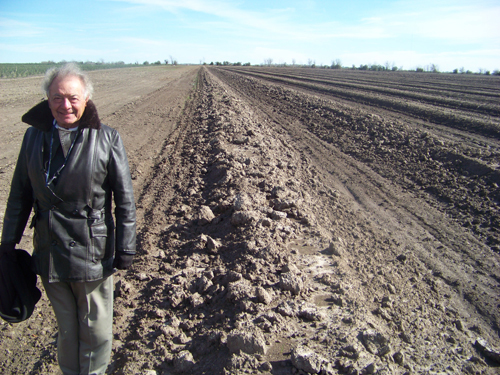
Gino Venitucci stands on a berm ready to plant another 6,500 olive trees in 2012. This will bring his total to 22,500 olive trees near Devers, Texas. Coastal Texas might have the farming break many hope for.

Texas olive farmer and entrepreneur Gino Venitucci says, “Regardless of the Latin phrase caveat emptor (meaning let the buyer beware) the future of the olive oil industry from the early ages has and still does depend on quality. And that includes truth in labeling of extra virgin olive oil.” No doubt the industry has suffered somewhat it the past with unscrupulous packagers of olive oil. Altered oil is often sold cheaply in stores because of the dilution of extra virgin olive oil with a mixture of various seed oils such as hazelnut, soy, rape, canola, sunflower and others. Some call that ‘lamp oil’, yet it might still have a label of “extra virgin”. As one person put it, “The center of the palate is the consumer’s conscience”. But if the efforts of Texas Olive Oil Council (TOOC) have its way, you will know when you purchase Texas olive oil it has been watched carefully.

Many pioneers in the production of olives in Texas agree with what Gino claims. In fact some of those pioneers are mentioned in the web site under the TOOC. Included in their formidable list of officers and directors on that page includes the founder of the TOOC Jim Henry. Along with Dr. Karen Lee and the members, they plan to add strength to the laws dating back to 1906 called “Pure foods and drug act” with a qualified Texas olive oil sticker to help ensure you get the quality you pay for.

No doubt, olive production might be in its infancy in coastal Texas but unless I miss my guess ‘you ain’t seen nothin’ yet’; as the saying goes. With over ninety percent of the olive oil consumed in the United States is imported, what does that mean to the farming opportunity here? Certainly it could mean the break we’ve been looking for.

Even Thomas Jefferson had the opinion olive production had distinct possibilities in the U.S. He himself invested in planting olive trees in South Carolina. In another case, an immigrant family in Galveston, Texas brought with them from Italy around the year 1910, five small olive seedlings placed carefully in their baggage. Today, over one hundred years later, those very trees still produce olives in Galveston.

Not that we see ourselves as just the new kids on the block, another example is the philosopher Plato had olive trees in his yard that still produce olives. Plato lived around three hundred years before Christ!

It would only take a glance while driving or flying over farms from Orange County, Texas to near the Rio Grande River, and observe vacant farm lands and weather beaten farm houses that once was home for share-croppers, that something should be done to bring farming back to life. After all, olive farming deserves a closer look.

At first glance, cautious farmers (and they should be as in any farming there are risks) might say, “This isn’t the Mediterranean area, or we don’t share the rocky hills of Greece.” That’s true but olive farms are happening right now as you can see. “But we don’t have a dry climate as in Spain, southern Italy or North Africa” they say. One thing that should be considered even if we do live in similar latitudes, olive trees need proper irrigation. That doesn’t mean soaking bogs or what they call “wet feet”, olive trees must be well drained but they still need a drink at proper times.

Initial capital investments can be substantial while other farmers might prefer to take it slower or smaller either for financial reasons or for their own confidence in olive farming. A big item would be land owned by the farmer which might be lying idle or unproductive. Often these farms have their own machinery stacked in the barn. Still, there remains labor and other items to consider and the period of about four years to realize the potential profit which could possibly continue for many years.

Suppose you have considered raising olives. What about the market for your olive oil? Also, what about the processing equipment? After all, one of the secrets of making quality olive oil is freshness off the vine (trees). Sooner-the-better, for the prompt processing to ensure freshness of the oil is important. For instance, pick a handful of fresh green or almost ripe olives and squeeze them by rubbing together briskly in your hands. Then put your nose in your cupped hands. The smell test should remind you exactly of what extra virgin olive should smell. Too long after picking is ‘too bad’, they say.

So where is this hero in shining armor when you don’t own your own processing plant yet or your minimal size crop couldn’t support the investment? There might be help on the way with farmers who do own a harvester to come pick your olives for you and even process the olives into oil for a price or even for part of the oil. One possible source in Texas might be found through your membership in the Texas Olive Oil Council (TOOC) in Dallas. Membership is open to all. Complete info is on their web site.

The mother of invention could also kick in with a unique idea of a company called, “Mill on Wheels” in California. It appears to be an eighteen wheeler containing a full processing plant on a mobile flat bed trailer. It consist of the hopper to catch the load of olives, washing stage device, another washed olive container, crusher, malaxing stage, separation stage separating olive oil into water clarification stage and next, outcomes olive oil ready for bottling. All of this hopper of olives might be done in an expected one hour.

A recent publication of the history of the olive oil business world wide brings you to the year of 2011 and is expertly written. It certainly is a worth while read. The name is “Extra Virginity” by Tom Mueller. You might even become an expert taster of olive oil. That part is a bit like tasting fine wine, it holds your interest and it is like a toast to your health.

Bob Jamison is a freelance writer contributing his time and effort on behalf of many honorable farmers of Texas. He is a retired ag banker, book author and columnist. jbobalong@yahoo.com

Mr. Jamison and The Dolphin have been following the progress of Gino Venitucci’s olive farm for the past several years.
Untitled Document