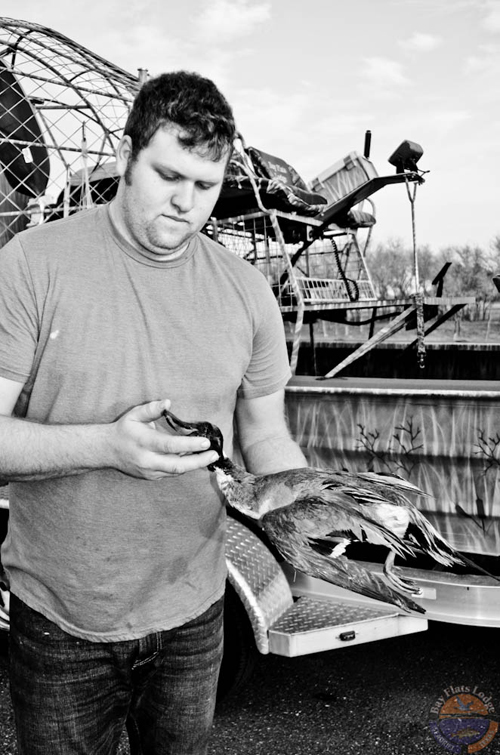
As my alarm clock rings violently I stumble as I make my way to slap its noise off. It’s 2:30 in the morning and I will be serving the duck hunters their scrumptious breakfast before they head off to pepper their limit of Pintails, Redheads and possibly some tasty Teal. Talking with them over their morning coffee, as they hastily scarf down a full hot breakfast, they started my thought process. Fewer than most, including me, don’t know what ducks you can eat and much less know what they can do to make them less game tasting. As I grew more intrigued at the thrill of hunting my own dinner, rather than catching it or ordering it; I asked the one man I knew would be able to tell me all the information I needed, Captain Chris Martin. After much pleading and convincing I got Captain Chris Martin and Captain T.J. Christensen to take me out for my first real duck hunt on San Antonio Bay.
“You better plan on wearin’ more than just a fishing shirt and jeans or you’re going to freeze your tail off Chef,” Chris Martin tells me as we clean and ready our Benelli 12 gauge shotguns. I begin to wonder what the next day had in store for me and what I would be cooking. How can I make it taste better? How can I improve the quality of the meat after I shoot the birds? How can I store them? A million questions were going through my mind as I search all over the internet and drilled Chris until I passed out in front of my computer on the couch from sheer exhaustion.
I’ve cooked a lot of ducks, but none of which were wild shot. The type of species you kill and the size of that bird will dictate whether you braise it in salt pork, marinate it in buttermilk, or brine it in a saltwater bath, simply pan-sear the breast, or roast it as a whole. For instance, Red Heads are the gamest tasting birds on the waters of San Antonio Bay. Not far off from the Mud Ducks of a local lake where I grew up, these ducks are really good for stews, soups, or braised in liquids for a long period of time. The flavor of these meats all depend on what the animal eats. Red headed ducks eat mostly aquatic plants, insects, mollusks, and fish. Tougher flesh means three cooking methods; braising, marinating, or mechanical action (pounding with a mallet or tenderizer).
As soon as the light hit the water and my watch chimed in with the faint shots of shotgun blasts from neighboring blinds, I realized it was 7:00 and zero hour was upon us. “To the left!” T.J. firmly tells me in a yelling whisper as two Pintails burn me from the rear and escape into the morning sun mockingly laughing. “Next birds you let by you I’m moving you to the center of the blind,” T.J. tells me in disappointment at my lack of attention to the horizon. I hear the sound of Chris’s duck call. “Four Teal coming in at 3 o’clock,” Chris announces as the ducks come in to foolishly land in our scattered decoys. “TAKE ’EM!” yells T.J. That was enough for me, as I pulled the trigger and sent steel shot into one of the fleeing Teal. “Nice shot, Chef Austin,” Chris said as he commends me on my one shot drop. With an unrealistic amount of excitement I smiled and grinned from ear to ear as our Ammo (aka THE MONSTER) launches out of the stand to retrieve what is rightfully my first duck of the morning with many to follow in its unwise ways.
Teal, Pintail, and Widgeon ducks are very clean and slower compared to the Red Head. These ducks are best served roasted or grilled. My favorite thing to put on the grill is Teal breast wrapped in bacon. Great for parties and finger foods; however, if you want to serve duck to your guests at the table, I have a really simple and easy recipe. An easy way to keep these ducks as opposed to breasting them, in my opinion, is to freeze them whole, skin on, with feathers off. The easiest way to pick your bird is to tell your guide to do it. (I’m going to take some heat on that comment.)
Once cleaned, the ducks can be dried off and put into Ziploc bags to be frozen for up to 2 months, for best quality. Generally, residential freezers freeze only the water in products. This means that the oils in the birds are not frozen so they typically do not last but two months.
As the sun starts to beam down on my proud pile of lifeless ducks, Ammo climbs next to me, ready for me to put on his ear muffs. It has been a great morning for me and I have a new found respect for these hard working guides and the beautiful waterfowl that San Antonio Bay has to offer. As I reach the dock to begin breasting these ducks I couldn’t help but wonder how these would taste. Some say they taste like heaven, some say they taste like liver; heck, I’ve heard people say they taste like chicken. One thing is for sure, as I ate my Teal wraps that evening, they tasted sweet and unlike something I had ever tasted before, Victory.
Bay Flats Lodge, Inc. 1.888.677.4868

Chef Austin Brown of Bay Flats Lodge