Fish Out of Water by Thomas Spychalski…

Archived in the category: Featured Writers, Fish Out of Water, General Info
Posted by Joyce Rhyne on 20 Jul 23 - 0 Comments

So I spend a lot of time writing about things that happen to me and how I perceive them and at times that is to be expected, as most of us ‘scribblers’ base their writing on personal experience.

Writing also lets you examine other people the way a painter might examine the subject matter of their current painting: Taking in the color and the shape of a person and their surroundings, trying to recreate the very essence of them via the medium of canvas and brush.

This leads me to my subject matter, my muse if you will, a person who sticks by your side no matter what.

If I speak of this person in terms that might make them seem like some rarity, or something mystical creature like a unicorn, that’s only because in some ways they are.

Despite me being one of the first ones to say I love every living thing on this planet in one way or another, I’m also realistic to know that a lot of people have their own burdens which makes them do many undesirable things, including causing them to be unreliable to various degrees depending on the person.

So in that sense people like my subject matter are very rare indeed, because this person has risen to the highest spot of trust I’ve ever given in over four decades of life barring a child’s love for his own mother.

Recently one of my small collections of phobias popped up in my daily life again, that of lilapsophobia, or fear of tornadoes that I’ve discussed here in previous columns over the years.

This person stayed with me for a good two hours or so as the events went on, even though they are physically separated from me by more than half the country (which at times that distance feels like it’s a million miles or none at all depending on the moment).

Never was it a concern, never was it a bother, the way it truly is when someone really cares about you and you alone, not just waiting for their turn to be cared for instead of being caring.
It’s only one of what feels like a million examples of how much this person does for me and what in just under four years they’ve come to mean to me.

I’d like to think that everybody has or had a person like that in their lives, although I know that might not be true, but if not it is still the thing to strive for both in who and what you take into your circle and also what you give out.

(I’ve been deemed at times infamous for my grunts, huffs, and scowls but even I know or have learned that you can expect life to smile at you if you never smile back.)

So this one’s for you my unicorn, my diamond in the rough terrain of life, I only hope I can be as much value to you as you are to me and I hope you understand my intent with you as much as I think you understand mine.

Thank you.
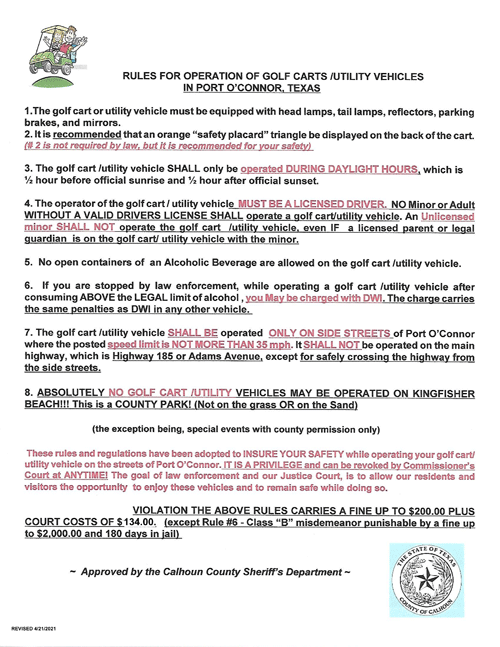
If you drive a golf cart, know the rules:

Archived in the category: Announcements, General Info
Posted by Joyce Rhyne on 20 Jul 23 - 0 Comments

GOLF-CART-RULES-PDF-2021_1_-(1)

Join Us at Church!

Archived in the category: General Info, Organizations
Posted by Joyce Rhyne on 20 Jul 23 - 0 Comments

Grace Episcopal Church, Port Lavaca

Join us at 11:00 am every Sunday for Holy Eucharist Service.

Coffee and conversation before and after each service in Parish Hall.

Jesus and Me (JAM) for ages 8-18 (approx.) the 1st and 3rd Sunday of the month in library at 10:00 a.m.

Love, Laughter and Lunch on the 1st Sunday of the month after the service in Parish Hall.

All are welcome!

Public Notice

Archived in the category: Announcements, General Info
Posted by Joyce Rhyne on 20 Jul 23 - 0 Comments

The Texas Parks and Wildlife Department is planning to conduct prescribed burns in Powderhorn Wildlife Management Area (WMA) at 10769 FM 1289, Port O’Connor, Texas 77982.
Our primary target timeframe for these burns is sometime between now through October 2023. Burn opportunities are dependent on weather, vegetation conditions, current and expected fire danger, and many other considerations.
If we are unable to conduct these burns within this target timeframe we will contact you again with the next potential timeframe.

Texas Shorelines: Plastic Isn’t Fantastic By Caleb Hess, Texas Sea Grant

Archived in the category: General Info
Posted by Joyce Rhyne on 20 Jul 23 - 0 Comments
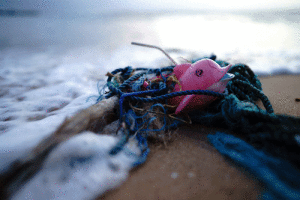
A small sample of plastic debris that washes ashore

A small sample of plastic debris that washes ashore

July is rife with reasons and opportunities to celebrate. The combination of warm weather, summer vacations and major holidays predictably leads to weekend barbecues, cookouts and parties. But when it comes time to decide who’s bringing the burgers, chips and deserts, consider calling dibs on the plates and cutlery—it might be the perfect way to participate in Plastic-Free July.

Plastic-Free July is a challenge started by the Plastic Free Foundation with the goal of reducing the use of single-use plastics like straws, jugs, and food wrappers. Discarded plastics like these account for some of the most abundant trash in the oceans. Because single-use plastics are designed to be discarded, they often wind up in the trash rather than being repurposed or recycled.

Discarded plastics end up in the ocean at an alarming rate—roughly 11 million tons of plastic enter the oceans each year. Hundreds of millions of tons of disposed plastics are already circulating within the world’s marine environments.

Removing plastics from the ocean is a costly and difficult task. Some estimates from a study commissioned by the World Wildlife Fund put the cost of cleaning up trash from the oceans at up to $15 billion per year. That estimate does not account for the cost of proper disposal and
processing of waste to limit the amount of trash entering the ocean. This trash is harmful to marine organsims and the health of the ecosystems that support them.

Unfortunately, the impacts of plastics in the ocean are not limited to the visible pieces of garbage caught in ocean currents. Microplastics, or plastics particles less than 5 millimeters in length, are tiny but harmful consequences of plastic pollution. Microplastics are usually either the result of industrial processes or from the breakdown of larger plastic objects. In the United States, microplastics called microbeads were once commonly used in health and beauty products as exfoliants—however, these were banned in 2015. Microplastics are the subject of much ongoing research, and the extent of their impacts on both human, plant, and animal life remains unknown.

The global Plastic Free July movement helps people learn about and become a part of solutions for plastic pollution. Throughout the month of July, Texas Sea Grant and other programs will provide resources and ideas for reducing individual single-use plastic waste at home, school, and work and beyond.

Be sure to tune in to Texas Sea Grant’s Facebook, Instagram, and YouTube channels to see plastic free content all through July and beyond! You can also find tips at plasticfreejuly.org.

Other Resources:
A Guide to Plastic in the Ocean
Plastic pollution in the ocean: data, facts, consequences

Texas Shorelines is a service of the Texas Sea Grant College Program at Texas A&M University. Texas Sea Grant is a unique partnership that unites the resources of the federal government, the State of Texas and universities across the state to create knowledge, tools, products and services that benefit the economy, the environment and the citizens of Texas. It is administered through the National Oceanic and Atmospheric Administration and is one of 34 university-based Sea Grant Programs around the country.

Texas Sea Grant is a non-academic research center at Texas A&M University. The program’s mission is to improve the understanding, wise use and stewardship of Texas coastal and marine resources.

Untitled Document