A lot of people think of the month of November and then automatically think of the word “fun”. For many of us, November symbolizes the official start of the annual holiday season, and for most of us our November fun is defined by spending some well-deserved quality time with family and friends while eating lots and lots of really good food at Thanksgiving time. Others who find fun in November are the die-hard shoppers amongst us. They tend to find their fun this month by taking advantage of the huge sales that are available throughout most stores on black Friday (the day after Thanksgiving) – the one day of the year that’s often recognized as being the busiest shopping day of the year. But there’s another large population of Texans who also happen to find an extreme amount of fun associated with the month of November. These are the many avid outdoor enthusiasts located all along the Texas Gulf Coast, and their interpretation of the term “November fun” means something else altogether. A lot of these folks are avid coastal anglers who have been counting the days until the opening of the various Texas hunting seasons. For a large percentage of them, this month represents the time of the year that a lot of them will be taking somewhat of a sabbatical from their normal fishing routines as they begin making preparations for the upcoming duck and deer seasons by cleaning and storing their rods and reels, and by then transitioning to shotguns, decoys, and rifles. After all, it is duck hunting season and everyone knows you can’t fish if you’re going to be duck hunting on a regular basis, right? Not necessarily! Personally, I love to hunt ducks – I’ve been doing it most all of my life, and I’ll continue to do it just as long as my body allows me to. But just because it’s duck season doesn’t mean I have to completely give up on my love for fishing. In November, most anyone who knows me can tell you that whenever I’m not sitting in a duck blind, I’ll more than likely be out on the water fishing, sometimes doing both on any given day – guiding blast and cast trips and enjoying the very best of what both sports have to offer. Simply due to the fact that it is hunting season means there’s going to be a lot less boat traffic on area bays and, consequently, a drastic reduction in fishing pressure over that of the previous warmer months. So, leave some room in the boat for the fishing rods on your next hunt and spend the late morning or early afternoon hours tossing some of your favorite soft or hard baits – you may just discover a new and unbridled passion for year-round fishing!
By the time you read this, water temperatures along Texas’ coast will probably still be hovering around the mid-to-upper 70-degree range. This slow cooling process continues to produce spectacular trout catches almost daily above shell pads whenever active bait is found. But although it’s generally November before we recognize much change in surface water temperatures, those changes are inevitable and can most often occur this month. It’s at the time of such drastic drops in barometric pressure and water temperatures that I like to specifically target large trout. Now then, when I refer to large trout I’m talking about trout in the four, five, and six pound class – fish in the seven, eight, and nine pound range are found in far less numbers and can truly be classified as “trophy” in nature. Anyhow, whenever November temperatures do decide to drop, I begin thinking of deeper water when searching for these larger fish. Shell pads in the coolness of autumn and early winter will often remain good choices for great trout, but instead of focusing my efforts atop these pads like I do when it’s warmer I’ll look for the trout to begin assembling in places where the edge of the shell reef quickly tapers or falls to quit deeper water. More times than not, shell areas that have historically produced for me at this time in the year are those which are situated right along, or those that are in close proximity to, deep water channels or guts. Examples of such areas are the numerous shell locales situated on or near the Intracoastal Waterway and the Victoria Barge Canal. If we happen to experience a brief period of extreme cold, I’ll look for concentrations of trout along steep (sometimes almost vertical) drop-offs along the shell in water depths of 15-to-25 feet. I toss larger-sized dark plastics at these fish with a retrieval pattern that doesn’t include bouncing my bait across the bottom, but dragging it ever so slowly instead, and with only a brief, occasional rise of the rod tip. These cold spells won’t last long at this time of the year, so we’ll almost always see warming-up periods between cold fronts. These warming-up periods tend to bring trout out of the depths and into shallower water. When this happens I try locating the fish by using the countdown method when casting my bait to the drop-off, counting 1-second for every foot of depth, and it’s during these warming periods that I look for the bite in the 5-to-15 feet depth range. So, by all means, please don’t put away your fishing gear when the north wind does finally begin to cool the coastal air and waters, as you could be cutting yourself out of some really nice trout action.
This year’s waterfowl season began on November 5th, so let the Bay Flats team of professional guides show you the hunt of a lifetime with an action-packed day of waterfowl hunting, fishing, or even both. Our “Blast & Cast” packages include morning shooting for ducks followed by a relaxing afternoon on the water while bay fishing for trout, redfish, and flounder – or, returning to the blind to finish-out your duck limit with an afternoon of hunting. And don’t forget that you can always stay informed as to the latest Bay Flats news by signing-up on the Bay Flats Lodge website to receive your daily newsletter. Until next time, remember to practice CPR, “Catch, Photo, and Release”, whenever possible on trophy Trout and Reds…Guide Chris Martin, Port O’Connor/Seadrift region. 1-888-677-4868
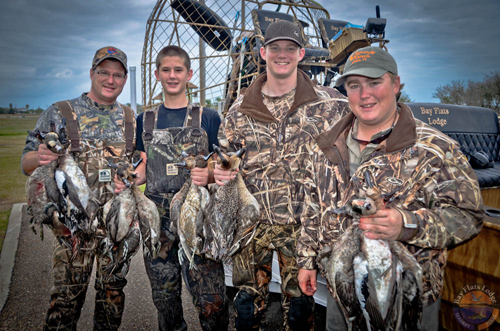
Pat B. of San Antonio and sons hunting with Capt. TJ Christensen of Bay Flats Lodge shot 5-man limits of ducks Nov. 6, 2011.