County Fair Royalty

Archived in the category: Announcements, General Info
Posted by Joyce Rhyne on 13 Oct 11 - 0 Comments

-Photo by Jasmine Gordon

Calhoun County Fair Queen Marissa Snyder
Junior Fair Queen Peyton Rudellat
Little Miss Cowgirl Kaleigh Diaz
Little Mister Cowboy Coltyn Judd

County Fair Pageant Winners

Marissa Snyder, daughter of Bernard and April Snyder: Fair Queen and Miss Photogenic;
Kendall Smith, daughter of Jerry and Nancy Smith: 1st Runner Up;
Kelsyi Paige Meza, daughter of Michelle Meza and Sam Sparks: 2nd Runner Up;
Kristen Machacek, daughter of Chuck and Terri Machacek: Miss Congeniality

Peyton Rudellat, daughter of Sandra and Jim Rudellat: Junior Fair Queen;
Karly Critendon, daughter of Kasi and Brandon Critendon: 1st Runner Up;
Kelsey Tidrick, daughter of Alice and Tony Tidrick: 2nd Runner Up and Miss Photogenic;
Chye Martinez, daughter of Cheryl and Brian Smith and David and Christina Martinez: Miss Congeniality

Kaleigh Diaz, daughter of Karie Skalak: Little Miss Cowgirl;
Briley Moldonaldo, daughter of Aaron and Tami Maldonado: 1st Runner Up;
Madison Maldonado, daughter of Elizabeth Villarreal and Lupe Maldonado: 2nd Runner Up

Coltyn Judd, son of Robert and Samantha Judd: Little Mister Cowboy;
Luke Vela, son of Raquel and Anthony Vela: Runner Up

Seadrift Ends Fiscal Year with Budget Surplus By Joyce Rhyne

Archived in the category: General Info
Posted by Joyce Rhyne on 13 Oct 11 - 0 Comments

While other cities, states, and the federal government are drowning in a tsunami of red ink, the City of Seadrift is living within its budget, even showing a surplus for the Oct. 1, 2010 to Sept. 30, 2011 fiscal year. At the latest City Council meeting on Oct. 4, Mayor Elmer DeForest submitted amended budgets to the City Council for approval and happily reported the statistics for the fiscal year ending September 30, 2011. The amended 2010 – 2011 budgets were approved by City Council with the following surplus:

Harbor Fund Surplus of $ 8,922.37
Hotel/Motel Surplus of $ 3,362.43
Utilities Surplus of $54,305.93
General Fund Surplus of $ 7,744.11

The Surplus in the Utilities Department were partially the result of increased revenues from water bills due to heavier than normal usage during the drought and fees collected from 14 water taps (up from the usual average of 5 per year) and 9 sewer taps (up from the estimated average of 5).

The General Fund, whose primary source of revenue is from property taxes is received mostly during the October – March period and supplemented by sales taxes, and miscellaneous permit fees throughout the year. Franchise taxes are usually received in the January to March period. With the bulk of operating revenue received in the October – March period the City must carefully consider expenditures during the April to September period to prevent shortfalls. In the 2009-2010 fiscal year, the General Fund was in the red and reserve funds were utilized to continue operating. In August 2011, Mayor DeForest froze all discretionary spending with additional levels of approval needed for spending, which was undoubtedly a major factor for Seadrift ending this fiscal year in the black.

The budget for fiscal year 2011-2012 will remain essentially the same as last year’s, except for a one and a half percent raise for employees. The budget surplus will be kept in reserve to cover any shortfalls or unexpected essential needs that may occur.

News of current projects of the Utilities Department was also good. Engineer, David Sheblak, for the Texas Department of Agriculture-Community Development Block Grants that help the City replace and upgrade existing water/wastewater lines reported that the 2010-2011 line replacement project is ahead of schedule and slightly under budget, and should be completed in December. Plus, an additional 2011-2012 TDA-CDBG grant for water/wastewater line replacement has been awarded and should begin by mid to late spring.

Of note is the final approval and contract signing for the wastewater Wind Turbine to generate electricity to supplement the electricity usage at the wastewater plant. People in town should begin to see the rise of the turbine tower by mid to late December 2011 with commissioning to be completed by early January 2012. Jody Weaver of G&W Engineering is the engineer for this State Energy Conservation Office (SECO) project funded mostly by a stimulus grant. Additional funds will come from the TDA-CDBG Program.

Good news for residents and tourists, alike, is that the long awaited pier will soon become a reality through a CIAP grant acquired and administered by Calhoun Commissioner’s Court. Construction could begin as early as January or February 2012. The 300 ft. pier with a 50 ft. T-Head will be constructed at A.D. Powers Bay Front Park, near the pavilion. It was permitted in 2009 by the Corps of Engineers using Urban Engineering who did the preliminary engineering and permit application.

The City’s Pier Fund, approximately $17,900, will be used to supplement the pier’s on-going maintenance. The Pier fund has accrued from private donations over the years with the primary donor being the Seadrift Chamber of Commerce. The City is also beginning to budget funds annually for on-going maintenance and repair.

An Interesting Find By Linda Pasztor

Archived in the category: General Info
Posted by Joyce Rhyne on 13 Oct 11 - 0 Comments

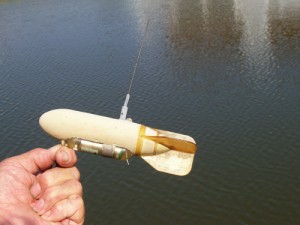
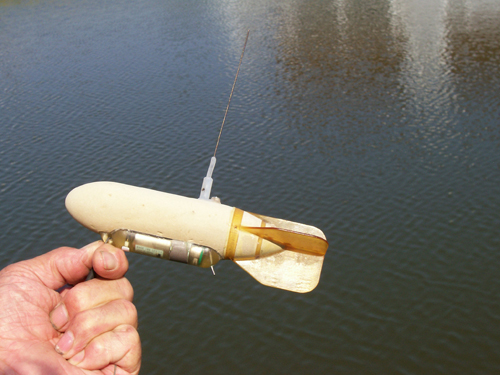
This tracker, found on Matagorda Island, had been attached to a whale shark off the Yucatan Peninsula by wildlife researchers.

The day started out as a beautiful morning with the sun shining, not a gust of wind. My husband and I took our boat out to Matagorda Island with the intention of enjoying fishing and the scenery. After about an hour of catching absolutely nothing, I decided I’d go beach combing by the lighthouse on the Island. As I was walking, I started imagining all sorts of lost treasures that may have been lost at sea and washed up on the shore. Just then I looked down at the sand and saw a small, grey, rocket shaped object just laying in the sand. Upon a closer look, I realized this thing was neither a toy, or trash, but some sort of transmitter. At this point, we decided to pack up and head to the boat ramp.

Along our way home, we stopped to pick up a lost wave runner. As we stopped, a big wave hit the boat and threw my husband out. He was not hurt so we started out again. Suddenly the boat stopped; we had run out of gas and had to be rescued. When we finally got back to dry land, we called the phone number on the transmitter and left a message saying we had found it. The next Monday I got a call from the Wildlife Conservation Society located in Belize saying that the transmitter belonged on a Whale Shark that had recently been tagged. The sharks are tagged off the coast of the Yucatan Peninsula, Mexico. The sharks gather there, several hundred of whale sharks at a time, to eat fish eggs.

I am sending the transmitter back so the data can be retrieved and the transmitter can be refitted to another animal. More information about this research can be found in the September issue of the Mens Journal or the June issue of the Smithsonian Magazine. You can also go the wildlife web site: www.wildlifetracking/org
 

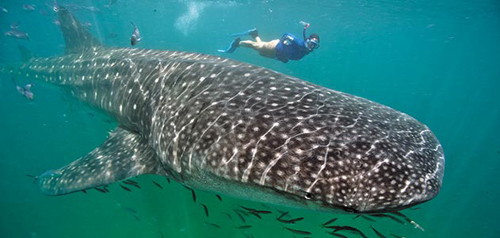
Whale Sharks

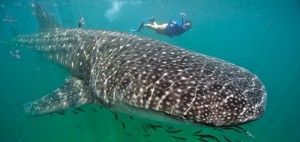
The average size of adult whale sharks is estimated at 31.82 ft. and 20,000 lb. The largest verified specimen was caught on November 11, 1947, near Baba Island, in Karachi, Pakistan. It was 41.50 ft. long, weighed more than 47,000 lbs., and had a girth of 23.0 ft. Stories exist of vastly larger specimens — quoted lengths of 59 ft. are not uncommon in the popular shark literature — but no scientific records support their existence.

As a filter feeder it has a capacious mouth which can be up to 1.5 metres (4.9 ft.) wide and can contain between 300 and 350 rows of tiny teeth. It has five large pairs of gills. Two small eyes are located towards the front of the shark’s wide, flat head. The body is mostly grey with a white belly; three prominent ridges run along each side of the animal and the skin is marked with a “checkerboard” of pale yellow spots and stripes. These spots are unique to each individual and are useful for counting populations. Its skin can be up to 3.9 inches thick.

The whale shark inhabits all tropical and warm-temperate seas. They are known to migrate every spring to the continental shelf of the central west coast of Australia. As a filter feeder, the whale shark feeds on macro-algae, plankton, krill, Christmas Island red crab larvae, and small nektonic life such as small squid or vertebrates. It also feeds on small fish. The many rows of teeth play no role in feeding; in fact, they are reduced in size in the whale shark. Instead, the shark sucks in a mouthful of water, closes its mouth and expels the water through its gills.

Despite its size, the whale shark does not pose significant danger to humans. Although massive, whale sharks are docile fish and sometimes allow swimmers to catch a ride. Whale sharks are actually quite gentle and can play with divers. Divers and snorkellers can swim with this giant fish without risk, apart from unintentional blows from the shark’s large tail fin. In July 2011, several sources reported, with photos, an incident of a diver who, allegedly, was nearly sucked into the mouth of a whale shark (but escaped unharmed) off the coast of Isla Mujeres, Mexico.

The capture of a female in July 1996 which was pregnant with 300 pups indicates that whale sharks are ovoviviparous. The eggs remain in the body and the females give birth to live young which are 40 to 60 centimeters (16 to 24 in.) long. It is believed that they reach sexual maturity at around 30 years and the life span is an estimated 70 to 100 years.

from Wikipedia

Want to Adopt a Whale?

The ECOCEAN Whale Shark Photo-identification Library is a visual database of whale shark (Rhincodon typus) encounters and of individually catalogued whale sharks. The library is maintained and used by marine biologists to collect and analyze whale shark encounter data to learn more about these amazing creatures. You can support the ongoing research of the ECOCEAN Whale Shark Photo-identification Library by adopting a whale shark: http://whaleshark.org/adoptashark.jsp

Editor’s Note: The above information should not be considered as an endorsement by Dolphin Talk. Interested readers should check out the organization for themselves.

Seadrift Librarian Retires By Joyce Rhyne

Archived in the category: General Info
Posted by Joyce Rhyne on 13 Oct 11 - 1 Comment

CJ Garriott was honored by Calhoun County Library Director Naomi Cruz and the Port Lavaca Library staff with a reception at the Seadrift Library on September 29.

After 8 years, 7 months as Librarian at the Seadrift Branch of Calhoun County Library, CJ Garriott, has retired. At age 76, this is CJ’s second time to retire from the workforce. The first was in 1998 when she retired from her 23-years as a typesetter for an Austin firm and moved to Seadrift. For one year she was actually “retired”, but found she kept wondering when her “vacation” should be over.

Feeling the need to have a productive job, CJ worked with the Census in 2000, and then in 2001 and 2002 held down a couple of part-time jobs, followed by nine months co-managing a Port O’Connor motel.

Having a lot of clerical experience, including being a church secretary, establishing and organizing a library for the church, CJ was a natural for the Librarian position when it became available. After working in cramped quarters serving the needs of Seadrift library patrons, she was privileged to oversee the recent move to the Library’s spacious new facility.

CJ plans to spend her extra time doing what she loves: writing and photography. She hopes to resume the “Livin’ on the Bay” newsletter that she began in 1999 (and stopped temporarily this year) and is searching for a venue to publish it on line. She invites everyone to check out her blog (livinonthebay.blogspot.com) and intends to make more day trips around the state so she can see more things to photograph and write about. CJ also welcomes anyone to contact her on Facebook or at her email address: mactracks@yahoo.com.

A few years ago, CJ wrote a book, Curve of the Coast, and she hopes her retirement will give her the time to write a second. She is also looking forward to being able to visit more with her family back in her home state of Kansas.

We wish CJ a happy retirement, and thank her for her years of service to the Seadrift community.

Robbie Bess, who has been substitute librarian for the past few years, is now the Seadrift Librarian.

Watching the Dallas Cowboys with Satellite TV By Peter DeForest

Archived in the category: Featured Writers, General Info
Posted by Joyce Rhyne on 13 Oct 11 - 0 Comments

Are you a Dallas Cowboys fan and use either DirecTV or DishNetwork as your television service provider? If so you probably get the Houston Network channels as your “local” channels. Do you get mad on some Sundays when for some unknown reason the Dallas Cowboys game is not on? Well I’ll explain it here:

If the Houston Texans have a home game at the same time the Dallas Cowboys play, per NFL rules the Houston Fox Affiliate KRIV 26 is prohibited from showing the Cowboys game. What do you need to do you may ask? One solution is to purchase the NFL Sunday Ticket from DirecTV which shows every NFL game every Sunday. However this can be pricey at $334 per year or $44 for one Sunday for most DirecTV customers.

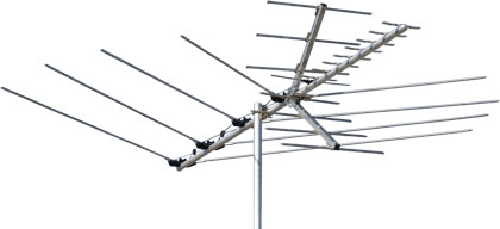
Another cheaper alternative is to put up a over the air antenna (OTA ) and connect it to your HD ready television set or converter box and watch the Cowboys game on the Victoria Fox Affiliate KVCT 19. The three main Victoria television stations; KVCT 19, KAVU 25, and KXTS 41 are currently broadcasting in digital HD. With a small UHF/VHF outdoor antenna you can receive these stations clearly. You will need a combination antenna as KVCT 19 is now broadcast in VHF, while KAVU 25 and KXTS 41 are broadcast in UHF. Gone are the old days of fuzzy reception with an outdoor TV antenna because with digital over the air HD broadcasts the picture is always crystal clear provided you can pick up the signal.

Outdoor TV antennas are making a comeback since the FCC mandated that all of the broadcast television stations switch to a digital signal. With my antenna, I get 28 channels in crystal clear HD, including additional stations out of Austin and San Antonio. For the Port O’Connor and Seadrift area you will need at least a 40 to 50 mile range antenna to pick up all of the Victoria television stations.

Information regarding satellite channel line-ups and packages is from the respective company offices and websites. Thanks to Jeff Pryor with the Victoria Television Group for his assistance concerning KVCT 19, KXTS 41, and KAVU 25. The NFL, NFL Sunday Ticket, Dallas Cowboys, Houston Texans, DirecTV, and DishNetwork, are all registered trademarks of their respective companies.

a Channel Master CM3016 TV Antenna, 45-mile range for VHF/FM reception, 30-mile range for UHF reception; www.solidsignal.com

Untitled Document