Hummingbirds, Our Welcome Guests By Joyce Rhyne

Archived in the category: General Info
Posted by Joyce Rhyne on 22 Sep 11 - 0 Comments

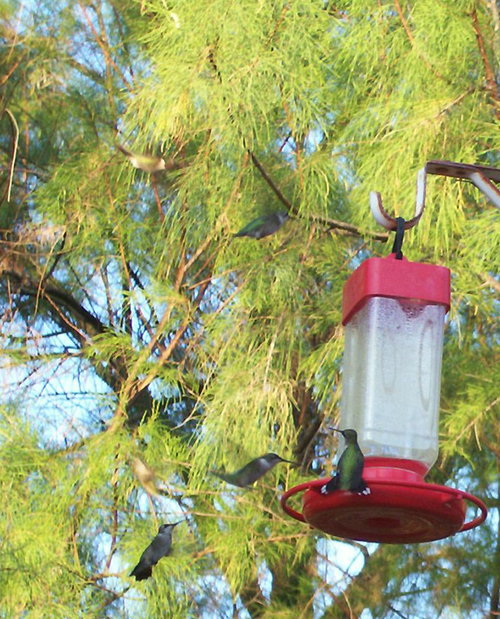
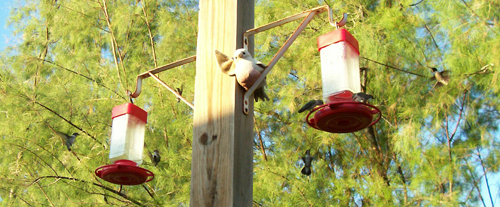
This time of year many in our area enjoy feeding and watching the hummingbirds as they rest and fatten themselves up for their long trek across the Gulf on their way to the Yucatan Peninsula. One day last week, Port O’Connor residents Jerry and Jan Nutt invited me to their home to see the birds feeding. Arriving around 6:30 p.m., I noticed there were five feeders hanging in view, but no birds. Taking a seat on the front porch, I watched and listened as Jerry began softly whistling. In a minute or two, hummingbirds, seemingly coming out of nowhere, began hovering near the two feeders that hung from a pole on the porch, just two or three feet away from us. I watched as the beautiful little creatures buzzed around and took turns getting a sip of nectar from the feeders. What a delightfully relaxing way to spend the evening!

After a while, the feeding subsided and Jerry told me to go stand very still by the post. I followed his instructions and he once again began whistling. Suddenly, there were hummingbirds all around me. There little wings made a loud, buzzing sound, and I could feel the wind they generated. It was quite a memorable experience.

That day we saw about 30 birds, but Jerry says there are often twice that many gathered at the feeders. There are four different varieties and they roost in the cedar trees at night. (He has seen them using a flashlight.) Early in the morning and late in the evening are the best time for viewing the hummingbirds.

Thank you, Jerry and Jan, for sharing this incredible experience with me. I only regret that I do not have a good enough camera to capture the beauty and scope of my experience.

Finally, A Little Rain!

Archived in the category: General Info
Posted by Joyce Rhyne on 22 Sep 11 - 0 Comments


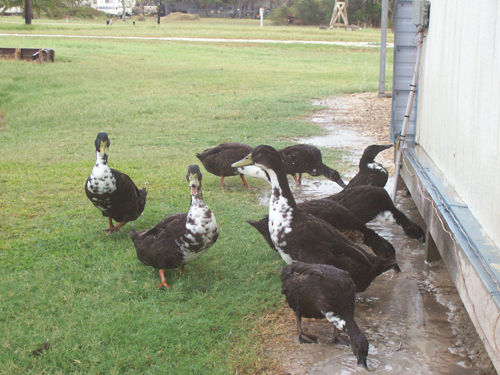
Look! It’s a puddle!
These ducks weren’t the only ones happy to see some rain around here. The rain began falling on September 16 and although intermittent over the next few days, has brought a little relief from the heat and dryness.

You Heard It From The Dolphin…

Archived in the category: General Info
Posted by Joyce Rhyne on 08 Sep 11 - 0 Comments

As you will see in this issue, our local school children are starting the new year with lots of learning and fun. Thank you, teachers and staff, for sharing with us, keeping our readers informed on school happenings.

And many thanks to the Albrecht family, Russell Cain and Jan Regan for sharing their Hurricane Carla memories and photos with us. Honestly, I had not remembered it was the 50th anniversary of that terrible event, so I find it particularly gratifying that some of our readers thought of sharing their memories in this publication.

I did remember that it is the 10th anniversary of the momentous attack against our country on September 11. And thanks to Peter DeForest, we can present a special article marking that event.

Because of our readers who keep us updated on events and who make the effort to put pen to paper (or fingers to keyboard), the Dolphin Talk can offer a variety of news, knowledge, insights and opinions for our entertainment and education. Thanks to you all!

-Joyce Rhyne, Editor

Hurricane Carla Remembered

Archived in the category: General Info
Posted by Joyce Rhyne on 08 Sep 11 - 1 Comment


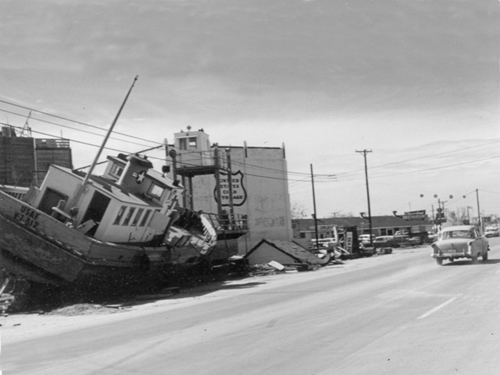
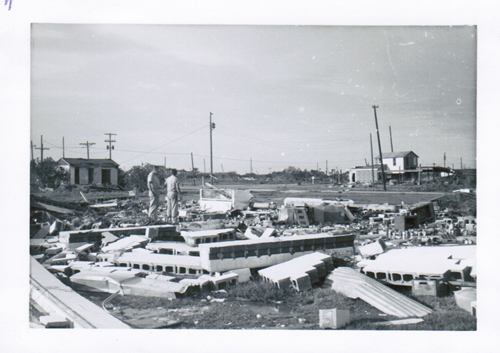
A common sight in Port O’Connor after Hurricane Carla
-Photo contributed by Clarence and Naomi Albrecht.

It has been 50 years since Hurricane Carla struck the Texas Coast on September 11, 1961. Carla killed 43 people, 31 of them in Texas. The low death toll is credited to what was then the largest peacetime evacuation in US history. Storm surge was measured at 22 feet near the heads of the bays, in some places penetrating 10 miles inland. Because of its large size, the entire Texas coast was affected, and damage was reported as far inland as Dallas. Sustained winds were reported to be 115 mph in Matagorda. Wind gusts as high as 170 mph were recorded in Port Lavaca.

This storm marked the first live television broadcast of a hurricane. Owing to the intensity of and destruction by the storm, the name Carla was retired, and will never again be used for an Atlantic hurricane.

Dolphin Talk is pleased to print the following recollections of Hurricane Carla and its aftermath, submitted by Janice Albrecht Stalder of Port O’Connor, who now resides in Copperas Cove and Russell Cain and Jan Regan of Port Lavaca.

Memories of Carla By Russell Cain

Our family was one of the last ones to travel across the two lane causeway between Port Lavaca and Point Comfort. We were proud to live in Point Comfort. My brother Alan and two sisters, Sharon & Barbara all learned how to swim in the city swimming pool and we also enjoyed fishing at the Point Comfort pier earlier that summer.

During the hurricane we stayed in a motel in San Antonio and the tornadoes were running wild. It took the roof off the two story hotel where we were.

A lot of the Alcoa people were worried about their homes and animals. Coming back it was hard to get into the area. I remember all the dead cattle all over the Highways between Port Lavaca and Point Comfort. A tornado hit the Mayor’s (Scott Vaughn) home on Texas Avenue in Point Comfort. The shrimp boats were up on Main Street in Port Lavaca and up on Hwy 316 near King Fisher and Magnolia Beach. Doc Roemer’s pots and pans were found over at Chocolate Bay with his name on the bottom of the pots. Doc told me that he and Joy ( his wife) were sitting in their den and heard a noise in the flower box in the house – a month later and there was a huge rattle snake.

There was 4’ of water over the bluff on Villa Road and South Virginia St. during Carla. Dr. York Lancaster’s house had the framing of their new home up. We did not have electricity for awhile and had to boil water.

We did not know if we were even going to have a home to return to. Many people stayed at the Courthouse, Bauer Dredge and Leonard Fisher’s warehouse. What a time in Calhoun County!
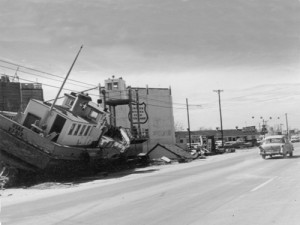
Port Lavaca after Carla: USAF boat on Broadway Freezing Plant -Photo contributed by Russell Cain

Carla Recalled By Janice Albrecht Stalder

On the Labor Day weekend in 1961 I had just returned from swimming in the canal with my cousin, Sydney Claire Albrecht, when my parents, Clarence and Naomi Albrecht, told me to start packing. A hurricane was headed in our direction; we needed to evacuate.

Some might choose to try to ride out the storm, but Clarence Albrecht grew up in Port O’Connor and knew the power of waves and wind: he would take his family to safety.

We threw clothing into suitcases and precious items into boxes, piled our station wagon and boat with all we could fit into it, hitched the boat trailer to the station wagon, and headed inland. Many of those next few days are vague to me now, but I remember listening to the radio on Sept 11, 1961, at my grandparents’ home in Lampasas county, only a few miles from where I now live and teach, and realizing that Hurricane Carla had slammed into Port O’Connor.

What that really meant I didn’t understand then, but I began to have some idea a few days later when we headed home and saw missing roofs and badly damaged buildings in Austin, over two hundred miles inland. Stopping at my Uncle Olin’s house in Victoria, we were relieved when we heard that planes flying over Port O’Connor had spotted our house still standing.

What we still didn’t understand was how much damage six feet of water and 170-mile-per-hour winds can do to a concrete block house even if it is “still standing.”

Driving from Victoria to Port O’Connor was like descending into hell. We saw broken telephone and electricity poles, dead cattle piled up against fence lines and barges stranded in the middle of pastures. A mile outside of town I spotted our platform rocker hanging from a barbed wire fence.

Yes, the house was still there – minus doors and windows and filled with mud and dead jellyfish.
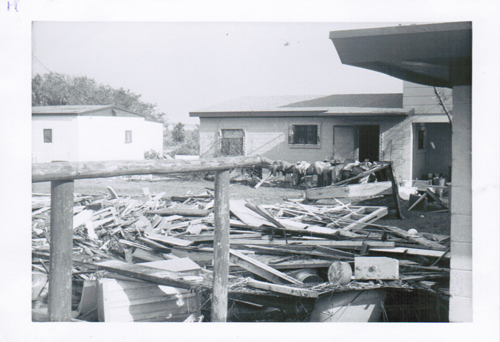
Back of Albrecht home

Pieces of other people’s homes and a massive tree trunk were piled five or six feet high in our back yard. A roof that clearly had flown through the air at some point had ended up against the outside wall of a bedroom. Our couch was on the back porch on top of the sliding glass doors, the refrigerator was in the back yard, and later we would find our freezer several blocks away. A friend would find our butane tank in the middle of a pasture outside town.

Of course, one of the first things I did was step on a nail, thus forcing my nearly overwhelmed parents to take me out of town to find a doctor and a tetanus shot.

My mother remained calm, if tight-lipped, as she reached up for a glass bowl that had been placed just above the high water mark and had miraculously survived the storm. She sat it on the drainboard and opened the dish cabinet above it – and a pile of broken dishes churned around in the cabinet by the rising waters fell out and broke the one surviving bowl.
That’s when she finally sat down in the middle of the kitchen floor and cried.

But I don’t think that it ever occurred to us not to stay in our home and begin cleaning up. My father purchased a gasoline engine to put over the well pump, and we had water to begin the cleanup process. We brought in an old washpot in which to heat the water (we had plenty of scrap wood to burn!) and borrowed a camp stove on which to cook . My parents’ upstairs bedroom had its windows broken out and pieces of glass piercing its sheetrock walls, but it was less of a disaster zone than the rest of the house. We would live there while we cleaned up the rest of our property.

Of course, it would be months before we would have electricity again, so in effect we were living as my grandparents had at the start of the 20th century. My parents remembered parts of that way of life, and I adjusted. We did the best we could with what we had.

And how we blessed the Salvation Army! Their mobile kitchen had arrived in town almost as quickly as we had and at once started serving hot meals. Nothing before or since has ever tasted so good.

The schoolhouse, refuge during the storm to the few people who stayed in town and survived the storm, now became a site for the Red Cross to unload truckloads of clothing and furniture. My mother, principal of the school, and teachers worked with them. At some point my father went back to work at the plant and I started the ninth grade at what was then Travis Junior High School in Port Lavaca.

We moved one of the Red Cross mattresses upstairs, put it on the floor behind two chests, and created me a semi-private bedroom area. Every day I took the bus to and from a different world, that of school, before returning home to do homework by a floundering lantern and try to help in the cleanup. (I doubt that I really was much help!)

I will never forget the smell of burning cattle along the road to Port Lavaca as the Corps of Engineers bulldozed up great piles of dead animals, covered them with chemicals, and set them afire.
I remember also the cattle and horses wandering about town for weeks, many of them far from the ranches – including Matagorda Island – from which they came and some of them badly cut up and injured by debris and wire fences. I kept trying to catch the worst injured horses and pour peroxide on infected wounds.

I remember also the day the Corps of Engineers brought in a crane to pick up the giant tree trunk lying in our backyard and lift it out over the top of our house.

Of course, I was too young fully to appreciate the challenges facing my parents and other adults struggling to recover lives smashed out of recognition.

But I was not too young to notice something else. I saw the men and women from church and civic groups who came from all over to help us clean up our town. I heard my parents talking about the farmers in another state who mortgaged crops in the field so that they could send funds to help Port O’Connor rebuild. I saw the shipment of little pine trees sent to our town to replace trees destroyed by the hurricane.
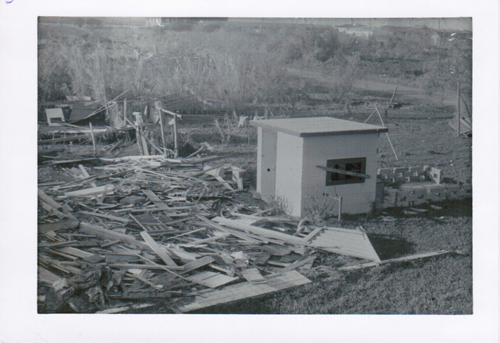
The Albrecht’s cinderblock pump house stands amidst the rubble.

I smiled as I drank pure spring water from what appeared to be a beer bottle, Two Texas breweries had shut down their beer production long enough to bottle water to ship to us in days before bottled water was easily available and when our own wells were too polluted for drinking.

I observed as the adults around me went back to their day jobs to earn badly needed salaries but continued to work until exhaustion to bring our town back to life.

I saw men and women with nothing work to rebuild something.

A few years later, when I was a senior in high school, I would write an essay about having seen the true Spirit of America that year. In the 50 years since Hurricane Carla forever changed Port O’Connor, I have seen nothing to make me change my mind.

On another 9/11 a few years ago, when I watched in shock as two great towers came down and felt pride when I heard of the heroism of men and women who struggled to survive that disaster, I was reminded again of that Spirit of America. As I read of construction workers in Manhattan who left their jobs to plunge into danger in hopes of helping the first responders who already had entered the damaged towers, I remembered those who came to Port O’Connor in 1961. When I read of restaurant owners who emptied their freezers to take food to the refugees of that man-made disaster, I remembered the volunteers with the Salvation Army.

True heroes are not actors on television screens or athletes in sports stadiums; they are the men and women of America who deal with whatever nature or unnatural men throw at them and fight to keep this nation not only building but, when necessary, rebuilding.

I learned that lesson in Port O’Connor in 1961.
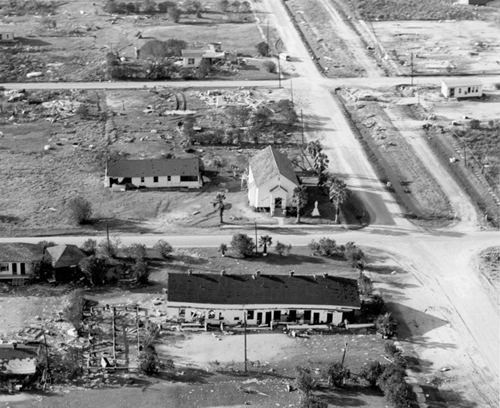
Port O’Connor after Carla

Carla and the Jan R By Jan Regan

My dad Woody Regan and Jimmy Wallace had a 72’ shrimp boat named the Jan R, after me. It was the largest shrimp boat on the Texas coast and could stay out in the Gulf of Mexico two weeks because of the amount of ice it could hold.

Dad decided that a safe place for his one shrimp boat during Carla was tied to the leeward side of Bauer Dredging Co.’s huge dredge that had spuds that could go 20 feet into the bay bottom.

Little did he know that Carla was pushing a 20’ storm surge by the time she hit Port Lavaca. Hence, the picture of the Jan R and the dredge sitting on top of the pile of oyster shells behind the dredging company.

Oh, well. There went the funds for my college education.
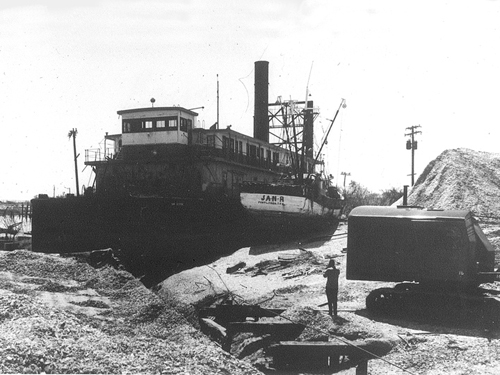
Shrimp boat Jan R after Carla
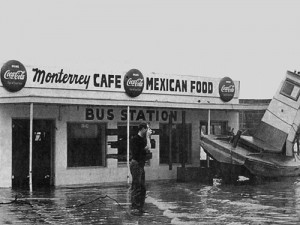
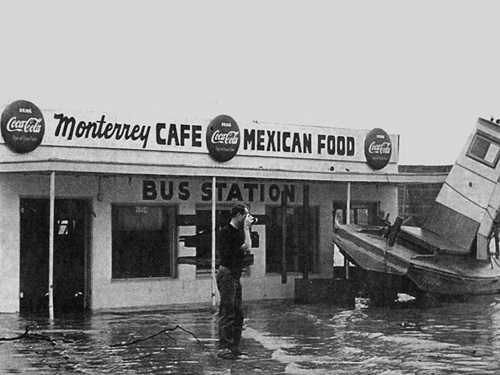
Monterrey Cafe afer Carla
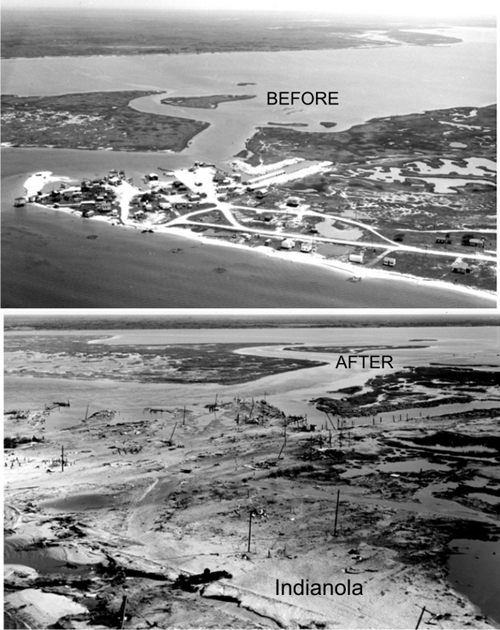
Indianola Before and After Carla
Remembering the World Trade Center By Peter DeForest

Archived in the category: Featured Writers, General Info
Posted by Joyce Rhyne on 08 Sep 11 - 0 Comments

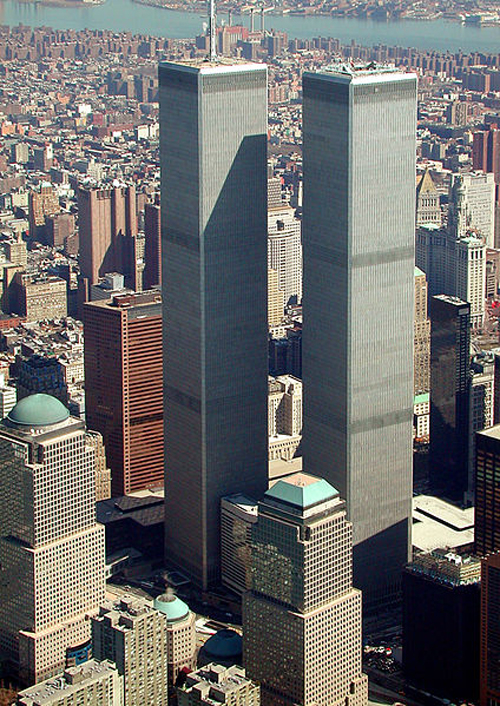
World Trade Center Complex, March, 2001

On the Morning of September 11, 2001, Americans and people around the world were shocked by the destruction of the World Trade Center in New York City and the damage to the Pentagon in Washington D.C. after three passenger aircraft were hijacked by terrorists and flown into the buildings. There was also a fourth hijacked aircraft that crashed in a field in Pennsylvania after heroic actions by the passengers which averted further tragedy. Ten years later our world has been permanently changed by the terrorist attacks.

The collapse of the twin 110 story skyscrapers of the World Trade Center (WTC) with the loss of over 2,700 lives has drawn a lot of scrutiny since the Sept. 11 attacks. Some engineers and studies have criticized the design of the WTC Towers. With this article I’ll talk about the design and collapse of the twin towers.

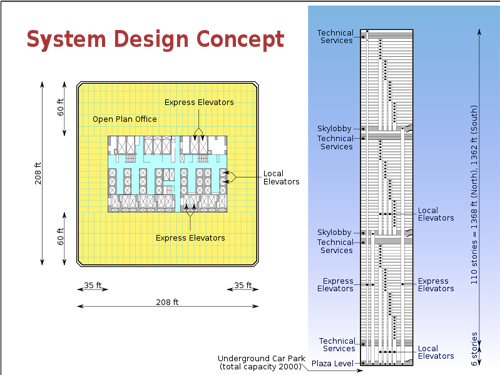
The Twin Towers of the WTC complex was designed by an Engineering Team led by Minoru Yamasaki who passed away in 1986. Yamasaki was considered one of the most prominent architects of the 20th century. Prior to the 1960’s, most skyscrapers such as the Empire State Building were built using the “steel frame” method, which can be simply described as a large steel box with many small steel boxes inside it. The WTC Twin Towers used a method of skyscraper construction which is called the “tube-frame” design. Tube-frame designed skyscrapers use high-strength, load-bearing perimeter steel columns that are spaced closely together to form a strong, rigid wall structure with a core structure of steel columns housing the elevator shafts and utility shafts. One big advantage of the tube frame design was that it allowed for fewer interior columns, creating more usable space per floor. Each floor of the 110 story Twin Towers consisted of a four-inch thick concrete slab poured on a fluted steel deck supported by a truss structure attached to the exterior walls and the core. (A truss is a structure comprising one or more triangular units constructed with straight members whose ends are connected at joints). Included in the design was another truss structure called a “hat truss” which was built into the top three floors. The hat truss was designed so that a large communication antenna could be fitted to each tower, but only one of the towers ever had an antenna added. Each Tower was split into three sections, with each section having a floor called a sky lobby and a floor dedicated to technical services. The sky lobby was designed so that people would take an “express” elevator to the sky lobby for their section of the building, then they would take a “local” elevator to their specific floor in that section. The technical services floors contained climate control equipment, electrical breakers, communications equipment, and elevator machinery. Each tower also had three stairways for use during emergencies.

The WTC engineering team also considered the possibility of an airplane crash due to the height of the towers. In 1945 a Air Force bomber lost in the fog had hit the Empire State Building. A design study was done where it was calculated that the towers should survive an impact from a Boeing 707, which was a first generation narrow-body jet powered passenger airplane.

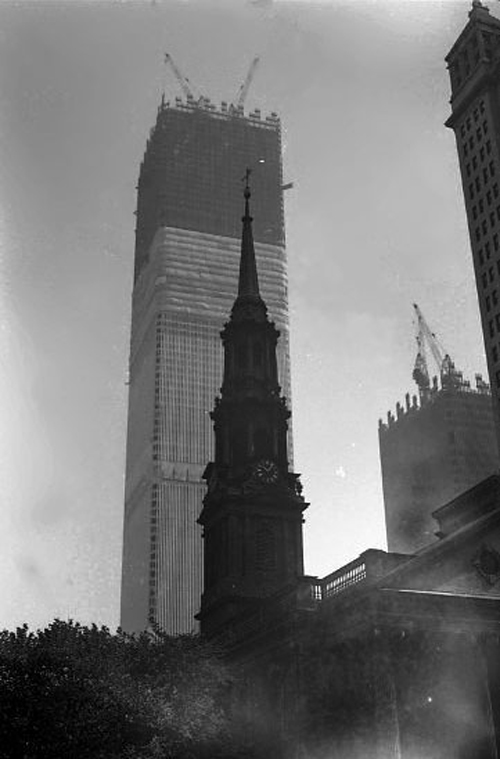
WTC Under Construction


Construction of the World Trade Center Towers began in 1968. The North Tower was called WTC 1, while the South Tower was called WTC 2. Both towers were completed by July of 1971. An estimated 20,000 people went to work daily at the twin towers. This total also included building technicians & engineers, custodians, security, delivery, and safety staff.

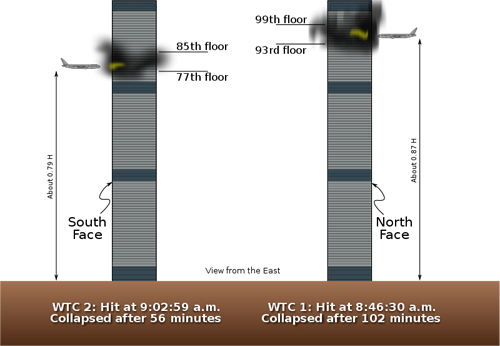
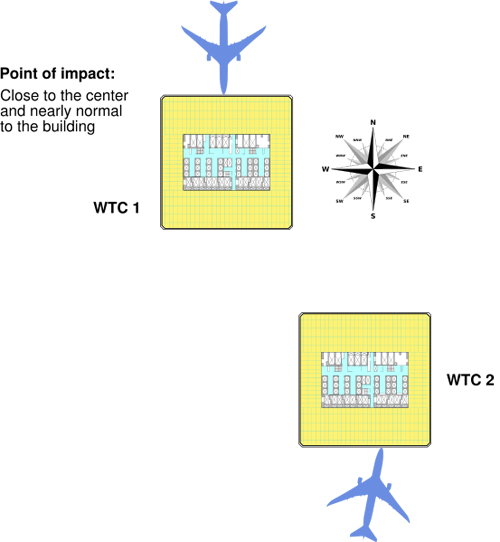
September 11, 2001 was primary election day for the City of New York, so many workers planned on showing up late for work that day so that they could vote. There were only around 8,900 workers in the Twin Towers by 8:45 that morning. At 8:46 a.m., hijacked American Airlines Flight 11, a Boeing 767 wide-body passenger airplane, flew into WTC 1 at an estimated speed of 440 miles per hour. Flight 11 carried 87 passengers and crew, had over 10,000-gallons of highly flammable jet fuel, and impacted between the 93rd and 99th floors of WTC 1. The impact damaged and/or sheared almost every exterior column on the North side of WTC 1, started many fires, severed the elevator shafts and all three emergency stairways trapping over 1,000 workers above the impact. Most occupants below the impact immediately started using the emergency stairways making their way to the main building exits at the ground floor. Many occupants of WTC 2 also started evacuating, despite orders to stay put, from building management, who assumed the plane crash in WTC 1 had been an accident.

At 9:02 a.m., hijacked United Airlines Flight 175, also a Boeing 767 wide-body passenger airplane, flew into WTC 2 at an estimated speed of 540 miles per hour. Flight 175 carried 60 passengers and crew, had over 9,000-gallons of jet fuel, and impacted between the 77th and 85th floors of WTC 2. The damage was somewhat different than WTC 1 as Flight 175 impacted WTC 2 at an angle, leaving a portion of the building core with one emergency stairway intact. The overall damage was greater however due to the increased speed of the plane, and the damage to exterior columns on two sides of the building.

WTC Plane Impact Locations

In both Twin Towers the hat trusses had the unintended function of redistributing the structural loads due to the damage to the exterior columns of both buildings. The jet fuel from the planes penetrated far inside the towers, igniting many large fires simultaneously over a wide area of the impacted floors. The fires also ignited the contents of the buildings. The fires were hot enough to weaken the core steel columns and cause some of the affected floors to sag, pulling perimeter columns inward and reducing their ability to support the mass of the building above. A large rescue operation was begun, with hundreds of New York City Firemen (FDNY) and Police Personnel from both New York City (NYPD) and the Port Authority (PAPD) responding.

Impact Locations

In WTC 1, some of the occupants trapped above the impact area, made the desperate decision to jump instead of being burned by the spreading fires or suffocated by the smoke. As the fires continued to burn, an occupant trapped on the 105th floor of WTC 2 managed to get through to 911 operators and report that floors beneath him were collapsing. An NYPD helicopter unit reported over the radio that “large pieces were falling from the top of WTC 2”. At 9:59 a.m., WTC 2 collapsed, 56 minutes after being struck; 630 building occupants perished. After the collapse of WTC 2, frantic efforts were made to contact the emergency responders in WTC 1 to evacuate, but due to radio communication problems, some did not get the orders. After WTC 2 collapsed, NYPD helicopters relayed information about the deteriorating conditions of the WTC 1. One NYPD helicopter reported that “the top of the tower might be leaning”. WTC 1 collapsed at 10:28 a.m., 102 minutes after being struck; 1,462 building occupants perished.

In all, 2,092 building occupants perished, along with 343 firefighters, 60 police officers, and 18 other recue workers. The total killed at the WTC complex was 2,749; this total includes the passengers and crew of the planes and 35 others who were bystanders or occupants of nearby buildings. Almost 6,800 occupants of the Twin Towers were able to evacuate before the Towers collapsed.
In the time since the attacks, studies have been done which suggest that the Twin Towers were flawed in their design. In 2005 the National Institute of Standards and Technology (NIST) issued a report which suggested that the towers would have not collapsed if the fires had not weakened the remaining steel supports. The NIST report also stated that the blast from the impact of the planes blew away most of the fireproofing on the floor trusses in the affected areas allowing the fires to further weaken the floor supports. As each Tower began its collapse, the floors collapsed within the towers, one on top of the other in what is called a “pancake collapse”. The NIST report also included 30 recommendations for improving building and occupant safety.
One must consider that almost three-quarters of the building occupants in the Twin Towers managed to evacuate and survive, a large number considering the magnitude of the attacks that day. Also before the September 11 attacks, no skyscraper was designed to survive the high speed impact of a large modern airliner carrying thousands of gallons of jet fuel.

In addition to the heroes who gave their lives in the attacks of September 11, 2001, I say that the Twin Towers should be praised instead of criticized, for staying up long enough for many occupants to escape.

Assistance with the writing of this article must be credited to the NIST World Trade Center Disaster Study published in October of 2005 and numerous other written sources.

Untitled Document