As the winds have backed down, Trout have been on a voracious feeding pattern as I predicted in my last report. From shorelines to shell reefs, virtually all structure is producing solid limits of Trout. While Trout are in the crosshairs, Redfish aren’t far from our thoughts with pods roaming shallow mud/grass flats and shell reefs feeding on finfish and small crabs. Catching them has been hit and miss with the lack of wind and an inability to bracket them.

Spaw Maxwell Arriba Pescado Guides Cup Winner, Castaway Lodge Capt. James Eastep, June 3011.

Arriba Pescado Guides Cup Winner

Working San Antonio Bay shorelines, our Capt. James Eastep managed to bring the Spaw Maxwell Arriba Pescado Guides Cup home to The Lodge. The weigh in required 10 Trout and 3 Redfish for qualification using artificial lures only. Working topwaters and soft plastic paddle tails, Rusty M. and guests managed to dig out their 10 Trout including a number of 23 and 24” fish with Capt. James topping off the Trout part of the stringer with a 27” bruiser. Digging in tight to the shorelines, the guys managed to work up two Redfish including one fish pushing 28” (a Tournament Red). With one Redfish yet to go, everyone was scrambling and pumping the plastics in a frenzied search for the “coup de grace”. With the weigh-in requiring participants to be “in line” by no later than 4:00pm, at 5 minutes to 3:00pm Jim stuck another Redfish and it was another fish pushing 28”. Now, it was a mad dash to the ramp in Seadrift and 90 to nothing for the weigh-in. That pretty much sealed the First Place honors and the team cleared 2nd Place by a half pound. Congratulations to all the runners-up for making it a tight contest.

Tejas Vaqueros Tournament Redfish Winner

Working mud/grass shallow put the winning Redfish in the box for Capt. James Cunningham fishing with Kenneth L. and guests during the TV Tournament in Port O over the weekend. Conditions didn’t materialize on their Trout bite but you can’t win them all.
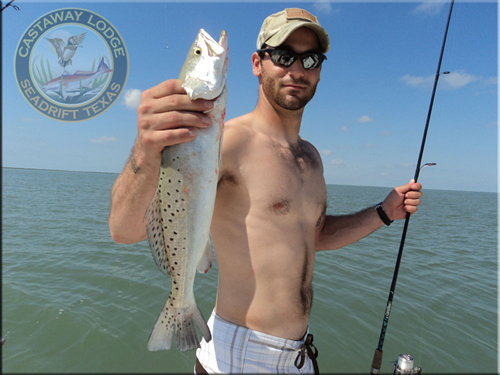
Army Ranger Trevor L. fishing with Castaway Lodge, June 2011.

Back To “The Ghan”

The lodge welcomed Chip L. and his two sons, Matt and Trevor. Chip called and asked me to line up a special occasion for him and the boys as Trevor is departing the end of June for his second tour in Afghanistan. Trevor (photo on page 14) is part of an elite Army Rangers Unit of reconnaissance equivalent to the “Vietnam Era” “Lurps”. We salute his service as did the Trout with full limits fishing with me aboard my Haynie 24’ Cat powered by Mercury Pro Team working shell in SAB. Many other quests including Paul F. corporate group; Brad M. and guests; Landon K. and father Lynn experienced the same or just short of full limits.

Historical Perspective

As of now, it seems that there are a lot of fish in a lot of locations which is a little different than the last couple of years and is reminiscent of “the good old days”. June historically was a “signature” month for SAB that was categorized by endless days of full limit Trout fishing with our catches ranging from 18” to 24” consistently. Come July, historically our size range would start tailing off and falling in the 16” to 18” range predominantly with a good handful of plus 20” fish. By August, historically, we would be working steadily taking limits in the 15 to 17” range. There was an exception in August and that was anytime we hit a stretch with excessive wind and tide. August was “the month” to catch the Trout coming back around for another spawn. We would intercept them in these conditions during August with Trout pushing 25 to 28” coming to hand regularly. While the size range isn’t quite back to “what it was back in the day”, it is certainly impressive to someone that has “scene it all” in this location.

As we have passed the “Trout Limit” debates and the tempest that always surrounds the discussion, I’m constantly reminded by the words of “the old timers” that were applying their skills guiding anglers long before me. Their words and emotions evoked an observed “ebb and flow” to fish populations that could only be explained by the whims of Mother Nature and not “the hand of man”. While we would like to pat our regulating officials on the back for “perceived” management success, we are also quick to beat them over the head for “perceived” failures and shortcomings. The bottom line, many things just aren’t within the grasp of man to “be controlled. Certainly, we have to commend everyone that protects our environment and “sets the table” for Mother Nature to do her thing. We know that environmental degradation certainly puts an end to any discussion concerning a healthy fishery. So, for that, we should all be thankful.

Have a great week and “come see us”.

Capt. Kris Kelley
Castaway Lodge
1-888-618-4868
www.seadriftbayfishing.com
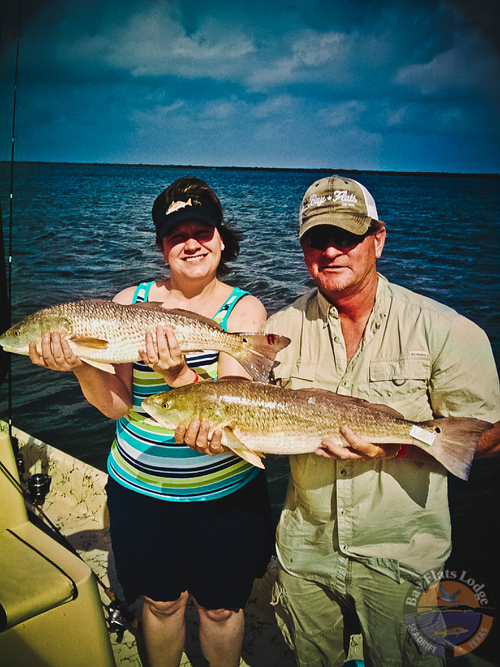
Robert and Christy Bryant from Seadrift spent Memorial Day fishing with friends Angie and husband, Captain TJ Christensen in Shoalwater Bay with finger mullet. -Bay Flats Lodge photo

The clock is showing 4:30am as I sit down to begin writing this edition of Guide Lines, and if this morning pre-dawn conditions are meant to be a precursor to that which will follow once the day’s sun rises then I don’t know that the obstacles that I’ll be facing on today’s fishing trip will be much different than those which I’ve faced over the past week, or so. What does this mean? Well, I’d almost be willing to bet that today I’ll see definite tide differences, and I can just about guarantee that there will be categorical fluctuation and variation in the speed and the direction of the wind, and let’s not forget, too, that the temperature of the water is now changing (rising) on an almost daily basis. Such diversity in the weather conditions has recently made it more challenging for me to determine what the fish will be doing, and when they will be doing it. And while it’s true that the diminishment of the stronger winds of springtime have yielded me opportunities, of late, at some truly spectacular wading successes in some of those otherwise blown-out locations, I’m sometimes recognizing failure at reproducing “previous- day” results.

In other words, I’m finding that a good bite at any one place during any one time of the day does not necessarily constitute a repeat performance the very next day in the exact same location during the exact same time of the day. I’ll need to confront these daily fishing pattern differences and deal with them accordingly if I hope to be successful on a regular basis over the course of the next few weeks.

At this stage, the most valuable tool I have available to me that will help avoid a bad day of fishing for me and my guests is my ability to rely upon myself to do today all the things I’ve found to have worked for me in the past.

If you’re like most of us, you simply don’t get to spend quite as much time out on the water fishing as you would like. And, when you do finally get a chance to fish, you prefer to see some action. In as such, when infrequent anglers spend the first couple hours of that one day they have to fish wading their favorite shoreline with minimal results, one of the first thoughts to cross their mind is that they will need to completely relocate their efforts if they stand any chance, whatsoever, at catching fish that day. It’s an understandable thought, and is probably one of the more common reactions for anglers sporting an empty stringer while facing a restricted window of opportunity. However, traveling and searching for a new location doesn’t have to be the only course of action in this situation, as doing so tends to inevitably waste valuable time. If I’m confident in believing there are fish in the area where I’m wading – due to strong fish signs, bait activity, or recent productivity – here are some things you’ll find me doing routinely in place of leaving the area altogether. If, while approaching a known “good” shoreline that I’ve fished recently, I notice that today there is a distinct difference in the water level, I’ll pause for a minute to recall what I’ve done previously to allow me success under similar conditions in this same area. In doing so, I’ll remember that as the tide falls away from the shore, the bait will fall with it, so I’ll position my wading effort a significant distance away from the shoreline towards the most outward tapered shelf. If, on the other hand, I notice that the tide is much higher today than it was on my last visit to this area, I’ll initially place myself a lot closer to the bank than I did previously, as experience tells me that the bait will have been carried toward shore with the incoming tide and consequently will have begun to bunch-up in the shallows. If after entering the water I find I’ve spent an unfortunate measurable amount of time delivering unanswered casts, I’ll relocate my efforts. But not by a far distance – like I said earlier, leaving an area altogether takes time, and should be considered a “last-resort” action, especially in an area showing great signs of fish activity. Instead, you’ll find me simply shuffling parallel to the shoreline a mere ten steps in any one direction, as in doing so (I recall) has sometimes made a considerable difference. I’ve happened upon a strong, steady bite on many occasions using this slight relocation method, and it’s a practice I’ve found that undoubtedly still works for me. There is, however, a second aspect to this particular lesson, and that is the importance of disciplining yourself to stop moving once you’ve located the bite. Continuing to walk into the fish is an easy trap for even the most experienced angler to fall in to, and for a long time I was as guilty of doing it as the next guy. It’s not hard to get caught-up in the excitement of catching a fish on almost every cast, thinking all the while that you may be able to get in on even more of the action if you were to just move a little bit closer. But to this day, I still recall a banner experience in my career as being the day in which I firmly planted my feet into the bay floor (didn’t take another step) immediately following me landing a four-pound trout – an action which supported a catch-and-release extravaganza of solid trout in excess of seven pounds for the next few hours by me and my guests. So, the next time you’re wading on a slow day along what you know to be a productive shoreline, you may just find that the best approach is for you to stop for a moment in order to recall exactly what it is you have done in the past under similar circumstances that enabled you to recognize your desired results. Good luck…and, keep grinding!

With the summer heat rapidly encroaching upon us, remember it to be of utmost importance that you apply plenty of sunscreen first thing in the morning, and to wear a long-sleeved shirt along with long pants. And I also highly recommend you drink plenty of fluids throughout the entire course of the day, particularly those of the non-alcohol variety, so as to keep yourself thoroughly hydrated. Remember to practice CPR, “Catch, Photo, and Release”, whenever possible on trophy Trout and Reds…Guide Chris Martin, Port O’Connor/Seadrift region…

1-888-677-4868 toll free
Captain Chris Martin-Owner
Bay Flats Lodge
www.BayFlatsLodge.com

TAA Shrimp Workshop

Archived in the category: Fishing Reports
Posted by Joyce Rhyne on 09 Jun 11 - 0 Comments

Texas Parks and Wildlife and the NOAA Fisheries Service (NMFS) are co-hosting three gear workshops in conjunction with Texas Sea Grant who is offering Trade Adjustment Assistance training for eligible applicants. These workshops will provide Shrimp Fishermen with updates on design, installation procedures of existing (those already in use) TEDs and BRDs and techniques to ensure their proper function and an introduction of newly approved BRDs which are optional for fishermen in State and Federal Waters. In addition, Mike Haby will present a course on fuel savings in the shrimp fleet as per guidelines for TAA intensive training. Meetings will be held in Port Isabel, Brownsville and Port Lavaca with Spanish translation available. The meeting in Port Lavaca is scheduled for Thursday, June 23, 2011 at 5 p.m. in the Ag Auditorium located at the Calhoun County Fairgrounds. For questions or more information, please call Rhonda Cummins at the Calhoun County Extension Office at 361-552-9747.

Pescado Grande

Archived in the category: Fishing Reports, General Info
Posted by Joyce Rhyne on 09 Jun 11 - 0 Comments

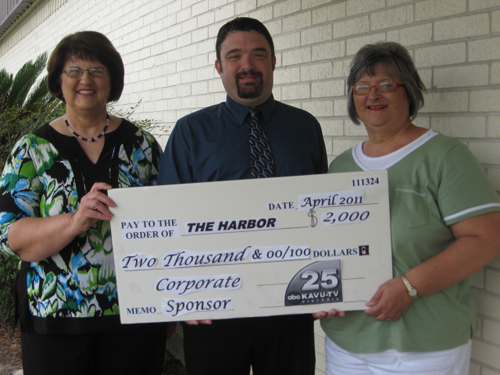
Mike Halbrook on behalf of Channel 25 is pictured above presenting a $2000 check to The Harbor Executive Director, Virginia Hahn, and Christine Mayer, chairperson of the 2011 Pescado Grande Fishing Tournament. Channel 25 is a “Corporate” sponsor for Pescado Grande Fishing Tournament 2011 coming up June 24 & 25 in Port O’Connor.

Boating Class June 18

Archived in the category: Fishing Reports, General Info
Posted by Joyce Rhyne on 09 Jun 11 - 0 Comments

All persons born after September 1, 1984 who have not reached their 18th birthday are required to have taken a boating course to be able to operate a vessel or personal watercraft by themselves.

The next class will be held June 18 at Coleto Creek Park Headquarters classroom. Pre-registration is required. To register call: Charles F. Schons at 361-575-8600
Area Chief/Instructor, Texas Boater Education USCG Auxiliary Instructor

Untitled Document