Invasive Species Pose a Threat to Native Ecosystems

What comes to mind when you think about an invasion? UFOs hanging ominously above the world’s major cities? What about shrimp larger than your head, or fish studded with poisonous spikes? Sometimes, reality is stranger than fiction: these creatures exist, and they are invasive.

Invasive species infiltrate ecosystems other than those where they naturally belong. They can have devastating impacts on both native species and the environment.

There are many ways invasive species can end up somewhere they do not belong. Some are brought in on cars, ships and planes. Other times, they are introduced through trafficking and trade; some species are imported for their exotic appearances then are released or escape their enclosures. Some invasive species were introduced for commercial or ecological purposes.

Invasive species generally lack natural predators to keep their populations controlled. And, because their populations can grow unchecked, they can quickly outcompete native species.

The Gulf of Mexico has become home to many invasive species that are cause for concern. Once invasive species take hold in an area, “they are not manageable,” says Tony Reisinger, Texas Sea Grant coastal and marine extension agent for Cameron County. “You do what you can to eliminate the ones you know about, but there will always be another one lurking around the corner.”

Lionfish, for example, are invasive and voracious predators that outcompete most native fish. They are covered in venomous spines which offer protection against any would-be predators in the Atlantic. In areas where lionfish have become established, such as the Caribbean, Bahamas, and the Gulf of Mexico, these invaders have ravaged ecosystems and decreased biodiversity.

Reisinger says that “we didn’t know when they [got] here, but they’re here. People are seeing them [in Texas], and they’re reporting them.” He cautions that lionfish are “dangerous and must be handled with care,” because of the venomous spikes that coat their bodies. But, once they’ve been killed and dressed, they’re as edible and delicious—as any other fish.

The Asian tiger shrimp (Penaeus monodon) is another species native to the Indo-Pacific that has taken up residence in the waters of the Gulf of Mexico. These shrimp are massive—they can grow up to a foot long and weigh nearly a pound.

Tiger shrimp are much larger than the species of shrimp that naturally inhabit the Gulf, and experts worry that tiger shrimp might pose a threat to native shrimp species, either by spreading diseases or outcompeting them for resources.

Reisinger says that while, “the population hasn’t seemingly taken off, I suspect that they’re here, and they’re breeding. We’ve had fishermen bring us juveniles—about eight inches long—that were caught in the Brownsville ship channel.”

Reisinger notes that you can, in fact, eat the Asian tiger shrimp. He shares a recipe from Shrimp Farmer, Gordon Lipscomb, “You peel it, leave the tail on like you usually do, then you split it open and lay in some cream cheese and jalapeno and then wrap it with bacon and put it on the grill.”
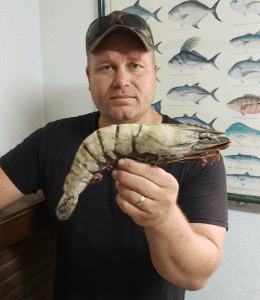
Captain Seth Sanders, a shrimp vessel owner from Brownsville, Texas, captured this 12.5-inch Asian tiger shrimp while trawling for white shrimp. -Photo credit: Tony Reisinger, Texas Sea Grant.

Captain Seth Sanders, a shrimp vessel owner from Brownsville, Texas, captured this 12.5-inch Asian tiger shrimp while trawling for white shrimp.
-Photo credit: Tony Reisinger, Texas Sea Grant.
Democrats to Meet

Archived in the category: General Info, Organizations
Posted by Joyce Rhyne on 20 Apr 23 - 0 Comments

The May meeting for Calhoun County Democratic Club will be held Tuesday, May 2, 2023 at the Calhoun County Library, in the community room, 200 W Mahan St., Port Lavaca.

The guest speaker, Jesse Hubbell the Chief Appraiser of Calhoun County Appraisal District, will give a presentation on the Appraisal District and how it works. He will also be there to answer your questions.

Social/potluck is at 5.30pm and the meeting starts at 6pm.

CalhounTXDemocrats.org

Shrimpfest is Coming!

Archived in the category: Announcements, Events, General Info
Posted by Joyce Rhyne on 20 Apr 23 - 0 Comments

The Seadrift Chamber of Commerce reminds us that Shrimpfest is almost here! Celebrate on June 9th and 10th with a 5K, Fishing Tournament, Pageant, Scavenger Hunt, SHRIMP, and more!

Lots of good music each day, Friday: Solido with special guest David Lee Garza Y Los Musicales, Greg Morales & The Steel Revival; Saturday: Roadside Libby, Kody West, Todd Dorn, The Haze Band.

Condolences – Judy Weaver Whitworth

Archived in the category: General Info, Obituaries
Posted by Joyce Rhyne on 20 Apr 23 - 0 Comments
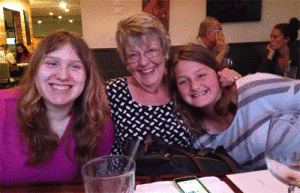
Judy Whitworth with her granddaughters Claire (l) and Ally (r).

Judy Whitworth with her granddaughters Claire (l) and Ally (r).

1/16/45 – 3/27/23

Judy Whitworth died March 27th at the Dornburg Center of Compassion in Victoria, Texas. She is survived by her husband Dain Whitworth, Sr.; daughter Cheryl Fries (Patrick); son Luke Bellsnyder; step-children Dain Paul Whitworth, Jr. and Lisa Whitworth; granddaughters Claire Fries and Alexandra Bellsnyder; brothers Russell Weaver and Ron Capehart (Joel Wilder); her cherished relatives in Alabama and Georgia, and many, many cherished friends she considered as family. She was preceded in death by her parents Russell Weaver, Sr. and Margaret and Luke Capehart and brother Lucien Capehart.

Her diminutive stature belied the size and scope of her impact on all she met. She was vivacious, fun-loving, big-hearted, and fierce. She loved good books, good music, good food, good dogs, under-dogs, good causes, and, most of all, a great party.

Born in Bremen, Georgia, but raised in Austin, Texas, as a child Judy helped ride the Barton Springs ponies to the barn at night. She made life-long friends while selling commercial property in Austin with Knight Real Estate, and thoroughly enjoyed her time as the meeting planner for the Texas District and County Attorneys Association. After retirement, she and Dain moved to Port O’Connor, Texas, where Judy was instrumental in raising the funds to build a community library, serving as president of the Friends of the Port O’Connor Library as the organization raised the necessary funds and built the library facility.

Judy, Dain and their close circle of friends spent many good times fishing, cooking, dancing and laughing on the Texas Gulf Coast, and Judy was an enthusiastic volunteer for the Coastal Conservation Association.

She was very proud of her children, whom she raised as a single mother, and especially of her granddaughters Claire and Alexandra.

Judy would want us to honor her life by putting some Willie Nelson or Kris Kristofferson on the stereo, drinking a glass of wine, and telling stories. A celebration of life to do just that will be held in Austin at a later time.

In lieu of flowers, the family suggests memorial donations to the Friends of the Port O’Connor Library, P. O. Box 497, Port O’Connor, Texas 77982; Hospice of South Texas; or the Texas Scottish Rite Hospital for Children 2222 Welborn St, Dallas, TX 75219.

Historical Marker Dedicated

Archived in the category: Announcements, General Info
Posted by Joyce Rhyne on 20 Apr 23 - 0 Comments

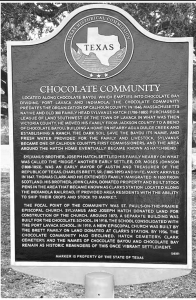
On April 22, the Calhoun County Historical Commission dedicated a marker at the Historical Hatch Cemetery.

Located along Chocolate Bayou which empties into Chocolate Bay, dividing Port Lavaca and Indianola, the Chocolate Community predates the organization of Calhoun County.

In 1846, Massachusetts native Slvanius Hatch purchased the land. He moved his family from Jackson County and built a home on nearby AguaDulce Creek and established a ranch.
Sylvanius became one of Calhoun County’s first Commissioners, and the area around the Hatch Home eventually became known as Hatch Bend.

The focal point of the community was St. Paul’s-on-the-Prairie Episcopal Church. Around 1872, a school was built, and in 1918 it was consolidated with the Port Lavaca School.

By 1936, the Chocolate Community had declined. Hatch Cemetery, Clark Cemetery, and the names of Chocolate Bayou and Chocolate Bay remain as historic reminders of this once vibrant settlement.
Marker

Untitled Document