Dead Stick Your Next Redfish and Speckled Trout By Capt. Robert Sloan

Archived in the category: Fishing Reports, General Info
Posted by The Dolphin Talk on 23 Mar 11 - 0 Comments

On Monday March 21 a buddy and I  were wading a backwater estuary lake here in Port O’Connor and had a blast catching redfish and trout on two of the most famous topwater plugs of all time – a Super Spook Jr. and TopDog. When it comes to catching a variety of saltwater gamefish these two plugs are tough to beat. But there are a few tricks that you can use to make these plugs fool more fish on each trip out.

Dead sticking is one of the absolute best and most exciting tactics for coaxing reds and trout to hit a topwater plug. Dead sticking is simple. You cast your favorite topwater plug out, and twitch the rod tip about three or four times, then let the plug sit dead still in the water for a few seconds. You won’t believe some of the blowups you’ll get when the lure is doing absolutely nothing. In fact that’s how I caught my heaviest trout, one that weighed 10.4 pounds.

When I caught that huge trout Bill Panto and I were in my boat and easing along the edge of a flat that dropped off into about 10 feet of water. I had the boat positioned in the deep water and we were casting TopDogs up onto the flat in about 2 feet of water. I made a cast, twitched the plug about five times and let it sit motionless. I turned to say something to Bill and heard the big trout eat the plug. When I set the hook I immediately knew this was no ordinary fish. In fact, it  was a career trout.
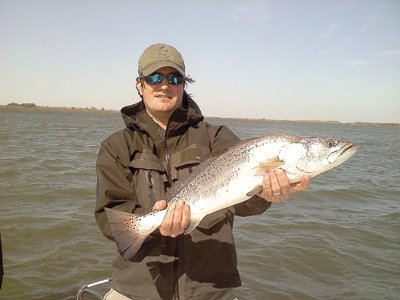
Warren Claybar caught this 7-pounder while dead sticking a mullet colored One Knock Super Spook in about three feet of water last week. -Capt. Robert Sloan

Just recently I was fishing over shallow shell on West Matagorda Bay when the dead sticking tactic was deadly on redfish.  At the time I was using a bone colored Super Spook Jr. When the plug came to a halt, after being worked a few feet, the big reds would unload on the plug sitting motionless. That’s the kind of topwater fishing you don’t forget.

As of the first day of spring (March 20)  the water temperature at Port O’Connor was 71 degrees and rising. And the forecast for the first week of spring was calling for about seven days of warming temperatures in the mid 80’s. That’s the kind of weather that’ll jump start the appetites of trout and reds. The fish I cleaned on March 21, were full of shad and small mullet. That morning, prior to heading out, I stopped off at the lighted pier in POC and noticed that there were big schools of shad under the lights. And with them were some 2 to 3 pound specks. That’s a sure sign that water currents are warming and trout and reds are slowly settling into their spring and summer feeding patterns.

A few weeks prior to the first day of spring I was fishing with Victor Randazzo and we actually found tailing reds. That was about a week after our last hard cold front. That was a very encouraging sign, especially for all of us fly fishing fanatics. Since that time we’ve found limited numbers of reds up on the flats in about 12 to 18 inches of water. You can catch those fish on No. 6 Clousers, 1/8 ounce gold spoons and a Mann’s Waker in a croaker pattern.

Other fish catching options right now include soaking half of a cracked blue crab on bottom, for black drum, in Mitchell’s Cut or Saluria Bayou.

Bull reds and big black drum are good at the jetties on cracked crab and fresh cut mullet. Sheepshead are good along the rocks on live shrimp fished about three feet under a slip cork.

Trout are best on the estuary lakes on TTF Trout Killers in white, chartreuse or black/chartreuse. The best tactic is to fish the 1/8 ounce jigs under a rattle float.

That’s a look at what’s happening on the fishing scene here in Port O’Connor.

To book a trip contact me, Capt. Robert Sloan at :
www.hightailangler.com, or call 409 782 6796.
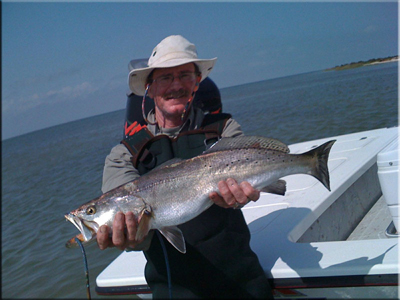
Castaway Lodge Capt. James Eastep putting his guest on topwater trout to 26”, with 24 caught and released.

This week has seen a big run of “big runs” with limits of Redfish pushing outside the slot to 31.5” along with action on broad shouldered schools of Black Drum. Elevated water levels made for some strong concentrations of fish prior to the waxing of the moon. With some strong winds, our emphasis has been on protected back country shallows.

On the Trout scene, Capt. Jake checked a nice box of Trout with Kyle W. and guests taking advantage of a lull in mid-bay winds to work shell reefs in SAB with PCS on Saturday. Capt. James E. checked a whopper Trout and had solid action over shell wade fishing lures with guests Wednesday. James had an awesome day on Trout to 26” catching and releasing 24 keepers. He said the topwater bite was “going off” as water temperatures have warmed.

With tides falling out much of the day and a full moon, the bite definitely changed up from last week. Hesitant, spooky fish made for some challenges but nothing that couldn’t be overcome with some extra effort. Capt. Doug managed to stay hot on solid Redfish working potholes along with Capt. Jake and I. Find a lull in the Redfish action and Black Drum picked up the slack. The under rated bruisers topped off heavy Redfish stringers with sore wrists and big smiles.

Black Drum over shallow flats are fast movers. Redfish will stick to an area despite wide ranging water levels but Black Drum will vacate an area if spooked by falling water. Super skinny water Redfish can be hard to approach and even harder to catch. Finding the right balance between fish concentrations and water depths are keys to success. Barren stretches of back lakes mud flats with sparse emergent grasses and similar pockets along outer lake shorelines are where you’ll find alot of the Redfish and Drum presently. Kicking mud stirs and humped up torpedo vees cutting through the water are a tell tale sign that there looking the structure over for a quick meal.

Bait camps are presently coming flush with live shrimp and a variety of mullet and crab are pretty readily available. I’m expecting a pretty good push of water after the full moon dissipates and that should set the stage for some awesome fishing as we head into the latter part of March heading for April.
– Capt. Kris Kelley  1-888-618-4868

Port O’Connor Fishing Report by Capt. Bob Hill

Archived in the category: Fishing Reports, General Info
Posted by The Dolphin Talk on 23 Mar 11 - 0 Comments

Andy Keeton of Fort Worth fishing with Capt. Bob Hill

I can finally report that the fishing is getting good! After months of really tough weather, all seems to be improving. Fishermen always seem to have a few issues… so, I wish the tides were higher and I wish the wind was a bit more forgiving but, all in all, it’s pretty good.

The bays aren’t giving up many fish but you can catch reds along the grassy shorelines and there are a few trout to be found around the reefs.

The back lakes are still pretty shallow but the tides should be back soon. If you can get back there, you’ll find redfish.

The jetties are still producing good boxes of reds and sheepshead with quite a few small drum as well. I’ve even caught some Pompano this week.

The Big Drum Run is in full swing. Mitchell’s and Saluria are full of the big girls. Be sure you take fresh crabs for bait.

Capt. Bob Hill   Port O’Connor Charters  (361) 983-4325
www.fishportoconnor.com

“Fast and Slick” By Captain Chris Martin

Archived in the category: Fishing Reports, General Info
Posted by Joyce Rhyne on 23 Mar 11 - 0 Comments

Whether you’re hunting, fishing, boating, or just sightseeing, life is simply too short for you to not be able to enjoy and make the most of the precious time you get to spend in the great outdoors. Personal responsibilities to family, friends, and business often makes for quite a hectic lifestyle that can leave almost no extra time for doing whatever it is you like doing the most. Now, and solely for the sake of the discussion here, I’m going to go out on a limb and will assume that this means that for most readers of this article, that they like to fish whenever they may have surplus time that will allow them to do so. And because the chances to fish may be few and far between at times, it’s very understandable for the “occasional” angler to wish to be able to say that they were successful in their endeavor regardless of however brief the opportunity may have been.

For a lot of you out there, this may mean that you’re mentally and physically worn out from having to spend the past several weeks (or maybe even months) putting in eighty or more hours each week on the job site or in the office, while at the same time attempting to juggle your personal life. You have an open weekend coming up in a couple days, and despite your exhaustion, you’ve decided you’re going to go fishing – you’re going to spend several hours after work on Friday driving down to the coast to fish, even if it’s only for one day.

You’ll arrive at your destination late in the night, unpack your things, and then spend some time preparing yourself and your gear for the events of the next morning. You’re dead on your feet at this point and suddenly realize that morning is just around the corner. So, you finally head off to bed, all the while knowing that you’ll still be driven to get up in the early, early predawn hours by the simple thought of catching fish. You are going fishing tomorrow, and you want to actually catch fish!

Mike B. kids love spending Spring Break at Bay Flats Lodge back lakes.

Don’t feel bad if you happen to fall into the infrequent angler category that’s depicted above, as you’re not alone – there are many, many other folks in the same boat! With that said, a lot of sporadic anglers who have only limited time when they do find themselves lucky enough to make it out onto the water are often frustrated at the end of their allotted day simply because they did not (for whatever reason or circumstances) produce the results they so desperately desired. The odds are stacked against them before they even put the boat in the water in that they haven’t been out fishing for quite some time, not to mention the any one of a myriad of other obstacles that may stand in their way on this particular day on the calendar – winds, rain, heat, cold, water temperature, tides, boat traffic, etc.

So, how can one work to beat the odds? Well, it seems as though nothing ever turns out being as easy as you first thought it would be, but there are some simple things you can do that may help you when you’re faced with time constraints. Begin by thinking “outside the box”, so as to not limit your decisions for this one brief day based solely upon those decisions which you made during your last fishing trip. Cruise some protected shorelines that are new to you instead of starting your day by immediately venturing from the dock to the spot where you caught fish last time you went fishing three (or more) months ago – there’s a great chance that the conditions for that area have changed since you were last there.

Another helpful hint for making the most of the little time you have out on the water is for you to pay close attention to, and to look for, specific fish signs and targets. A lot of different things fall onto the list of fish signs like nervous baitfish, shrimp busting the water’s surface, floating pods of mullet, and mud boils along the shallows. But one fish sign that particularly draws my attention during late March and April is slicks. Slicks appear of the surface of the water often in the form of a small, round sheen and are the results of feeding predatory fish – trout, reds, flounder, and yes even hardheads. When the fish, especially trout, are on an aggressive feeding pattern, and when they happen to be feeding on oily baitfish, a slick often forms as a result of the trout regurgitating its meal after filling its stomach to near capacity. While it’s true that slicks have led many anglers to many feeding trout and reds, it’s also just as true that anglers are often led astray by the wrong type of slick.

Clint Truit and family wade fishing with TTF lures in San Antonio Bay.

Many crab traps, especially those found up and down the Texas coastline, tend to put out a similar slick as that of feeding game fish. The crab trap owners often bait the traps with things like menhaden or other oily baitfish, and that in itself often produces a slick from the moment the trap is lowered into the water. There are lots and lots of crab traps in our bay systems, so keep a close lookout for a crab trap marker next time you see a slick nearby. If so, don’t waste your time in stopping to investigate as chances are good that the slick is a product of the trap. A good way to determine whether the slick is a product feeding fish is to be lucky enough to see the slick as it first begins to evolve. Again, a fresh fish slick is generally small and circular in shape, anywhere from the size of a coffee cup saucer to that of a trash can lid. You don’t have time to waste on your one day of fishing, so if the slick appears in a broken pattern and is larger than ten or twelve feet in circumference then continue on your way – focus on the smaller and the more well-formed slicks.

This past weekend was extremely busy at the lodge with the beginning of spring break. We appreciate the Central Houston CCA Chapter members and guest for giving BFL an opportunity. The lodge hosted 20 anglers including board members and guest on Sunday. Wade fishing with lures was the focus and all 6-boats had their way with the red fish. According to Shannon, “All the boats limited out on reds, and we also caught some nice size trout on top water lures, and I heard a very large trout pushing over 27-inches was lost this morning while trying to land it.” We also appreciate Martin G. and guest from Dallas who fished 2-days with us. Monday brings a busy schedule with a 6-boat session.

The Gulf of Mexico Fishery Management Council is soliciting applications for seats currently available on its advisory panels. Working at the grass roots level, advisory panel members provide information and guidance in the development and implementation of federal fishery management plans. Advisory panels are composed of individuals who are engaged in the harvest of, or are knowledgeable and interested in the conservation and management of the fishery or group of fishes to be managed. Members include recreational and commercial fishermen, seafood dealers and processors, conservationists, scientists, and concerned citizens. Advisory panel members serve for two years and can reapply for their positions.

AP members generally meet no more than once or twice each year and are compensated for travel and per diem expenses for all meetings. Applications are now being solicited for the following Advisory Panels: Ad Hoc Aquaculture; Ad Hoc Data Collection; Ad Hoc Mackerel LAPP; Ad Hoc Reef Fish LAPP; Coastal Migratory Pelagics; Coral; Ad Hoc Grouper IFQ; Florida/Alabama Habitat Protection; Mississippi/ Louisiana Habitat Protection; Texas Habitat Protection; Law Enforcement; Outreach & Education; Red Drum; Ad Hoc Review Panel for Red Drum; Red Snapper; Reef Fish; SEDAR NGO; Shrimp; Spiny Lobster; Stone Crab; VMS.

Anyone interested in serving on any of these panels should submit a letter and resume to:
Phyllis Miranda

Gulf of Mexico Fishery
Management Council
2203 N. Lois Ave.
Suite 1100
Tampa, FL 33607

Materials may also be faxed to: 813-348-1711; or e-mailed to phyllis.miranda@gulfcouncil.org.

Resumes and letters should be received no later than close of business April 5, 2011.

Untitled Document