House Lighting Contest

Archived in the category: Announcements, General Info
Posted by Joyce Rhyne on 22 Jan 23 - 0 Comments

We want to congratulate the winners of the Christmas Lighted House Contest. There were so many beautiful homes and businesses! Thank you for lighting up Port O’Connor during the holiday season! Thank you also to our Judges who took the time both evenings to ride around, judging the lights. It’s not an easy task!

Best Overall- Studio 14
Best Christmas Theme- Danny & Terri McGuire,
Best Coastal Theme- Studio 14
Most Colorful- Scott & Tiffany Brown
Best Decorated – Otto & Alane Haardt
Most Unique – Sunny Schumann
Best Commercial – Studio 14
Best RV- name unknown, 16th Street between Adams & Monroe

-Port O’Connor Chamber of Commerce

Christmas in the City by Tanya DeForest

Archived in the category: General Info
Posted by Joyce Rhyne on 22 Jan 23 - 0 Comments
Christmas Program at Seadrift First Baptist Church

Christmas Program at Seadrift First Baptist Church

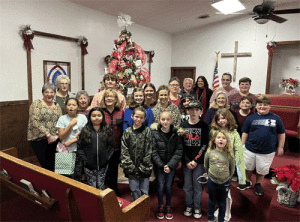
The night of December 21st Seadrift’s First Baptist Church celebrated the birth of our Lord with a beautiful candlelight service! Each congregant held a lighted candle while singing the beloved Christmas carol “Silent Night.” The program, also, entailed Christmas songs sung by the congregation, special music, Christmas scripture passages read by the youth, and Communion. Communion was given by Pastor David Parks to alternating groups of people at the Communion Table. Each group was given a brief devotion by the pastor. It was truly inspiring!
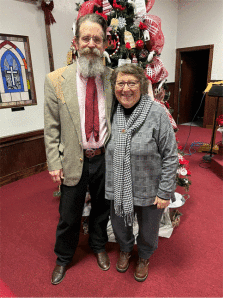
Pastor David Parks is the Interim Pastor at Seadrift’s First Baptist Church. He and his wife Shelley have been in ministry for forty years. They have pastored six churches and interim pastored five. They have one son and three grandsons.
The Christmas program was directed by Vickie Campbell. Her expertise made the program delightful. Vickie, commenting about the program, said, “It was the Lord working through me and we praise His name for the kids who showed up from our kid’s program.”
First Baptist’s youth program “Bible Journaling” has had upwards to forty children and youth in attendance and the program continues to grow!
Author’s note: I was so moved by this program. It was like watching your favorite Christmas movie… only better!

Pastor David Parks and wife Shelley

Pastor David Parks and wife Shelley

Robins… Old and New World Birds by Martin Hagne

Archived in the category: General Info
Posted by Joyce Rhyne on 22 Jan 23 - 0 Comments
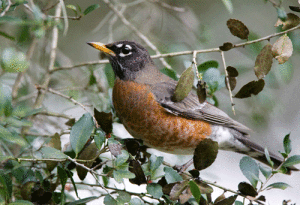
The American Robin is a spring harbinger for many, but here it’s a winter bird. By Mike Williams

The American Robin is a spring harbinger for many, but here it’s a winter bird. By Mike Williams

Most folks have seen American Robins in the winter months along the mid and upper Texas coast, as they regularly erupt south for food when it gets scarce up north. They don’t as much “migrate” as many migrant species do… they erupt. A few species will tough it out up north as long as there is food. But in years when its hard to find forage they move, maybe south, east or west, or even north. Wherever the food is. They are a gregarious bunch, flocking to yards and feeders, town parks, or woodlands.

Robins are in the thrush “family” … and if we look at the original robins… well, they wouldn’t be robins at all! The American Robin was named after the European Robin, a much smaller and not closely related bird species from Europe, and certainly not a thrush. So how did the American bird get named a robin? Well, the European bird has a red breast, is often associated with Christmas holiday cards, etc., and when European settlers moved to North America they missed their little colorful bird and called what they found here, also with a red breast… a robin!

They also managed to physically bring with them House Sparrows (once called English Sparrow), Rock Pigeons, and European Starlings. Once those three species were released here they multiplied well, and are now found over much of the Americas! The settlers also named a few other birds here after the European birds they remembered. Buzzards, as Turkey Vultures were often referred as, got their names from Europeans. Although the Old-World buzzards aren’t vultures at all, but rather hawks! Oh well, small details! There are other examples as well, often confusing folks when traveling either way across the ocean.

Our robins here eat both invertebrates and fruit. In spring and summer, they can often be found pulling earthworms from moist lawns, and picking off insects, and even snails. They also eat a huge number and variety of fruits, berries, and many kinds of seeds, especially in winter when insects and invertebrates are scarce. They seem to feel at home in towns as well as in the countryside, and aren’t normally at all afraid to live alongside us humans. They are a fun bunch to watch as they hop around the grass at the Gulf Coast Bird Observatory, sometimes hovering over the ground looking for a bug, and even sitting motionless looking for a worm, a bit like a heron in water would for a fish.

Enjoy our holiday visitors… most years anyhow! They are certainly here this year!

Endemism by Adam Trujillo

Archived in the category: General Info
Posted by Joyce Rhyne on 22 Jan 23 - 0 Comments
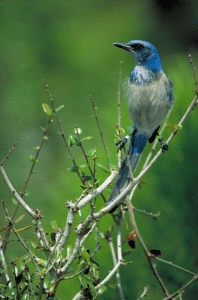
Florida Scrub Jays are one of the few birds endemic to the U.S. Photo credit: USFWS

Florida Scrub Jays are one of the few birds endemic to the U.S.
Photo credit: USFWS

When researching species, either floral or faunal, you can look at a map and find where the particular species resides. Some species have wide ranges of occurrence or winter and summer in different locations. Then there are some species that call only a single geographic place home, whether that home is a single mountain range, an island, or one country in Europe. These are known as endemic species.

Some common examples of endemic animal species include the polar bear, which naturally inhabit the frozen areas of the arctic North Pole, and the lemurs of Madagascar. It’s important to note that I said “naturally” inhabit, so seeing a polar bear at the San Diego Zoo does not count as the polar bear’s range extending into that area.

In the bird world, the Island Scrub-Jay is found only on the island of Santa Cruz off the Southern California coast. The Florida Scrub-Jay can be found only in Florida. While the Island Scrub-Jay and Florida Scrub-Jay are close in appearance to their cousin the California Scrub Jay, they inhabit different areas. The California Scrub-Jay can extend up into Mexico, Oregon and Washington, hence it is not an endemic species.

There are tons of examples of other species being endemic to an area. But there are only 15 species of birds endemic to the continental United States, including both of these scrub jays.
Endemic species face certain challenges given that they inhabit only one area. First, because they live in only a small, specific area, certain physical characteristics may develop that make them only suitable for that one area. For instance, a polar bear needs a big layer of fat and fur to survive in the freezing Arctic conditions. If the polar bears were to be introduced farther South, or if the North Pole gets much warmer, the heavy fur and fat might be detrimental to the bear.
Secondly, these species often have small population sizes, or few separate populations. This means that their gene pool is already small, and any decrease in their numbers could have a huge effect. Third, extinction threats are highest amongst endemic species due to their limited range and reliance on the very specific resources found there. Once those resources are depleted, those species face higher extinction risks.

It’s for these reasons that conservation efforts are being made to protect many endemic species. Some threats, like natural disasters, are out of our control, but reducing climate change conditions, poaching, and habitat destruction are all ways we can help ensure these species can live on. Since there are only 15 species of birds that are endemic to the United States, we want to make sure these species continue on for future generations to see.

On September 1, 2022 the Matagorda Bay Mitigation Trust published a Request for Proposals for coastal environmental projects in five categories: habitat restoration, environmental research, public education, improving public access, and youth camps. In response to the published advertisements a total of 26 proposals, from 19 entities, totaling 10.5 million dollars were received.
Today, Steven Raabe, Trustee of the Matagorda Bay Mitigation Trust, announces that fifteen projects, from twelve entities, totaling over 5.8 million dollars have been approved for funding.
“We are so fortunate to have received some great project proposals and it was difficult for the selection committee to make their final recommendations,” Raabe stated. “But we are extremely pleased with the quality, scope, and cost effectiveness of the proposals selected as a significant step in furthering the mission of the Trust to research, restore and improve the Matagorda and San Antonio bays area environment,” he added.
The projects being funded, by category, are:
Habitat Restoration (Two projects totaling $771,280)
Oliver Point and Oliver Reef Restoration Project, $271,280, Matagorda Bay Foundation
Matagorda Island Gulf Shoreline Erosion and Pass Cavallo Exchange Restoration, $500,000, Coastal Bend Bays and Estuaries Program
Environmental Research (Nine projects totaling $4,128,353)
Microplastic Distribution and Impacts to Diamond-backed Terrapin, Highlighting Public Education and Future Effects of Sea-Level Rise, $500,000, University of Houston – Clear Lake
Sediment Quality Assessment Survey of San Antonio Bay, $416,817, Texas A&M University – Corpus Christi
Evaluating photodegradation products of plastic nurdles and their toxicity in Matagorda Bay, $499,500, University of Texas at Austin Marine Sciences Institute
Reproductive and developmental toxicity of “Forever Chemicals” to Matagorda Bay’s prey fishes, $396,691, University of Texas at Austin Marine Sciences Institute
Micro-plastics water column and sediment residence times: quantifying the cycling and flux between bay waters and sediment, and the burial history of micro-plastics within the Matagorda and San Antonio Bay Systems, $499,985, Texas A&M University – Galveston
Sediment mercury concentrations in the Closed Area of Lavaca Bay and the risk to wildlife from mercury remobilization during dredging, $497,818, Texas State University
Assessing the risk to ecosystem health from increasing nitrogen and phosphorus levels in Lavaca Bay, $454,162, Texas A&M University – Corpus Christi
Assessing the risks of lithium pollution on estuarine fishes, $399,998, University of Texas at Austin Marine Sciences Institute
Assessing multi-trophic impacts of microplastic pollutants across macroinvertebrate food webs in Matagorda Bay, Texas, $463,382, Tarleton State University
Public Education (One project totaling $25,811):
Calhoun County Texas A&M AgriLife Extension Service | Texas Sea Grant | Calhoun County 4-H – Public Education, $25,811, Calhoun County 4H Sportfishing Club
Improving Public Access (Two projects totaling $694,000):
Bulkhead Improvements at Swan Point, $494,000, Calhoun County
Harbor of Refuge Old Landfill Shoreline Erosion Response and Protection – Phase 1
Engineering, $200,000, City of Port Lavaca
Youth Camps (One project totaling $186,213):
Palacios Summer Day Camp, $186,213, Calhoun County YMCA
The effective time frame of these projects ranges from 12 to 36 months.
“With today’s environmental challenges, it is clear that the significance of these projects to the environmental health of the bay area cannot be overstated. These projects will serve our coastal community – and our state – well,” Raabe stated.
Matagorda Bay Mitigation Trust was funded as a result of the settlement of a Clean Water Act lawsuit, San Antonio Bay Estuarine Waterkeeper and S. Diane Wilson v. Formosa. The settlement called for, among other things, the establishment of the Matagorda Bay Mitigation Trust with funding provided by Formosa in the amount of $50 million over a five-year period. The mission of the Trust is to support and fund environmental mitigation projects, studies, and initiatives in the Matagorda Bay and San Antonio Bay ecosystems.
For further information visit the trust’s website at www.MBMTrust.com.
Untitled Document