Week ending March 25

Pre-Kindergarten –Izabella Ureste & Nova Moore
Kindergarten – Jolee Wooldridge & Elijah Velazquez
First Grade –Falen Rivera & Xadie Quintanilla
Second Grade – Waylon Wooldridge & Jaxon Treumer
Third Grade – Yarexzia Anzaldua & Brooklyn Flint
Fourth Grade – Memphis Speer & John Glover
Fifth Grade – Brooklyn Russell & Layla Banda
Gym – Emalyna Pedrotti

Week ending April 8

Pre-Kindergarten – Ezekiel Gohlke & Mateo Vallejo   Kindergarten – Bristol Moyers & Frances Odell
First Grade – Brooklynn Vasquez & Alice Ureste
Second Grade – Dylan Resendez-Montalvo &
Aaron Hartman
Third Grade – Lucas Resendez-Montalvo &
Davian Martinez
Fourth Grade – Randy Thompson & Symone Smith
Fifth Grade – Tyler Saylors & Isrrael Jaramillo
Gym – Haiven Swallow

Chimney Swifts Are Returning For Spring By Susan Heath

Archived in the category: Featured Writers, General Info
Posted by Joyce Rhyne on 14 Apr 22 - 0 Comments
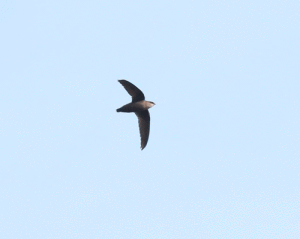
Chimney swifts famously look like cigars with wings.

Chimney swifts famously look like cigars with wings.


Chimney Swifts are one of my favorite birds and I eagerly await their return each year in the spring. I love their chattery calls and that is most often how I am alerted to their presence. When I was first learning about birds, they were described to me as a cigar with wings. They do look like that with their slender tube-shaped body and long narrow curved wings. Those stiff curving wings give then a unique flight style that make them easy to recognize and their aerial acrobatics are fun to watch as they forage for insects in the sky.
Chimney Swifts spend most of their time in the air, and when they perch it is on the side of a chimney, tree hollow, or other upright structure. In fact, they are unable to perch horizontally like other birds. Their short legs, small feet, strong toes and sharp claws aid them in this upright perching style.
While aloft, they forage for insects including flies, bees, wasps, ants, beetles, fleas and most any type of flying insect they can find. They feed over urban and rural habitats alike. Anywhere you find flying insects, you can find Chimney Swifts.
They are common in towns because they use chimneys and other human structures for nesting and roosting. Their populations probably expanded greatly with the coming of European settlements but chimneys are now becoming less common and are often capped, making them inaccessible. So the birds are being pushed back into more traditional nesting habitats such as dead trees, caves, or cliff faces.
The Chimney Swift Conservation Association promotes the creation of nesting and roosting sites with plans on how to build a Chimney Swift tower. We have one at Gulf Coast Bird Observatory and each year a pair of swifts nests there!
Chimney Swifts engage in some really cool aerial courtship displays with the pair flying close together and calling. Then, suddenly, they put their wings into a V shape and glide downward together in a curve before starting all over again.
Once paired, these birds build their nest of loosely woven twigs and sticks stuck together with their glue-like saliva and glued to the wall of the chimney or other structure. They lay three to five eggs and incubate them for up to 21 days. The young are able to fly in another 20 days.
Although they may tolerate unmated swifts sharing their chimney, there will only be one mated pair per chimney or other nest site. Once nesting is complete however, Chimney Swifts gather together in large flocks that roost together at night. It is an amazing sight to see them all flying into a chimney at dusk as if the chimney was vacuuming them out of the sky.
In the fall they migrate to South America for the winter and I wait for them to return each spring! Spring has now sprung, so keep an eye out for those flying cigars!

What’s Up?

Archived in the category: General Info, What's Up
Posted by Joyce Rhyne on 14 Apr 22 - 0 Comments

Sat., April 16    Easter Egg Hunt  2:00 pm   First Baptist Church, Port O’Connor
Sun., April 17    EASTER SUNRISE SERVICES:
6:45 am        Seadrift Bay Front
7:00 am        King Fisher Beach, POC
Mon., April 18    Book Signing, Program- Myra McIlvain
6:00-7:30 pm    Port O’Connor Library
Wed., April 20    Burger Night at Port VFW Post 4403
5:00-7:00 pm    16 Konrad Rd., Port Lavaca
Sat., April 23    Chamber of Commerce Poker Tournament
Seadrift Civic Center
Tues., April 26    Town Hall for POCID Bond Election
7:00 pm        POC School Library
Sat., April 30    BYOBible to the Community BayPraise
6:00 pm         at the bay front (bring a chair, meal provided)
Sat., April 30    POC Crawfish Festival
Opens 10:00 am    King Fisher Beach
Tues., May 3     Bunco
6:30 pm         POC Community Center
Wed., May 4    Burger Night at VFW Post 4403
5:00-7:00 pm    16 Konrad Rd., Port Lavaca
Thurs., May 5     National Day of Prayer
Sat., May 7    Election Day
Sat., May 7    Mother Clucker’s Traveling Market
10:00-3:00    Seadrift Bayfront
Sun., May 8    Mother’s Day
Mon., May 9    Chamber of Commerce Meeting
6:00 pm        POC Library
Tues., May 10    Hooked on Books Club
2:00 pm         alanehaardt@yahoo.com
Sat.,May 14    Farmers Market
8:00 am -Noon    Kingfisher Beach Pavilion
Sat.,May 14    Help Plant 7,000 Flags for Warrior’s Weekend
begin 8:00 am    Port O’Connor Community Center
Sat., May 14    Children’s Program:  Arts and Crafts
10:00-11:30 am    Port O’Connor Library
MAY 20    WARRIOR’S WEEKEND Begins
Weekly Meetings:
Every Saturday    Friends of Bill W
7:00 pm        POC Baptist Fellowship Hall
Every Wed.    Coffee and Conversation
9:00 am        POC Library Multipurpose Room
Every Thurs.     POC Bridge Club
1:00.-3:00 pm    POC Library Multipurpose Room
Every Friday:     Mahjong
1:00-3:00 pm    POC Library Multipurpose Room
Every Friday:    S.M.A.R.T. Recovery
6:00 p.m        POC Library Multipurpose Room

Little Jetties Improvement

Archived in the category: Announcements, General Info, Organizations
Posted by Joyce Rhyne on 17 Mar 22 - 0 Comments

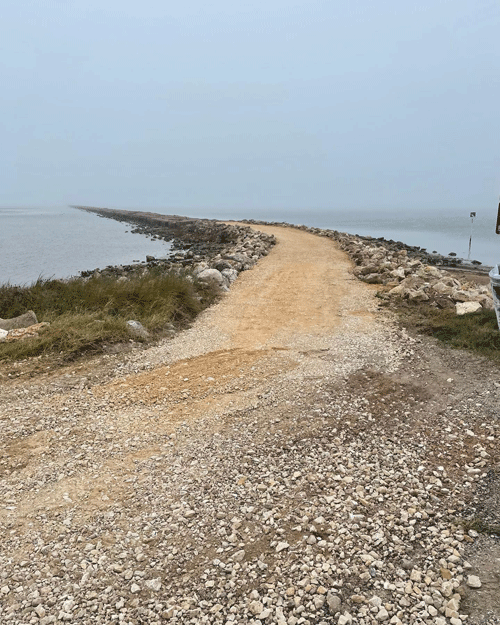
jetties-after

The Port O’Connor Chamber of Commerce is very excited to announce that Phase One of the Chamber’s Little Jetties Project is complete. Phase Two is now underway. Thank you to Commissioner Gary Reese and his team for all their help.

Over 1000 Abandoned Traps Removed from Mid-Coast Bays

Archived in the category: Announcements, Events, General Info, Organizations
Posted by Joyce Rhyne on 17 Mar 22 - 0 Comments

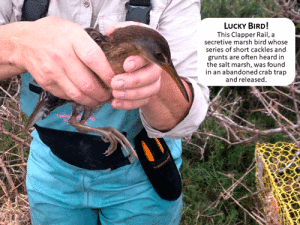
Clapper-Rail
Abandoned crab traps are unsightly litter, navigation hazards and they can entrap and kill crabs, fish, and turtles (ghost fishing) and land-based animals too when washed ashore. This is why in 2001, the Texas Legislature passed Senate Bill 1410 creating a ten-day crab trap closure that begins the third Friday of each February. During this year’s closure period (February 18-27, 2022), volunteers and agencies scoured Aransas, San Antonio, and Matagorda Bay systems in a coordinated effort to locate and remove derelict crab traps. Despite six of the ten days being lost to bad weather, a total of 1047 traps were removed. This was a result of the effort performed by 184 people and 61 boats. In 2021 and 2020, 1203 and 1632 traps were removed, respectively.

The location, content and ownership of each trap is documented on a phone app which displays on a shared map. Full analysis of this data will help inform future efforts to reduce trap dereliction. Allan Berger, who coordinated the cleanup effort for San Antonio Bay, made the following observations of this year’s results:
• Most of the traps removed were at the shoreline or on shore, the result of high winds and tides during Hurricane Nicolas.

• Winter Storm Uri killed mangroves which exposed older traps on the shoreline.

• Traps removed from open water were down significantly from previous years due to diligent efforts by commercial crabbers to pick up their traps prior to the closure period.

• Bad weather hampered cleanup efforts. Only 4 days offered workable weather, leaving several areas unsearched.

The volunteer activities were coordinated by the Mission-Aransas National Estuary Research Reserve, the San Antonio Bay Partnership, and the Matagorda Bay Foundation. Boats and volunteers came from numerous local organizations: CCA chapters, GBRA, LNRA, GBR Trust, TPWD, USFW, TMN, CBBEP, UTMSI, ICF, Dallas Zoo, Texas Sea Grant, and concerned citizens. Special thanks to the Calhoun High School Navy ROTC students and Madden Guevara, president of the Calhoun County 4-H Sportfishing Club for manning the TPWD Dock in Port O’Connor to unload boats and process the cleaner traps for metal recycling.

For the past two years the cleanup has been funded by a NOAA Marine Debris Removal grant obtained by the Coastal Bend Bays & Estuaries Program and supplemented by local sponsors Guadalupe Blanco River Trust and Guadalupe Blanco River Authority.
Berger emphasizes that the program’s success is due to the efforts of the volunteers and agencies noted above, as well as the commercial crabbers’ efforts to improve management of their traps. Together, we can keep our Bays clean and productive. To sign up for notifications related to next year’s efforts, contact Allan Berger at AllanRBerger@outlook.com.

-Brigid Berger
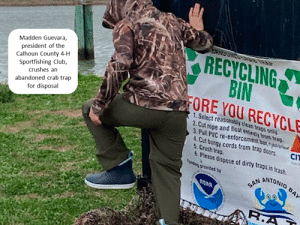
Madden

Untitled Document