Happenings at First Baptist Church by Diane Cooley

Archived in the category: General Info, Organizations
Posted by Joyce Rhyne on 20 Jan 22 - 0 Comments

Save the date!! Thursday, February 10, 2022, at 6:00 pm, is the evening FBC will be celebrating the 25th Sweetheart Banquet. The event originally started as a small gathering for FBC members. Over the next few years, it outgrew the church Fellowship Hall, started including anyone who wanted to come and was moved to the Community Center. Many people have celebrated Valentine’s Day, dined on great food and been entertained at those banquets. This 25th banquet will carry  on those traditions. Come join us for this special evening. For tickets, you can call the church at 983-2727 or visit First National Bank in POC.

Team Kids is continuing to be a big draw for POC children. Every Wednesday from 5:30 p.m. until 7:00 p.m., over 20 children meet at FBC to have dinner, sing, do crafts and, most importantly, learn about Jesus. Our church van picks up a full load of children each week. If you have a child, pre-K through 5th grade, that would like to be part of Team Kids, call FBC to arrange for pick up.

The POC Food Pantry continues to have a need for donations of non perishable food or cash. FBC helps with collections and Fisherman’s Chapel distributes the donations as needed. Pray about supporting this worthy cause. These trying times have caused hardships for so many.

We are also already starting to collect items for this year’s Shoe Box Project. In November, 2021, we were able to deliver 200 filled boxes to be sent around the world as Christmas blessings. Thank you to everyone who donated last year. Now it’s time to start again! Small toys, school supplies, soap, wash rags, small books, etc. are some of the items we are already collecting. Our goal this year is 250 boxes! We can do it!

Pastor Phillip Miller and the friendly people at FBC are waiting to welcome you to any or all of our weekly services and events. Come join us.

Sunday at 9:00 a.m., Sunday School and 11:00 a.m. and 6:00 p.m. church.
Tuesday 4:00 p.m. Ladies Bible Study and 7:00 p.m. Men’s  Bible Study.
Wednesday 5:30 p.m. Team Kids and Youth Activities for grades 6 through 12 start at 6:00 p.m., as well as our regular mid-week service.
Happy Birthday, Lillian Stubbs!

Archived in the category: Announcements, General Info
Posted by Joyce Rhyne on 20 Jan 22 - 0 Comments
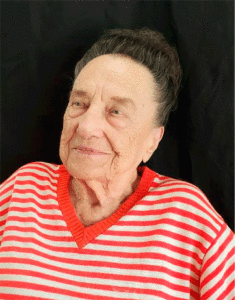
A birthday is a special time to let people know that they are just so mighty fine! Whether you have five or whether you have fifty, Just remember, too, that God thinks you are mighty nifty!! (Lillian Stubbs of Seadrift turns 97 February 3!)

A birthday is a special time to let people know that
they are just so mighty fine!
Whether you have five or whether you have fifty,
Just remember, too, that God thinks you are mighty nifty!!
(Lillian Stubbs of Seadrift turns 97 February 3!)

Boater Education Class

Archived in the category: Announcements, Events, Fishing Reports, General Info
Posted by Joyce Rhyne on 20 Jan 22 - 0 Comments

Calhoun County Fairgrounds – February 26, 2022

Now is the time to go through your boat and make sure your safety gear is ready for another season.  Check your life jackets to make sure that they are not torn or faded, which could mean that the fabric has been weakened.  If you have any doubt, replace it.  Take a good look at your fire extinguisher and make sure that the indicator needle is still pointing to the green area of the gauge.  Look at the expiration date on your flares and if they are going to expire within the next year replace them now so you don’t forget to do it during the fishing season.  If you were born after September 1, 1993 and you do not have the TPWD Boater Education Certification now is the time to take care of it.  Even if you were born before 1993 it never hurts to review boating safety.  It might save your life or the life of one of your family members or friends.  The Texas A&M Agrilife Extension Service/Texas Sea Grant Boating Safety Series will have a classroom and hands-on Boaters Education Course on February 26, 2022, from 9:00am – 3:00 pm at the Calhoun County Agriculture Building in Port Lavaca.  Successful completion of this course will provide the participant with the Texas Parks and Wildlife Department (TPWD) Boaters Education Certification.  The TPWD Boaters Education Certification is required for anyone born on or after September 1, 1993 who operates any vessel over 15 horsepower, wind-blown vessel over 14 feet and all personal watercraft.  Participants should dress for the weather on the day of the class.  Expect to be outside for 2-3 hours.  Professional Mariners from several Local, State and Federal Agencies will be on site to assist in providing hands-on boating safety.  The cost of the course is $20 which is due at the door.  Participants must register for the class at https://tpwd.elementlms.com/course/boater-education-classroom-course-1543 .  Lunch will be provided courtesy of Coastal Bend Marine.  If you have any questions, please contact Capt. RJ Shelly at the Calhoun County Texas A&M Agrilife Extension Service office (361) 552-9747 or rj.shelly@tamu.edu.

Crabbing Closure February 18-27

Archived in the category: Announcements, Fishing Reports, General Info
Posted by Joyce Rhyne on 20 Jan 22 - 0 Comments


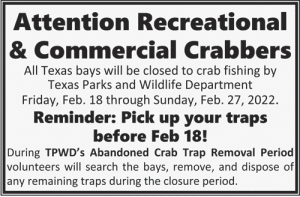
Crab-Trap-announcements-DTBAY-RAT

MOTUS Tracking Birds with Tech by Martin Hagne

Archived in the category: General Info
Posted by Joyce Rhyne on 20 Jan 22 - 0 Comments

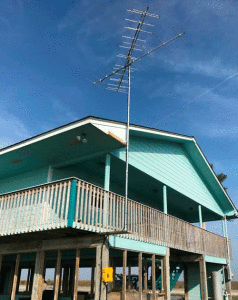
Motus towers are places along the Texas coast to receivedmigration data form birds crossing their paths. Photo by Susan Heath, GCBO

Motus towers are places along the Texas coast to receivedmigration data form birds crossing their paths.
Photo by Susan Heath, GCBO


For decades, bird biologists have been trying to track the movements of birds in numerous ways. Finding bird migration paths, breeding grounds or wintering grounds was not always an easy task. Today we still don’t know where some birds go. Banding birds with fine metal bands on their leg with an individual number was one way to keep track of them. But that required someone else to re-catch that bird somewhere. Monitoring sites suspected of being a winter habitat was labor intensive and expensive and could take years.

Along came modern tracking technology, and before long it was adapted for wildlife tracking. Bears and wolfs were fitted with GPS location trackers, and similar devises were used for other animals. Whales and sharks were tagged with little sensors, and sea turtles had GPS trackers glued to their shells. And eventually technology produced smaller and smaller devices that could be fitted on large birds. Eagles and hawks were tracked for up to 2 seasons showing their long, often meandering, flights in migration. But until more recent years it was not possible to do so with smaller birds due to the weight of the device.

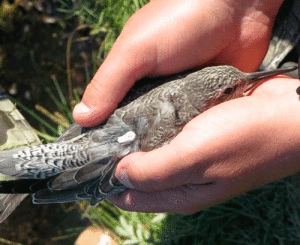
The Motus Wildlife Tracing System was developed in Canada by Birds Canada in partnership with collaborating researchers and organizations. Motus is Latin for “movement”, an appropriate name for this system. Motus is now an international collaborative research network that uses a coordinated automated radio telemetry array to track the movement and behavior of small birds and other organisms affixed with digitally-encoded radio transmitters (nano-tags). These tags broadcast signals several times each minute. The signals are detected by automated radio telemetry stations that scan for signals 24 hours a day, and 365 days a year. When results from many stations are combined, the array can track animals across a diversity of landscapes covering thousands of miles.

Radio telemetry uses radio signals, which are made up of invisible and silent electromagnetic waves, to determine location. A radio telemetry system is made up of three parts: a radio transmitter (in this case a very small radio transmitter called a nano-tag), a radio antenna (looks like an old roof TV antenna), and the radio receiver and computer gear that records it.

Gulf Coast Bird Observatory and the Texas Midcoast National Wildlife Refuge Complex initiated a Motus project in 2016 to establish a network of Motus Towers along the Texas coast. We worked with partners to install 15 Motus towers creating a “fence” which migrating birds will pass through during spring and fall migration. These towers are augmented by two to the north and four to the south which nearly completes a network along the entire Texas coast. Birds outfitted with nanotags that migrate through this “fence” will be picked up by the towers and the data will be recorded.

So why does all this matter? One reason is to learn the migratory paths and timing of bird species. For neotropical migrants, we spend a lot of effort saving habitat on their northern breeding grounds and in their southern wintering grounds. But unless birds have stopover sites to rest and feed during migration, they will never complete that migration. Without migration, there wouldn’t be any of the beautiful birds that return to the U.S. each spring to breed. Knowing what areas and sites are the most important for migratory birds is crucial so we can also try to save those sites. That is getting harder and harder to do as birds often use coastlines, which are being rapidly developed.

So, if you ever see what looks like a TV antenna on a coastal refuge or sanctuary, or maybe even on a house, it may very well be one of our Motus towers silently monitoring bird migration data!

A tiny Nano tag that emits a signal is attached to birds. Photo by Susan Heath, GCBO

A tiny Nano tag that emits a signal is attached to birds.
Photo by Susan Heath, GCBO

Untitled Document