Condolences – Steven James “Styme” Saenz

Archived in the category: General, Obituaries
Posted by Joyce Rhyne on 17 Jan 25 - Comments Off on Condolences – Steven James “Styme” Saenz

Steven James “Styme” Saenz, 51, of Port O’Connor passed away January 4, 2025.  He was born February 9, 1973, in Houston to Manuel R. Saenz Jr. and Mary Helen Saenz.  Styme worked at Speedy Stop and Walmart and was a Catholic.

He is survived by his mother; sisters, Maria Saenz and Jeanette Chavez Hernandez; brother, Manuel Saenz III; he was a devoted loving uncle to his nieces and nephews, and leaves many extended family and friends to cherish his memory.

He was preceded in death by his father and grandparents, Manuel Saenz and Aurelia Ramos Breeden, and Jesse Ramirez and Victoria Ramirez.

Funeral Mass was Monday, January 13, 2025, at 10 a.m. at St. Joseph’s Catholic Church in Port O’Connor.  Burial will follow in Port O’Connor Cemetery.

Pallbearers were Calvin Ragusin, Jose Ernesto Chavez Jr., Christopher Allen Saenz, Ricco Dante Saenz, Luis Alejandro Torres, Jaidence Pierce Villarreal and Jorge E. Torres Jr.

Words of comfort and special memories of Styme can be shared with the family at www.richardsoncolonial.com.

A Life Well-Lived: Virgil Dixon Price

Archived in the category: General, Obituaries
Posted by Joyce Rhyne on 17 Jan 25 - Comments Off on A Life Well-Lived: Virgil Dixon Price

July 24, 1946 – December 19, 2024

Virgil Dixon Price, Jr., of Port O’Connor, Texas, passed away on December 19, 2024, after a recurrence of metastatic melanoma. Born on July 24, 1946, in Gladewater, Texas, Virgil lived a life rich in purpose, love and adventure.

Virgil is survived by his loving wife of 48 years, Ursula Kalina Price, whose partnership and love helped him achieve his dreams. Together, they raised a family and a built a legacy of hard work, resilience, and deep connection.

Virgil leaves behind three children who were the pride of his life: his daughter Kelly Sudderth (of Gunnison, Colorado) and her husband David, along with their children Lily, Joseph, Caroline, and Wesley; his son Vincent Price (of Vanderbilt, Texas) and his wife Tracee, along with their children Luke and Paige; and his daughter Colleen Eckermann (of Lampasas, Texas) and her husband Derrek, along with their children Layton and Cora. He is also survived by many extended family members and close friends who will cherish his memory. He is also survived by his sister Pat Putnam, of Highlands, Texas.

Virgil was preceded in death by his mother, Wilda Sue Williams Kavitt, and his sister, Andrea Shanks.

Virgil proudly served his country with honor in the Army during the Vietnam War. After returning home, he dedicated over three decades of service to the U.S. Postal Service. Virgil was born to farm. He and Ursula bought their first farm in Ben Arnold, Texas, in 1976. They raised their family on that farm, and as farming families know, there were lots of good times and bad. Virgil and Ursula never gave up, and after Virgil retired from the post office, they began moving their life (and eventually the farm) to the Texas Coast.

Retirement was not a time of slowing down for Virgil—it was a time of living life to the fullest. With Ursula by his side, he chased his dreams with determination, traveling the world, exploring their love of wine by visiting the word’s greatest wineries, and building a vibrant life and community in Port O’Connor, Texas. He especially loved visiting wineries in Europe, discovering new wines and visiting with winemakers. He loved visiting the museums, monuments and churches of Paris and was always ready to share travel tips with family and friends. Virgil was happiest when surrounded by family and friends, whether hosting gatherings, building projects with his own hands, or sharing a glass of wine while swapping stories.

He was a devoted father and grandfather who rarely missed a school performance, sports event, or holiday gathering. His grandchildren will remember him as their biggest cheerleader and an endless source of love and support.

Virgil loved farming, the Texas Coast, the Colorado mountains, France, traveling, trying new wines, and, most of all, being with those he loved. With hard work, perseverance, and Ursula by his side, he turned dreams into reality.

His family and friends will remember Virgil as a quiet man who was hard-working, honest, and steadfast in his love. His legacy lives on in the countless lives he touched and in the memories of a life lived with purpose, adventure, and an unwavering devotion to family.

Visitation was at 9 am on Monday, December 23, 202, at St. Mary’s Catholic Church in Praha, Texas, followed by a rosary at 9:30 am and a funeral mass and burial at 10 am. A BBQ luncheon – one of Virgil’s favorite meals – followed at the parish hall. All are invited.

In lieu of flowers, the family requests that donations be made in Virgil’s memory to the Port O’Connor Volunteer Fire Department, Gunnison Valley Hospital Paramedics Training Fund, (https://www.gunnisonvalleyhealth.org/foundation/ways-to-give/ ), or Lampasas County Young Life, (https://giving.younglife.org/s/), or The Harbor Children’s Alliance and Victim Center (https://www.paypal.com/us/fundraiser/charity/2429464).
City of Seadrift Announcement

Archived in the category: General, Organizations
Posted by Joyce Rhyne on 17 Jan 25 - Comments Off on City of Seadrift Announcement

Would you like to run for office? The city of Seadrift is looking for a few good women and men who would like to run for the mayor’s position as well as a chance to be on city council.

A lot of changes have taken place with the city since Mayor Elmer DeForest had retired last May. Perhaps you can come on board and help the city navigate through the change!

Aside filling the vacancy for the mayor’s slot, three city council positions will be open. You can pick up your application at city hall starting January 15. The deadline to apply is February 14.

Honoring Our Veterans by Tanya DeForest

Archived in the category: General
Posted by Joyce Rhyne on 17 Jan 25 - Comments Off on Honoring Our Veterans by Tanya DeForest

Honoeinf-our-vweterans
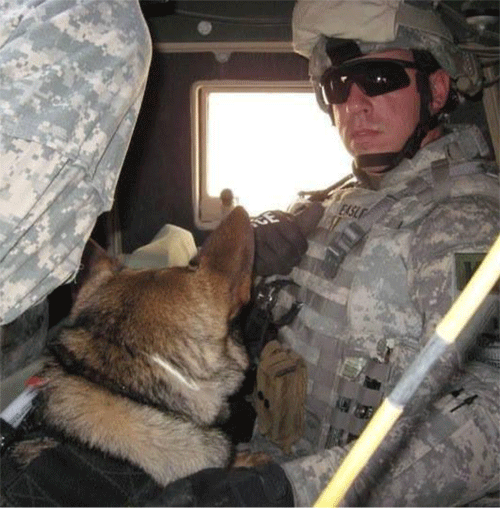
You may not recognize this soldier in this picture. He is serving our country in Iraq. The furry friend is a military working dog and the soldier is his handler. You know him as Seadrift PD Patrolman James Easley, Jr. In the picture he is USN Master at Arms 2nd Class Petty Officer James Easley, Jr. Officer Easley served in the Navy from 2003 to 2014. We salute his service and honor his commitment to fight for our country. How blessed we are as a nation to have these men and women put their lives on the line for our freedoms!

James served on the USS Benfold from 2003 to 2005. In 2005-2009 he served in Yokosuka, Japan with the Commander Fleet Activity and worked with the military police. In 2009-2010 he served in Iraq as a military working dog handler that you see in the picture. James finished out his service state-side.

A Hidden World of Color by Hannah Beckett

Archived in the category: Featured Writers, General, General Info
Posted by Joyce Rhyne on 17 Jan 25 - Comments Off on A Hidden World of Color by Hannah Beckett
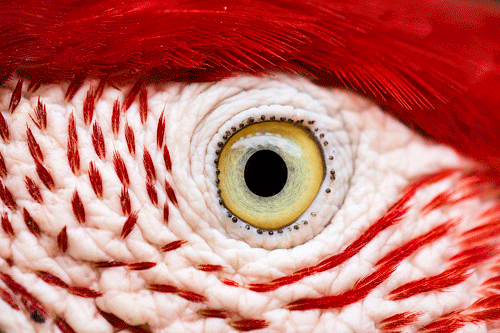
Photo: A macro shot of a red-and-green macaw's (Ara chloropterus) eye, Serra da Capivara National Park, Piauí state, Brazil. Credit: Leonardo Ramos, Public domain, via Wikimedia Commons

Photo: A macro shot of a red-and-green macaw’s (Ara chloropterus) eye, Serra da Capivara National Park, Piauí state, Brazil.
Credit: Leonardo Ramos, Public domain, via Wikimedia Commons

The beautiful hues and plumes of birds have long drawn the attention and interest of mankind. But, do we really know the true spectrum of avian coloration and vision? The answer may lie in the unique biology of a bird’s eye.
While all animals see a portion of the electromagnetic radiation emanating from the sun, which portion of the spectrum is perceived varies among species. Humans detect light with three different types of retinal cone photoreceptors for red, green, and blue light. This allows us to see light from wavelengths of roughly 400 nanometers (violet) to 700 nm (red), but not the longer (infrared) wavelengths or the shorter (ultraviolet) wavelengths. Our vision is thus “trichromatic.”

In contrast, may birds have “tetrachromatic” vision. They have red, green, and blue cones similar to our own, but they also have a cone enabling them to detect wavelengths in the ultraviolet range (300–400 nm). With the exception of the nocturnal species, the eyes of avians are able to see ultraviolet “colors”. Since birds rely on vision to choose mates, find food, and scan for predators, how might this knowledge of enriched UV vision affect what we already know about birds?

The past few decades have seen a flurry of studies testing the premise of how bird behavior may be shaped by the secret visual signals humans cannot see. Research involving European Starlings found the normal sexual monomorphism (males and females of a species look identical) appeared different when the color of UV reflectance was measured. The researchers found females used UV cues to choose males as mates, suggesting the difference is from sexual selection.

In the case of the common and well–studied Blue Tit bird, the male and female appear visually identical to the human eye. However, when viewed under UV light, males have UV-reflectant crown patches. These are used in the avian community to identify males from females. Studies found that females preferred bright-crowned males. This sexual dichromatism under UV light appears in about 70 percent of songbird species once thought to be sexually monochromatic. These studies fill in missing pieces of the puzzle of why certain species, whose males and females look the same, displayed such intense sexual selection and mate assessment.

Ultraviolet vision and reflectance play roles not only in interactions among birds, but also in interactions between birds and their environment. Ultraviolet patterning on flower petals may attract pollinating hummingbirds. Many fruits and seeds use UV reflectance to advertise themselves to seed-dispersing birds. The use of UV color range in insects may play a role in avian foraging as well. Some birds of prey have been shown to use the UV reflective urine of rodents to follow the inconspicuous trails of their prey through the tall grass.

Knowing what an animal really sees is a crucial step toward understanding its behavior. Many behavioral and ecological studies are now taking into account the differences between avian and human vision. Scientists using technology to view, describe, and experimentally alter avian plumage in the UV range have already reinterpreted signaling among birds in several systems. As technological equipment becomes more available and affordable, ornithologists may be able to better understand the world of avian ecology.

Untitled Document