Bay Flats Lodge Resort by Capt. Chris Martin

Archived in the category: Fishing Reports, General Info
Posted by Joyce Rhyne on 19 Nov 20 - 0 Comments
"Braggin' Rights" Bay Flats Lodge

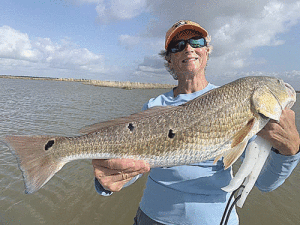
“Braggin’ Rights”
Bay Flats Lodge

November is generally the initial month for some fairly noticeable transitions along the Texas Gulf coast. This means we should have already experienced a couple significant cooling trends, and air and water temperatures will have already begun to drop as a direct result. Along with changing weather conditions, we will begin to experience other types of transitions, as well. The first transition, this month will be the incorporation of Daylight Savings Time, which means we’ll begin seeing less daylight with each passing day. We’ll be officially entering into the wintertime months, so another change would be that we should learn to expect a greater potential for foul weather as we proceed into colder months. Another transition will be the fact that trout and reds will now begin looking for mud and grass or mud and shell instead of sand. The sand is great for spring and summertime conditions where the fish are looking for the warmth of the sun to reflect off the sand, but when the days turn cold those fish are going to be looking for warmth that can only be radiated and stored by that of thick, black mud.

Another transition taking place this month will be the metabolism of the fish. As early as two or three weeks ago these fish were probably eating a meal at every opportunity, or whenever they had a craving to do so. Once the temperature of the wind and the water have dropped considerably, so too shall the feeding periods for the fish. Fish often get quite lethargic during the colder months of the year, and their feeding pattern slows down greatly as a result. They would probably much rather eat one large meal instead of expounding the energy of eating several small meals throughout the course of each day. This is the very reason why anglers should always cast to a single mullet jumping in the wintertime. More times than not, the single mullet that is jumping is really big and is being slowly chased by a really hungry trout or redfish that’s looking for their one, single meal for that day.

Your choice of artificial baits should also begin a transition in November. As mentioned earlier, the fish are sometimes chasing one large meal per day, so you should start tossing much larger surface baits beginning in November. In doing so, you should also begin slowing your retrieve to a snail’s pace, often raising the tip of the rod only once or twice in a 10-15 second period. Also, begin using darker baits this month as they tend to portray a much more distinctive silhouette and work exceptionally well in low-light conditions. Until next time, tight lines to all!
Cast & Blast by Capt. Stephen Boriskie

Archived in the category: Fishing Reports, General Info
Posted by Joyce Rhyne on 19 Nov 20 - 0 Comments
"Two Aces" Bay Flats Lodge

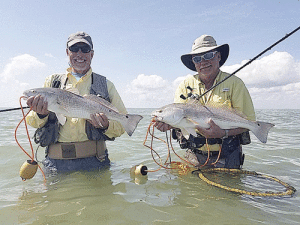
“Two Aces”
Bay Flats Lodge

Fishing the bay was solid the second half of October! Limits of speckled trout and redfish have been common and we are blessed to have such a great fishery. As we turn the calendar we are entering my favorite time of the year for outdoor adventures here at Bay Flats Lodge.
The 2020-2010 duck season is upon us and signs are this is going to be another great year water fowling on the middle Texas coast. We have experienced several strong cool fronts already and as we are out fishing we are seeing solid flights of our favorite duck species including Teal, Redheads, Pintail, Gadwall and many others.

We will be running both fishing and duck hunting trips during the next three months and we are looking forward to some healthy stringers of fish and straps of ducks! The best way to enjoy this magical season is our Blast N Cast! Don’t like the order of the title, then do a Cast N Blast! Sometimes it’s better to sleep in and fish the morning then hunt the afternoon until the sun sets. Either way once you spend your hard earned dollars on a full day of outdoor fun with us on the salt water fishing and duck hunting, you will wonder why you haven’t joined us in the past, and quite possibly make arrangements to book that trip again-even a year in advance! This combo makes a great gift for your family, it makes the perfect venue for a corporate thank you to customers and it’s a good team building outing for the customer looking to deepen employee loyalty and boost morale.

Redheads and Redfish! My mantra this time of year tends to be just what that implies, on the duck hunt we commonly take good numbers of our most populous species, the Redhead duck, in addition to the other species of course. Then on the fishing there’s a good chance we we will be on some Redfish in addition to Speckled Trout. Come see us soon and get in on this action…Blast N Cast!

Capt. Stephen Boriskie
Bay Flats Lodge

First Place Winners

Archived in the category: Fishing Reports, General Info
Posted by Joyce Rhyne on 19 Nov 20 - 0 Comments
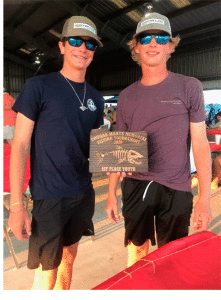
Will Wleczyk & Kaden Rohan (both from Richmond, TX) won First Place in the “Cougar Moats Memorial Fishing Tournament” Youth Division on 10/10/2020.   Will is the Grandson of Otto & Alane Haardt of POC.  Congratulations, Guys!!

Will Wleczyk & Kaden Rohan (both from Richmond, TX) won First Place in the “Cougar Moats Memorial Fishing Tournament” Youth Division on 10/10/2020.
Will is the Grandson of Otto & Alane Haardt of POC.
Congratulations, Guys!!

Feeling Ducky? by Susan Heath

Archived in the category: Featured Writers, General Info
Posted by Joyce Rhyne on 19 Nov 20 - 0 Comments
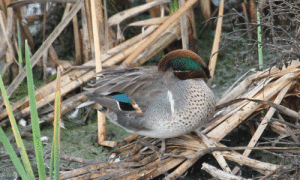
The Green-winged Teal is one of the more common dabbling ducks. -Photo by Sue Heath

The Green-winged Teal is one of the more common dabbling ducks.
-Photo by Sue Heath

Now that the cooler weather is here, it’s time to get out and get some fresh air and exercise. November is a great time to go in search of wintering waterfowl. The Texas coast regularly hosts three to five species of geese and 20 species of ducks during the winter. The most common geese are Greater White-fronted, Snow, and Ross’s.

Greater White-fronted Geese are often called “speckle bellies” by the locals because they have black splotches on their stomachs that are visible when the birds are in flight. These geese are light brown with orange beaks. Snow Geese come in two colors, white and blue. Both have black wing tips. Ross’s Geese look just like white Snow Geese, only they are about half the size.

You can find all three of these geese in mixed flocks in farm fields where they feed on waste grain during the winter. Sometimes you can find Canada and Cackling Geese in these flocks too, but they are getting rarer and rarer because these geese are staying farther north for the winter. They are abundant in the Panhandle.

Canada and Cackling Geese are brown with black bills and they are often called “cheeked geese” because they have a white chin strap that makes their cheeks white. As with Snow and Ross’s Geese, Cackling Geese have a similar appearance to Canada Geese but they are smaller. While you’re out there looking at the geese, don’t forget to look for Sandhill Cranes. They aren’t waterfowl but they are beautiful to see and the evening show when they come in to roost can be spectacular!

Ducks are divided in two main groups, the dabblers and the divers. Dabbling ducks tip up in shallow water to pull food from the bottom of the pond. You can often see their rear ends sticking up in the water as they feed. Common ducks in this category are Blue and Green-winged Teal, Gadwall, Mottled Duck, Mallard, American Wigeon, Northern Shoveler, Northern Pintail, and the gorgeous Wood Duck. The Wood Duck is secretive but can often be spotted in small ponds and wetlands.

Diving ducks live in deeper water and dive under the water to catch fish or other animals or to pull vegetation from the bottom of the pond. Common diving ducks found along the coast include Ring-necked Duck, Lesser Scaup, and Ruddy Duck. Other less common diving ducks include Common Goldeneye, Bufflehead and Hooded Merganser. Sea ducks are diving ducks that are found in salt water. The most common one found here is Red-breasted Merganser.

There are several other species of birds found on ponds and lakes here that are often included with ducks but they aren’t waterfowl at all. The American Coot is an all gray bird found in huge flocks that is actually part of the Rail family. Pied-billed Grebes are also found here in large numbers. They are brown with a bi-colored bill and are part of the Grebe family.

These are just a few of the birds found on local water in the winter. Take some time one weekend to see how many of them you can see!

Make Your Own Christmas Wreath

Archived in the category: Announcements, Events, General Info, Organizations
Posted by Joyce Rhyne on 19 Nov 20 - 0 Comments

COME-JONT-THE-FUN

Untitled Document