Bay Flats Lodge Report by Capt. Chris Martin

Archived in the category: Fishing Reports, General Info
Posted by Joyce Rhyne on 17 May 19 - 0 Comments

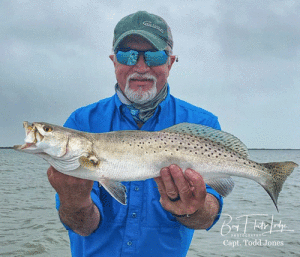
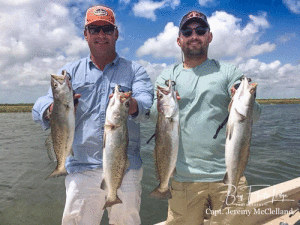
Photo-#2 It’s May, and in the cooler months leading up to now the guides have been finding pre-spawning trout scattered throughout much of our entire San Antonio Bay system, to include lower salinity areas like that of many of our inland estuaries and rivers. However, and as we progress through this month, most all of the trout that are large enough to spawn should soon begin congregating in the larger, more prominent bays. Contributing heavily to these spawning activities also are May’s water temperatures and the length of the days during this month. Needless to say, the spawn will turn-on in full force this month and, consequently, so will the trout’s appetite.

Now then, when we talk about spawning trout, we’re talking about larger-sized female trout. In their younger years, these females probably feed mainly on shrimp and other small crustaceans. However, as they reach their third and fourth years of life, they probably start eating small baitfish like glass minnows, and such. But, as these “big gals” continue to grow, their favorite food becomes larger baitfish like that of mullet and croaker. This is the reason why avid live-bait anglers start looking forward to May, as this is when croaker fishing kicks-off, with their primary targets being areas associated with sand and shell mixtures, or grass-lined potholes if they can find them.

For the artificial enthusiasts, May generally marks a couple of different types of annual regimens. The first being that this will be the month that die-hard wading anglers will no longer need to wear their neoprene or breathable chest-waders, and the second is that regular success on top water baits probably isn’t too far off in the future. It’s in May when anglers should toss smaller top water baits in calm, shallow waters, and larger and noisier surface walkers in heavier chop over deeper water. If you don’t find the bite on top, throw a suspending-bait in the lower portion of the water column until you draw a strike. Regardless, the month of May can’t be beat for having fun. It’s just that simple!
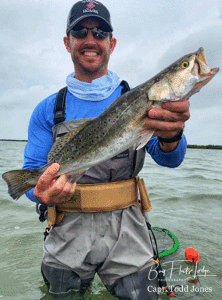
Photo-#1Photo-#4

Who Do You Use? by Capt. Stephen Boriske

Archived in the category: Fishing Reports, General Info
Posted by Joyce Rhyne on 17 May 19 - 0 Comments
Fishing with Capt. Stephen Boriske

Fishing with Capt. Stephen Boriske

It’s time to get out on the salt water and get in on the action because it is about to go wide open down here on the middle coast of Texas. May is one of my top three months to fish with customers because the action is almost non-stop given our normal weather with winds in the 10 to 15 mph range and partly cloudy days. Warm temperatures both in the air and the water set the stage for hot action with Speckled Trout being the main focus using a variety of angling methods with live shrimp in abundance and decorating my hooks under 4Horsemen popping corks.

Look for feeding slicks to start popping up all over the bay from the back lakes to the shell reefs to the skinny flats which are signs these trout are working the bait over and feeding their appetites as they spawn for the first few times of the year. These fish need to keep themselves in top shape for this exhausting activity as they are producing future trout populations in the millions. It’s a good time of the year to be out drifting a boat using a myriad of bait to box some good trout for the dinner table. I’m often asked what my favorite fish to eat is and hands down it’s trout lightly battered and fried to perfection! The key on cooking fish and other delicious bay fare is not to overcook it. Hot grease and a hot pit with turn those fried fish and shrimp or half-shell redfish into your next meal quickly so keep an eye on it or you will end up with a rubbery mess.

A phrase I hear almost every trip with our customers, who are largely down here at the lodge doing business by entertaining their customers, is ‘who do you use?” Who do you use for shingle purchases? Who do you use for a title company? Who do you use for large lumber buys? Who do you use for crop pesticides? All good questions and it’s great to get that kind of information from folks in your own line of work. It’s good business to share information and suppliers and it’s great business to be entertaining your customers in a relaxed setting like we have at the lodge.

We often get rave reviews of the lodge and the friendliness of staff, excellence in food, compliments on accommodations and of course positive feedback on the fishing guides but also perhaps hard to measure but commonly achieved down here at Bay Flats Lodge is the solidification of business relationships and the renewing of business for the coming years. We all need to reach our customers but lack the channels to really get in their ear and get to know them one on one. We are doing that daily and it’s our business more than taking people fishing-we are creating an opportunity for you to entertain your customers and get to know them in ways uncommon to normal everyday operations and it makes a difference for commerce now and in the future.

Tight lines and see you down here in paradise.

Capt Stephen Boriskie Bay Flats Lodge Seadrift, Texas
888-677-4868

Vessel Turn-In Program

Archived in the category: Announcements, Fishing Reports, General Info
Posted by Joyce Rhyne on 17 May 19 - 0 Comments

Texas Land Commissioner George P. Bush announced that the Vessel Turn-In program provided by the Texas General Land Office will be offered in Calhoun county on June 4th, 5th and 6th.

“Vessels, if not disposed of properly, can be detrimental to our coast,” said Commissioner Bush. “Here at the Texas General Land Office, we work diligently to provide alternative ways for people to dispose of their vessels in an environmentally friendly way. This project always provides a great outcome as we collect a lot of debris that generates an untold cost from lost recreation opportunities and potential storm hazards.”

June 4th, 5th and 6th
8:00 a.m. – 4:00 p.m.

Two Calhoun County Drop Off Locations:
900 Landfill Road
Port Lavaca, TX
& 448 Harbor Rd Seadrift, TX

Upcoming Tournaments

Archived in the category: Announcements, Events, Fishing Reports, General Info
Posted by Joyce Rhyne on 17 May 19 - 0 Comments

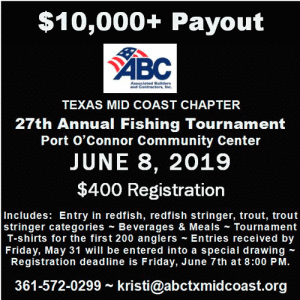
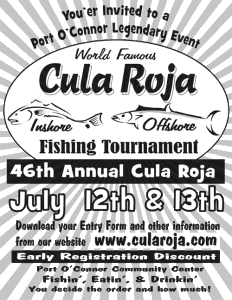
ABC-TournamentCula-Roja-Ad

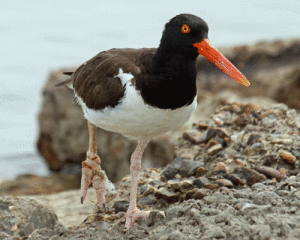
This American Oystercatcher’s right foot is cut and swollen due to tightly wrapped fishing line. Photo by Debbie Repasz

This American Oystercatcher’s right foot is cut and swollen due to tightly wrapped fishing line. Photo by Debbie Repasz

There are invisible shackles hidden in all of our oceans, lakes, and waterways. They imprison our wildlife in the very ecosystems they live in, leading to cuts, amputations, starvation, and even death. Unfortunately, this is no natural, circle of life situation. Humans are responsible for this material in the water and we need to be aware of the consequences. Let’s talk about lost and discarded fishing line.

First off, why is lost and discarded fishing line even a problem to begin with? Part of the issue is the fact that most fishing line takes an extremely long time to biodegrade. We’re talking 600 years, over twice the amount of time the United States has been a country. It’s also plentiful and very hard for animals to free themselves if they get stuck in it. It can look like food or contain entangled food, leading wildlife to mistakenly consume it. What is the result of an animal encounter with fishing line? Tangled feet and wings keep birds from walking and flying, making them vulnerable to predators and limiting their access to food. Tightly wrapped line can cut off circulation, potentially amputating whatever body part it’s caught on. Mistakenly eating fishing line can fatally damage internal organs and become impacted in the stomach, causing starvation. Some birds will even use fishing line as nesting material, inadvertently endangering their chicks. Then there’s “ghost fishing” – when nets, lines, crab traps, and other fishing gear continue to catch aquatic life even after they’ve been lost or discarded. It’s not just fish, either: Any kind of aquatic animal can be affected or killed by ghost fishing, from starfish to turtles to dolphins. Googling “fishing line and wildlife” will bring up numerous sobering photos and stories, if you want an eye-opening experience.

Now that we know what the problem is, we can talk about solutions. For one, monofilament fishing line, one of the most common kinds, is recyclable. Texas A&M’s Monofilament Recovery and Recycling webpage (mrrp.tamu.edu/binlocations.html) has a very long list of monofilament recycling bins in Texas, many of which are conveniently located right next to the bodies of water being fished. Line that can’t be recycled should be cut into very small pieces, less than 6 inches, and put into a trash can with a lid that’ll keep curious and hungry animals out and keep the fishing line from blowing away. What if you find an animal that’s caught in fishing line? The best thing for both your and the animal’s safety is to call a local wildlife rehabilitator and seek professional instructions. Want to just help out in general? Consider putting some time into a local shoreline cleanup event or volunteering to monitor one of the previously mentioned fishing line recycling bins. The more hands on deck, the more litter gets picked up, and the less our wildlife comes in contact with this life-threatening pollution.

Lost and discarded fishing line is not only a problem for our boat motors, but also for the diverse cast of animals we are lucky to call neighbors. There are steps we can take to lessen our impact and the more steps we take, the nicer the world will be for ALL of us.

Untitled Document