Seadrift Solid Waste Service

Archived in the category: General Info
Posted by Joyce Rhyne on 18 Jan 19 - 0 Comments
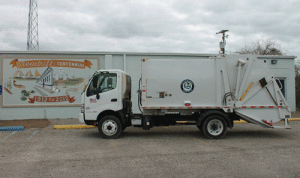
Starting in November 2017 Seadrift’s Solid Waste Truck and its Crew began picking up trash in our community. It’s a dream come true for the city and it’s residents! Involved in its operation are two seasoned employees and one fairly new hire.  Thank you, guys, for your service! Tanya DeForest Photo by Kenneth Reese.

Starting in November 2017 Seadrift’s Solid Waste Truck and its Crew began picking up trash in our community. It’s a dream come true for the city and it’s residents! Involved in its operation are two seasoned employees and one fairly new hire.
Thank you, guys, for your service! Tanya DeForest
Photo by Kenneth Reese.

EO’s Made Easy by Kelly Gee

Archived in the category: General Info
Posted by Joyce Rhyne on 18 Jan 19 - 0 Comments

Maybe you have read about essential oils and are curious. Essential oils are made from parts of plants like leaves, herbs, barks, and rinds. They are processed to distill or express parts of them into concentrated oils. some add the oils to unscented oils, creams or gels. You can rub them on your skin, put them in your bath or diffuse them in your house. Research shows they can be helpful if used the right way.

Simple oils smells such as lavender, chamomile, and rosewater might calm, while others like peppermint or thyme may stimulate or wake you up. Scientists think they work by sending chemical messages to parts of the brain that affect mood and emotion. oils won’t take all your stress away, but the aroma may help you relax.

Some oils that are fine on your arms and legs may not be safe to put inside your mouth, nose, eyes, or private parts. Lemongrass, peppermint, and cinnamon bark are some examples.

Look for pure oils from a trusted producer that makes pure oils without anything added. You’re more likely to have an allergic reaction to oils that have other ingredients. Not all extras are bad. Some added ‘carrier’ or dilution oil may be normal for certain more expensive essential oils.

The most common use of essential oils is diffusing or electro sonically pulsing them into the air through cold water. Diffusers are inexpensive and available everywhere. They are safe and easy to use. A few (3-6) drops of oil in a water reservoir can scent your house and make oils available for you in the air of your home or office. This kind of oil delivery can be beneficial to your health and well-being.

Any essential oil you plan to use should be tested in small amounts. Touch a drop on your arm or leg, Smell the lid not the bottle and see how you react. Dilute with unscented lotion or skin oil such as argan or almond oil. If you have or develop a rash or itchy bumps, stop. If your skin is injured don’t use an oil you are unfamiliar with. Some might help, and some might harm. Don’t be fooled by words like natural and pure…natural can still irritate or make your allergic, or you might just not like it. Oils can age and ruin just like your cooking oil, so if it seems funky or off toss it. Babies and old folks may be more sensitive to oils and some could be dangerous. Do your homework and go slowly when using a new oil. Store all oils out of light out of heat and out of reach of little hands and paws and claws. There are oils that can be fatal for pets. If you are pregnant always ask before using essential oils. Some can complicate your pregnancy. Do tell your doctor if you are using or even trying essential oils. Research shows some cancer drugs and others can be absorbed differently if exposed to certain oils. There are lots of reputable websites for information about using essential oils and the library is sure to have information you can use. If someone claims to be an aromatherapist, ask if they have a license and if they are an oil enthusiast, check their information. With essential oils, a little is a lot. they are concentrated and should be used sparingly. More is not always better with essential oils.

Used the right way, they can help you feel better with few side effects. For example, you may feel less nauseateed from chemotherapy cancer treatment if you breathe in ginger vapors. You may be able to fight certain bacterial or fungal infections, including the dangerous MRSA bacteria with tea tree oil. In one study, tea tree oil was as effective as a prescription antifungal cream in easing symptoms of a fungal foot infection. Peppermint, wintergreen, rosemary and others may help with pain or bruising. The uses are endless, and they are fun and exciting to try. Many who thought they were the latest ‘snake oil cure’ find their effectiveness surprising and helpful. if you want to know more email me for a list of websites you might find helpful. gollygeetx@alumni.ou.edu
(Austin)  The Legislature will pass sweeping reforms to the way it pays for public schools this session, according to the leaders of both chambers and Governor Greg Abbott.   Abbott appeared with Lt. Governor Dan Patrick and newly elected House Speaker Dennis Bonnen at a press conference on Wednesday to announce that all three were committed to addressing education funding and property tax growth in 2019.  “If the three of us are aligned, that we’re going to accomplish a mission, and pass legislation, it happens,” said Patrick.  “This is not just a message to the public and to the media, but I think our members will take note, that this is really unprecedented, that we’re addressing these issues at the beginning of session, totally united with one another.”

A commission made up of stakeholders, experts and lawmakers studied the issue over the interim and issued findings and recommendations in December last year.  The Texas Commission on Public School Finance found that the current formulas that determine how much each school gets per student are outdated and insufficient to meet the needs of students, especially those from low-income backgrounds, those with special education needs and those learning English.  They recommended an overhaul of allotments and weights, the variables that drive the funding formulas, to redirect $3.5 billion in existing funds towards these vulnerable populations as well as other programs that produce strong educational outcomes for all students.

The commission also made recommendations for property tax reform, offering three solutions but not recommending one above another.  The commission found that the amount of recapture, that is local property tax revenue above a certain threshold remitted to the state and then redirected to property-poor districts, is increasing significantly.  The number of districts paying recapture is more than 200, up many times more than the 34 who originally paid recapture when the law was passed in 1993.  One proposed solution would use growth in recapture to compress local property tax rates.  Another would take this growth and divide it equally among the state, school districts, and taxpayers.  The final plan would simply cap property tax growth at 2.5 percent per year.  What eventually reaches the Senate floor will be developed by a newly formed committee on property taxes.

Also this week, budget writers found out how much money they’ll have to work with as they figure out how to pay for state services for the next two years when Comptroller Glenn Hegar issued his biennial revenue estimate.  The state is constitutionally prohibited from spending more than it takes in, so this estimate sets a cap on how much lawmakers can appropriate.  Unlike in 2017, when legislators arrived in Austin to discover they had less money to work with than the previous session, strong economic growth and sales tax collections have increased available revenue by eight percent over last session, for a total of just under $120 billion in non-dedicated general revenue.

Hegar also releases growth projections for the Texas economy with the revenue estimate, and he said that a recovery in the oil market in 2018 and expansion of the national economy led to robust 3 percent growth in gross state product, and forecast an even stronger four percent rate for 2019.   Beyond that, he said, economic uncertainties cloud the state’s economic prospects.  Rising federal interest rates, a drop in the price of a barrel of oil from its October high, and volatility in the global market and questions about US global trade policy will rein in growth.  While the state should still outpace the national economy, he said, his office predicts more modest growth in GSP of 2.5 percent in each year of the 2020-2021 biennium.

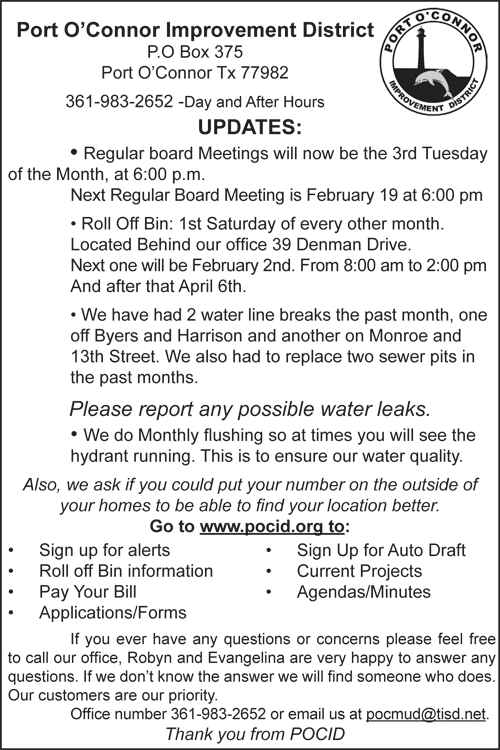
Port O’Connor Improvement District Update

Archived in the category: General Info, Organizations
Posted by Joyce Rhyne on 18 Jan 19 - 0 Comments

POCID-Update

Silva Graduates from VC EMT Class

Archived in the category: Announcements, General Info
Posted by Joyce Rhyne on 18 Jan 19 - 0 Comments
Erwin Silva, left, of Port Lavaca poses with Victoria College Emergency Medical Services Program Clinical Coordinator Emilio Reyes during the Dec. 11 graduation ceremony honoring VC’s Fall 2018 Emergency Medical Technician students at VC’s Student Center.

Erwin Silva, left, of Port Lavaca poses with Victoria College Emergency Medical Services Program Clinical Coordinator Emilio Reyes during the Dec. 11 graduation ceremony honoring VC’s Fall 2018 Emergency Medical Technician students at VC’s Student Center.

VICTORIA – Erwin Silva of Port Lavaca was one of 18 students honored during a ceremony for graduates of Victoria College’s Fall 2018 Emergency Medical Technician class on Dec. 11 at VC’s Student Center.
The students completed 80 hours of hands-on clinical training in emergency room, respiratory therapy and EMS while also completing six credit hours of classroom lecture and labs totaling over 124 hours.
Victoria College’s EMS Program offers EMT through Paramedic courses leading to a certificate or Associate of Applied Science degree.
For more information on the program, call (361) 582-3208 or email Susie.Jechow@VictoriaCollege.edu.

Untitled Document