Lost Words by Emma Shelly

Archived in the category: Featured Writers, General Info
Posted by Joyce Rhyne on 18 Jan 18 - 0 Comments

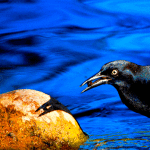
grackle
Over the past weekend I read a book called “Lost Words” by Jackie Morris and Robert MacFarlane. It took me less than an hour because it’s a big, illustrated book filled with poems in huge font meant to be read aloud to kids. The subject of these poems: ferns and kingfishers, ivy and heather, herons and owls. And more so than the poems (which were quite fun) and the illustrations (which were very beautiful), I found myself interested in the why of the book and what it all means.

Morris first got the idea for the book when she was asked to sign a petition to return words that had been culled from the Oxford University Press Junior Dictionary. These words included bluebell, acorn, heron, and the one that she said cut the most: kingfisher. It wasn’t the dictionary’s fault that the words were cut, “but the culture in which we live,” Morris writes, “seems to give more importance to the urban than the wild.” She wondered how could these words be removed? “How can we teach children that bluebells are important, that acorns have value, if the words are not important enough to be in the dictionary found in most schools?”

Indeed, there’s been a lot of debate about whether the kids of today are more removed from nature than their predecessors and a lot of the research suggests that yes, yes they are. They spend less time outside, participate in fewer hiking and camping excursions, and don’t have the same exposure to the great outdoors. One study demonstrated that they can name cartoon characters more easily than they can name the plants, birds, and bugs in their backyard; they can tell you that the bright yellow rodent with the red cheeks and pointed ears is Pikachu, but struggle to call to mind the word “weasel.” Or “milkweed” or “egret.”

Morris would argue that those are some more lost words.

This past weekend I was in the Walmart parking lot and one of the grackles there was making a racket. They can be super noisy birds and this one was whistling and squawking away under a car so loudly that I had to take a peek to make sure it wasn’t hurt. Besides me there was one other person drawn to the bird – a five or six year old boy who was so curious he went down to his hands and knees so he could get a look at the feathery loudspeaker underneath the vehicle. “Mom!” he said, “Look at this bird? What’s it doing?”

“Being loud,” his mother said. (Accurate.)

“What kind of bird is it?” the kid wanted to know.

“Just one of the black birds that hang around here,” she replied.

The lost word here, of course, was “grackle.”

But why does it matter, knowing exactly what it is? Mom was technically correct, wasn’t she? They are black birds and they do hang around in urban places like parking lots and parks and beaches. Why can’t we call them “just a black bird” and move on?

Because then all birds become “just a bird,” and all trees become “just a tree.”

Things start falling into the broadest categories possible and what’s the point of stopping to look at that perching hawk when a hawk is just another bird? What’s the incentive to know your garden plants when all flowers are just flowers? Interchangeable, unremarkable, “just” another bit of nature that crosses your path here and there.

There’s a kind of magic in a name. Morris knew this and when it came time to find an author to pair with her illustrations, she contacted Robert MacFarlane. MacFarlane immediately pitched a children’s book filled with poems that he doesn’t refer to as poems but as “spells of language.” It’s hard to read the poems and not think of the animal or plant they are describing – a swift, fast-flowing poem for the kingfisher, a rolling, softer touch for the heather, as they work to summon these words back into our everyday language.

I’m nowhere near as talented as MacFarlane but here’s my own little homage to that noisy grackle of this past weekend – one of Lake Jackson’s very own lost words.

Grackle, grackle, dart and cackle,
With a whistle and a squeal!
You’re a city bird, an asphalt bird,
A bird of concrete sky.
A black bird, some say a haughty bird,
A bold swagger that flies.
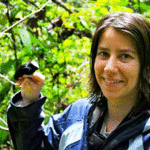
Emma-ShellyEmma Shelly is the Education and Outreach Manager of the Gulf Coast Bird Observatory. The GCBO is a non-profit organization dedicated to saving the birds and their habitats along the entire Gulf Coast, and beyond into their Central and South America wintering grounds.
 

4-H Club News by Secretary/Reporter-McKenna Guevara

Archived in the category: Fishing Reports
Posted by Joyce Rhyne on 18 Jan 18 - 0 Comments

The Intercoastal 4-H Club had their annual monthly meeting on January 8th, 2018. We had Eric Taylor come to show us photography judging. We all had a fun time with it! We will hold our next 4-H meeting on February 5th, 2018 @ 6:30 p.m. at the Port O´Connor Elementary Library.

2018: How Shall We Proceed? by Donnie L. Martin

Archived in the category: Featured Writers, General Info
Posted by Joyce Rhyne on 18 Jan 18 - 0 Comments

Has it dawned on you yet that 2018 has dawned upon us? Ready or not, the New Year is here, and the question is no longer “What shall we do when it arrives?” but rather, “How shall we proceed?” One would like to think that we could prepare for every contingency. But we know full well that that’s impossible. All we can do is prepare for the future as best we know how, and trust God with the rest. The Word of God counsels us with these words: “Boast not thyself of tomorrow; for thou knowest not what a day may bring forth” (Proverbs 27:1).

James also had something to say about making plans in an uncertain world. We can either live our lives focused on “self” or we can live life focused on the Savior, living in daily submission to Him. James strongly suggests the latter. Take his words to heart in the following verses:

James 4:13 “Look here, you who say, ‘Today or tomorrow we are going to a certain town and will stay there a year. We will do business there and make a profit.’

14 How do you know what your life will be like tomorrow? Your life is like the morning fog—it’s here a little while, then it’s gone.
15 What you ought to say is, ‘If the Lord wants us to, we will live and do this or that.’
16 Otherwise you are boasting about your own plans, and all such boasting is evil.
17 Remember, it is sin to know what you ought to do and then not do it.”

Life isn’t static; and therefore, we must be ready to accept the fact that even our best-laid plans are sometimes thwarted by the unforeseen curveballs of life. A commentator, reflecting on James 4:13-17, made the following observation:

It is good to have goals, but goals can disappoint us if we leave God out of them. There is no point in making plans as though God does not exist because the future is in his hands. The beginning of good planning is to ask: “What would I like to be doing ten years from now? One year from now? Tomorrow? How will I react if God steps in and rearranges my plans?” We can plan ahead, but we must hold on to our plans loosely. If we put God’s desires at the center of our planning, he will never disappoint us.

There’s an old gospel song that says, “Many things about tomorrow, I don’t seem to understand. But I know Who holds tomorrow, And I know He holds my hand.” Now that we’re at the beginning of 2018, how do we proceed from here? We should determine to keep holding tightly to the hand of Jesus; trust Him to guide you through those troublesome and confusing days when nothing seems clear; and we should share the love of Jesus to those around us. Proverbs puts it this way: “Trust in the Lord with all thine heart; and lean not unto thine own understanding. In all thy ways acknowledge him, and he shall direct thy paths” (Proverbs 3:5-6). Though 2018 is as yet an untrodden path, may we entrust it to Christ, that He will be glorified in the year before us.

I’d like to close with the following thoughts from Frances R. Havergal, that godly songwriter of last century. May her prayer be ours today.

Another year is dawning,
Dear Father let it be,
In working or in waiting,
Another year with thee.

Another year of progress,
Another year of praise,
Another year of proving
Thy presence all the days.

Another year of mercies,
Of faithfulness and grace,
Another year of gladness,
The glory of thy face.

Another year of leaning
Upon thy loving breast,
Another year of trusting,
Of quiet, happy rest.

Another year of service,
Of witness for thy love,
Another year of training
For holier work above.

Another year is dawning,
Dear Father, let it be,
On earth, or else in heaven,
Another year for thee.


Questions for a New Year by Kelly Gee

Archived in the category: Featured Writers, General Info
Posted by Joyce Rhyne on 18 Jan 18 - 0 Comments

A new year is like a gift that if you use it right you get to open and enjoy 365 times. It comes with the joy of a mulligan, a do over you used to call for as a child; the freshness of a sunrise or the potential of a new item out of the box. It is a treasure that will mostly become what you make it. I ask myself a few questions when looking a brand-new year. I am not too good with resolutions, but I like purpose, I set goals and feel good when I achieve things that may have looked hard in the beginning. So, when setting goals, I asked myself a few questions to make sure the goals match my purpose. I asked Who am I?

Many things converge to make us who we are as people, partners and friends. I am a lifetime First Class Girl Scout, always prepared. I am a daughter, a mother, a helpmate and friend, a woman of faith with childlike wonder and curiosity. Those things drive my purpose on the minute to minute, day by day even year by year adventure we call living. Who I am influences my time, my yes and no commitments, my finances, my relationships and decisions. Who I am is a constant that provides a frame for my new year and for my lifetime. I also asked Whose I am? My spouse, my family, my church, my community and even my friends hold a part of me, a part of my heart, my time, my energy, my life. So, those who have invested in my life have earned some ownership and give some structure to my year. It is up to me to choose and build healthy strong structure in my life by investing in positive and constructive relationships and by not investing in relationships that are counterproductive. I also asked myself What I value most? Where do I invest myself and my assets? What vows or mottos am I committed to live by? Where do I work, serve, spend, and find authentic experiences? My Marriage vows, faith in God, core beliefs and values, statements of affirmation and mottos stating my fundamental ideals are core to the roadmap of my year. They not only tell me where to go forward and invest myself, but can also tell me where to stop, avoid or turn and run away from matters that face me in this new year.

The last question: Pick a few words that keep you on track with your core self and make them your yearly catchphrase. I ask is what good do I see in my past year? What good stuff has been growing and happening in my life? If I can find the good and then build on that, I can expect more good. Whatever you pay most attention and care to will be what grows in your life. So, grow the good. It is not new or even novel, but knowing who I am, whose I am, what I find significant and what is good for me is a great way to build a wonderful 2018.Hope your New Year is filled with joy.

Library Survey Results

Archived in the category: General Info
Posted by Joyce Rhyne on 18 Jan 18 - 0 Comments

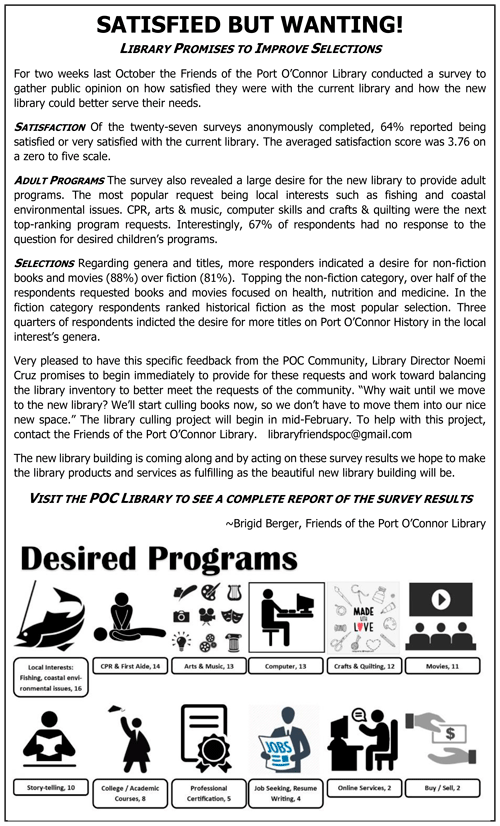
2018-01-Library-Survey-Results-DT-article

Untitled Document