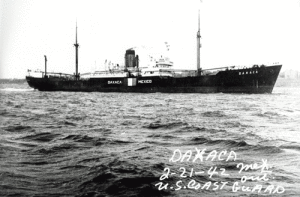
The freighter Oaxaca, which was sunk by German Submarine U-171 off of Port O’Connor during World War II.
-Picture courtesy of Henry Wolff Jr. of Victoria
This July 26th will be the 75th anniversary of when World War II came close to our shores. When most people think of World War II they often think of places such as Normandy, Pearl Harbor, or other battlefields far from South Texas. But some of the fighting occurred right off our beaches, within sight of land.
World War II, or the Second World War, took place from 1939 to 1945 and involved a majority of the world’s nations, including the United States. The United States entered World War II when war with Japan was declared on December 8, 1941, the day after the Japanese attacked the U.S. naval base at Pearl Harbor. Three days later on December 11, 1941, Germany declared war on the United States. In January of 1942 the German Navy launched “Operation Drumbeat”, this operation involved the sending of five U-Boats to attack shipping off of the East coast of the United States. The word U-Boat is a version of the German word Unterseeboot, and refers to military submarines operated by Germany in World War II.
The United States, having no experience of a modern naval war close to its own shores, did not employ shore-side blackouts, or any increased naval patrols. The U-Boats simply waited and picked off ship after ship in broad daylight, and at night as the ships were silhouetted against the lights of the major cities. Sometimes the U-boats attacked on the surface, using their deck guns to save torpedoes. People on shore sometimes witnessed these attacks firsthand. By the time this first group of U-Boats ran out of torpedoes and started their return trip back to Europe, twenty-three ships had been sunk without a single U-Boat loss.
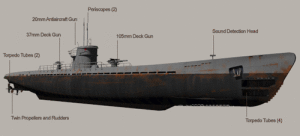
When the second group of U-boats left their bases in Europe for the United States, several of them had orders to enter the Caribbean and Gulf of Mexico. Most of the U-Boats sent to the Gulf of Mexico were type IX-C U-Boats, which were large ocean-going submarines designed for sustained operations far from any support facilities. They had a range of over 13,000 nautical miles, and could easily operate in the Caribbean, Gulf of Mexico and the South Atlantic without needing to refuel. Type IX-C U-Boats were armed with a 105mm deck gun, a 37mm anti-aircraft gun, a 20mm anti-aircraft gun, and had six torpedo tubes; four at the bow and two at the stern. They carried six extra torpedoes internally and had five external torpedo containers (three at the stern and two at the bow), which stored ten additional torpedoes for a total of twenty-two torpedoes.
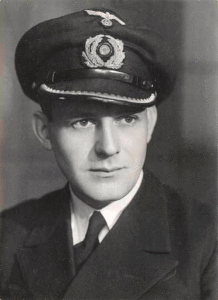
One of the Type IX-C U-Boats to enter the Gulf of Mexico was Unterseeboot 171 (U-171). U-171 was sent to the Gulf of Mexico under the command of Oblt. Günther Pfeffer and sank three ships in the Gulf of Mexico; the oil tanker Amatlan near the Texas-Mexico border, the oil tanker R.M. Parker Jr off of Louisiana, and the freighter Oaxaca off of Port O’Connor.
The Oaxaca was a freighter that had previously been a German-owned ship, but when World War II broke out, the Mexican Government took possession of the ship and changed the name. The Oaxaca was a 6,000-ton freighter that normally carried dry cargo. The captain of the Oaxaca was Francisco Rodríguez Reybell. On July 26, 1942, the Oaxaca left the port of Corpus Christi with a load of rubber, caustic soda, and other miscellaneous cargo. The crew of the Oaxaca thought wrongly that by keeping close to shore they would be safe from any U-Boat attack. That night the U-171 sighted the Oaxaca sailing up the Gulf Coast eleven miles from Port O’Connor. The U-171 fired two torpedoes, one of which hit the Oaxaca and detonated with a loud explosion, Oaxaca broke in half and sank within three or four minutes of being hit. Six crewmen out of the crew of thirty-six were killed. The Air base on Matagorda Island was being built at the time, and workers who were asleep in temporary housing on the island were awakened by the sound of the torpedo exploding and assisted many of the survivors as they were brought to shore. On October 9, 1942 while returning to base, U-171 hit a mine and sank in the Bay of Biscay off of the Western coast of France.
Other German U-Boats also wreaked havoc in the Caribbean and the Gulf of Mexico. U-507 under the command of Kapitänleutnant Harro Schacht sank the cargo ship Alcoa Puritan with its deck gun about 45 miles south of the New Orleans on May 6, 1942, and then shocked authorities by torpedoing and sinking the gasoline tanker Virginia in the mouth of the Mississippi River on May 12, with the loss of twenty-six sailors.
Another U-boat that achieved notoriety in the Gulf of Mexico was the U-506, commanded by Knight’s Cross winner Erich Würdemann. U-506 attacked eight ships in the Gulf of Mexico from May 10 to May 20, 1942. Four of these ships were badly damaged while the other four were sunk, including the tanker Gulfpenn. The Gulfpenn was transporting four million gallons of gasoline from Port Arthur, Texas to Philadelphia, Pennsylvania when it was hit by a torpedo from the U-506 off of Louisiana. The Gulfpenn exploded and sank quickly after being torpedoed, thirteen crewmembers perished.
Oblt. Hans-Günther Kuhlmann commanded the U-166 which sank four ships off of Louisiana from July 11 to July 30, 1942. One of these ships was the passenger ship Robert E. Lee, which was carrying 407 passengers and crew, 25 lost their lives in the sinking.
U-126, commanded by Knight’s Cross winner Ernst Bauer, sank several ships off of Cuba, including the merchant ship Kahuku. A sailor from the Kahuku, Archie Gibbs of Roscoe, Texas, was held captive on the U-126 for four days before being released in an inflatable rubber boat within sight of land.
U-156 was sent to the Caribbean on a secret mission to attack the oil refinery and tank farm on the island of Aruba. The attack failed when the first shot from the 105mm deck gun prematurely exploded in the barrel, damaging it. This happened because the protective cap at the end of the barrel was not removed before the gun was fired, causing the end of the barrel to burst. Working at top speed, Captain Werner Hartenstein and his crew managed to cut off the damaged part of the barrel, but the alarm had been sounded in Aruba and the attack was called off. This freak accident saved what was then the world’s largest oil refinery from a surprise attack. Hartenstein later sank two cargo ships off of Cuba with his sawed-off deck gun.
After an alarming number of ships were sunk by U-Boats off of the Gulf Coast, a panic set in and rumors were rampant. The most famous of these rumors concerned U-Boat crewmen who were supposedly coming ashore to watch movies in New Orleans or going shopping in Houston. None of these rumors were ever verified as being true.
By the end of World War II, fifty-six ships were sunk with an additional fourteen ships damaged by German U-boats in the Gulf of Mexico. A total of twenty-four U-Boats were used in these operations with the U-166 being the only U-Boat lost. For many years U-166 was thought to have been sunk by a U.S. Coast Guard aircraft on August 1, 1942, but was actually sunk two days earlier by depth charges from the U.S. Navy sub-chaser, PC-556. The Coast Guard aircraft may have spotted and attacked the U-171 instead, inflicting no damage. The mystery of the U-166 was solved in 2001 when it was found off of Louisiana in 5,000 feet of water one mile from the shipwreck of its last victim, the passenger ship Robert E. Lee.
Of the fifty-four type IX-C U-boats built, only the U-505 survived World War II. U-505 was captured by the U.S. Navy in 1944 and is now on display in Chicago, Illinois at the Museum of Science and Industry.
The wreck of the Oaxaca lies eight miles offshore from the Matagorda Ship Channel, resting in 60-65 feet of water. One of the masts of the ship stuck out of the water until sometime in 1945 when the Coast Guard removed it and set off explosives in the superstructure so the wreck wouldn’t be a hazard to navigation. During the late 1990’s, students with the Texas A&M Nautical Archaeology program conducted dives on the wreck. In 2004 the Texas Parks and Wildlife “Ships to Reefs” Program investigated the Oaxaca shipwreck. Side scan sonar and sub-bottom profiler investigations show the ship is sitting upright in two pieces on the sea floor with parts of the wreckage only forty feet from the surface. Locally the wreck is sometimes known as the “rubber ship” due to the rubber bales that occasionally wash ashore, which was part of the Oaxaca’s cargo.
Many thanks for assistance with this article go to Henry Wolff Jr. of Victoria, Steve Hoyt formerly with the Texas Historical Commission, Dale Shively with the Texas Parks & Wildlife Ships to Reefs Program, the U.S. Navy Historical Center, the PAST Foundation, and the late George Fred Rhodes of Port Lavaca.
German Submarine U-171
Captain Oblt. Gunther Pfeffer
-Picture from
the author’s collection
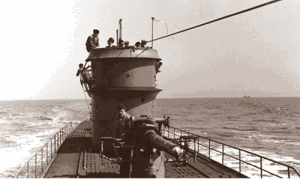
German Submarine U-166 underway showing the 105mm deck gun with protective cap.
-Picture courtesy of the PAST Foundation