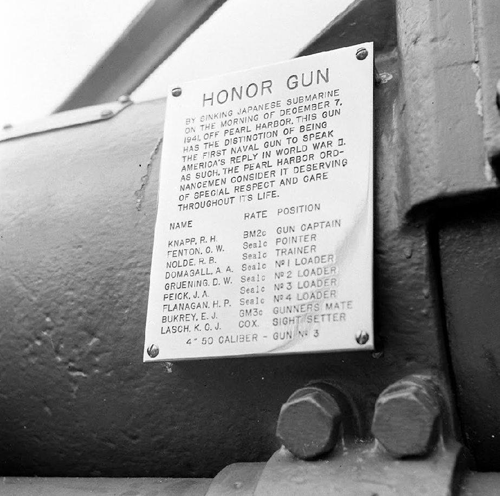
Plaque attached to the 4” gun on the USS Ward which sank
the first Japanese mini-submarine
On December 7, 1941, “A Date Which Will Live in Infamy” according to President Franklin Delano Roosevelt, the Japanese attacked the U.S. Naval Base at Pearl Harbor in Hawaii. This attack 75 years ago brought the United States into World War II, a global conflict where over 400,000 U.S. military personnel would lose their lives. Japan’s surprise attack on Pearl Harbor consisted of a striking force of six aircraft carriers that launched 408 aircraft. The purpose of this attack was to destroy the U.S. Pacific Fleet which was anchored at Pearl Harbor on the island of Oahu. Lesser known was that a Japanese submarine force was positioned offshore to launch small mini-submarines intended to penetrate into Pearl Harbor during the air attack. This is their story:
Five Type A Ko-hyoteki Class Japanese mini-submarines were to be used in the attack. They measured 78 feet long, 6 feet wide and 6 feet in height. The mini-submarines were built in three sections, and then bolted together. Carrying two torpedoes and a crew of two; they were powered by an electric motor using multiple batteries. Due to their limited range because they were battery-powered, the mini-submarines were designed to be carried on a full size “mother” submarine, and then transported to where they were intended to be used.
The Japanese mini-submarines to be used in the attack on Pearl Harbor were specially modified with unique figure 8 torpedo guards on the bow, extra air tanks, and other modifications. Five Japanese full size I-Boats (I-Boat was the Japanese designation for a full size ocean going submarine) were assigned to carry the five mini-subs to Pearl Harbor. They were the I-16, I-18, I-20, I-22, and I-24. The Japanese Navy also sent other I-Boats to be positioned around Hawaii during the attack to rescue downed airmen and/or the mini-sub crews if needed. The ten sailors manning the five mini-submarines were: Masaharu Yokoyama, Tei Uyeda, Akira Hiroo, Yoshio Katayama, Shigemi Furuno, Shigenori Yokoyama, Kazuo Sakamaki, Kiyoshi Inagaki, Naokichi Sasaki, and Naoji Iwasa, who was the overall commander of the mini-submarine group.
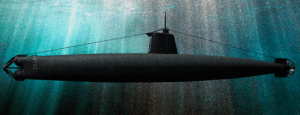
Rendering of a Japanese Type A Ko-hyoteki class mini-submarine
The five I-Boats carrying the mini-submarines arrived off of Hawaii on December 5, 1941 and took up position off of Pearl Harbor. At 12:42am on the morning of December 7th, the first mini-submarine was launched ten miles from the entrance of Pearl Harbor. The rest of the mini-subs were launched shortly thereafter with the last one being launched at 3:33am. The plan called for the mini-subs to penetrate Pearl Harbor, launch their torpedoes at U.S. Battleships, and then exit the harbor and meet up with the “mother” I-Boats off of Lanai Island, which was Southeast of Pearl Harbor.
The channel into Pearl Harbor was guarded by a floating two section anti-torpedo net, which hung down 35 feet and was designed to stop torpedoes from being fired into the harbor. However, the nets had been opened around 2:00am on the morning of December 7th, and were not closed until 8:46am, which allowed plenty of time for the mini-submarines to enter the harbor that morning. Even though the United States was not at war yet, U.S. Ships were instructed to attack any suspected threat to Pearl Harbor.
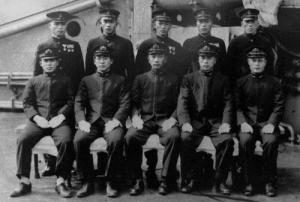
The 10 Japanese sailors who manned the five mini-submarines
in the Pearl Harbor attack.
Outside of Pearl Harbor, the Minesweeper USS Condor sighted what it thought was a submarine periscope two miles from the harbor entrance at 3:42am and called the Destroyer USS Ward to investigate, but nothing was found. At 5:45am, the Cargo Ship USS Antares was in the channel heading into Pearl Harbor when its crew saw what looked like a small submarine following them. Again the USS Ward came to investigate and at 6:37am sighted the submarine with the help of a U.S. Navy PBY Patrol Plane. Captain William Outerbridge on the USS Ward had been captain of the Ward for only two days, which was his first command. Ordering his crew to attack the submarine, they fired on it at 6:45am with the Ward’s 4-inch guns and hit it. The Ward’s crew saw the mini-submarine stop, and then sink with the Ward dropping depth charges as it passed over the last position of the sinking mini-sub. (Depth charges were explosive containers dropped into the water set to explode at a certain depth) At 6:53am Captain Outerbridge sent the following message to U.S. Navy Headquarters at Pearl Harbor: “We have attacked, fired upon, and dropped depth charges upon submarine operating in defensive sea area.”
This warning unfortunately raised no alerts at U.S. Navy Headquarters and less than an hour later at 7:50am the first Japanese bombers and torpedo planes arrived, attacking the U.S. fleet in Pearl Harbor and the nearby military installations. The attack was a complete surprise with the Japanese planes sinking seven U.S. ships including four battleships and seriously damaging nine other ships. Also destroyed were 188 aircraft at the nearby air bases. Killed in the attack were 2,402 U.S. Military Personnel and 57 Civilians.
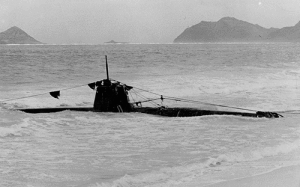
Mini-submarine found beached off Oahu
the day after the Pearl Harbor Attack
During the air attack, two more Japanese mini-submarines were sighted. The first by the Destroyer USS Helm at 8:17am when it sighted a submarine hung up on a reef outside of the harbor entrance. The Helm fired on the mini-sub, but it managed to get off the reef and escape. Inside Pearl Harbor a few minutes later at 8:30am, the Minesweeper USS Zane sighted another possible mini-submarine inside of Pearl Harbor and sent out the alert: “Japanese Sub in Harbor”. The Destroyer USS Monaghan responded and sighted the mini-submarine just as it fired a torpedo at the Seaplane Tender USS Curtis, the torpedo missed. The mini-sub then fired its 2nd torpedo at the USS Monaghan as it raced in to attack, this torpedo also missed and exploded on the harbor shore. The mini-submarine then completely surfaced apparently damaged. USS Monaghan proceeded to ram the mini-submarine, dropping depth charges as it passed over, sinking it.
After the Japanese air attack ended, Pearl Harbor was a mess, ships were burning, harbor installations wrecked, sailors were trapped in some of the sunken ships, and frantic rescue efforts were started. Several other unconfirmed mini-submarine sightings were reported both inside and outside the harbor throughout the day. Later that night at 11:41 pm, Japanese Submarine I-16 heard by radio from one of the mini-submarines, the message was “successful attack”. At 1:11 am in the morning on December 8th, the same mini-submarine radioed “unable to navigate”. This mini-submarine was manned by Masaharu Yokoyama and Tei Uyeda. This was the last contact the Japanese Navy had with any of the mini-submarines, the “mother” I-Boats waited in vain for two nights off of Lanai Island for the mini-submarines and their crews.
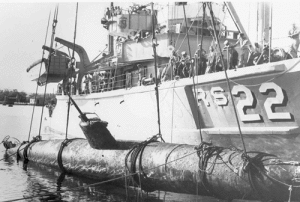
Japanese Mini-submarine being salvaged that was found in Keehi Lagoon off of Honolulu in 1960.
On the morning of December 8th, Japanese Sailor Kazuo Sakamaki was found unconscious washed up on a beach on the Southeast side of Oahu, taken prisoner he became the first prisoner-of-war taken by the United States in World War II. His mini-submarine was found abandoned shortly thereafter with its torpedoes still loaded wallowing in the surf a short distance away. The body of the other crewmember, Kiyoshi Inagaki was found later that day on the beach, he had apparently drowned. Interrogation of Sakamaki revealed that his mini-submarine was the one that was sighted by the USS Helm. The compass had stopped working and the mini-sub had been damaged after hitting several reefs resulting in some of the batteries breaking open releasing toxic fumes. Sakamaki had activated the self-destruct charge (which failed to work) and then abandoned the submarine with Inagaki. This submarine was later salvaged and went on tour in the United States during World War II to raise money for the war effort. It is now on display at the National Museum of the Pacific War in Fredericksburg, Texas.
The mini-submarine sank by the USS Monaghan inside of Pearl Harbor was raised in the days after the attack. The body of one crewman was removed and buried, while the other was unable to be removed from the badly wrecked submarine. Both submarine and the dead sailor within were used as landfill at the Pearl Harbor Submarine Base where they remain to this day. An investigation after the war ended revealed that this was the submarine manned by Naokichi Sasaki and Naoji Iwasa, who was the commander of the Pearl Harbor mini-submarine attack group.
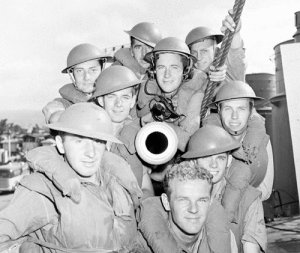
The crew of the 4” gun which sank the first Japanese mini-submarine to be sunk by their gun on the USS Ward in 1942
The Japanese also launched mini-submarine attacks on Sydney Harbor in Australia and on Diego Suarez Harbor in Madagascar during World War II. The War in the Pacific ended with Japan’s surrender on August 15, 1945. Kazuo Sakamaki, who was taken prisoner the day after the Pearl Harbor attack was released after the War and worked for Toyota for many years, he passed away in 1999. The fate of the other three Pearl Harbor mini-submarines and their crews remained a mystery.
In 1960, U.S. Navy divers who were undergoing training found a slightly damaged Japanese mini-submarine in the shallow waters of Keehi Lagoon near Honolulu. The hatch was open and no human remains were found inside suggesting that the crew had possibly escaped. Both torpedoes were still loaded indicating that it had never fired its torpedoes. Further investigation revealed that this was probably the mini-submarine manned by Shigemi Furuno and Shigenori Yokoyama of which no trace has ever been found. The U.S. Navy raised the submarine and gave it to Japan in 1962 where it is displayed as a memorial at the Japanese Naval Academy in Etajima City, Japan.
In August 2002, the Pisces IV and Pisces V, two deep diving research submarines operated by the Hawaii Undersea Research Laboratory found a sunken Japanese mini-submarine in 1200 feet of water South of Pearl Harbor. Pictures revealed a prominent shell hole in the top part of the mini-submarine, this damage and the location it was found at meant that this was the one sank by the USS Ward before the air attack started, leaving only one submarine unaccounted for.
During the search for the mini-submarine sank by the USS Ward, another sunken Japanese mini-submarine was found disassembled in its three sections off of Hawaii. The sections of the submarine were scattered on the seafloor among damaged U.S. landing craft and other miscellaneous debris that was obviously dumped offshore by the U.S. Navy. Each of the three sections of the mini-submarine had steel cables attached to them as if it had been salvaged previously. The center section looked like it had been damaged by an internal explosion. At the time it was assumed this submarine was a war prize as the U.S. Navy had captured other Japanese Type A Ko-hyoteki class mini-submarines during World War II in Guadalcanal, Okinawa, and Kiska, Alaska. However, research after the Hawaii Undersea Research Laboratory dived on this wreck again in 2009 revealed that the bow section of this mini-submarine had the figure 8 torpedo guard attached. Documentation showed that only the five Pearl Harbor mini-submarines were ever fitted with these unique figure 8 torpedo guards. If this was the final missing Pearl Harbor mini-submarine, when was it salvaged, why was there no record showing it as being found, and what happened to the crew? Researchers came to the conclusion that the submarine may have been salvaged from the West Loch (loch is a word that means lake or sea inlet) of Pearl Harbor in 1944.
In 1944 the West Loch of Pearl Harbor was a staging area for U.S. Navy “Landing Ships Tanks” (LSTs) and other amphibious attack ships for an invasion of the Japanese-held Mariana Islands. On May 21, 1944 an explosion occurred in one of the LSTs, The explosion was heard miles away, followed immediately by more explosions, sparking fears of another Japanese attack or an earthquake. A chain reaction of explosions was started as fire and debris rained down on the fuel and ammunition stored on the decks of other LSTs. Eleven buildings on the shore were destroyed, and several vehicles were blown on their side. The fires burned for over 24 hours, 6 LSTs were sunk and 163 men lost their lives. The incident was declared “Top Secret” and a “Press Blackout” was ordered following the incident. Survivors and eyewitnesses were not permitted to ever mention the incident. The wreckage was quickly cleared in a secret salvage operation and dumped at sea, leaving only the beached rusted bow of one LST in the loch as present-day evidence of the disaster. The incident was not made public until 1960.
Some researchers now believe that the Japanese mini-submarine was found during the secret salvage operation and dumped at sea with the debris from the disaster. It was then re-discovered years later during the search for the mini-submarine sank by the USS Ward. The torpedo tubes were empty indicating that it had fired its torpedoes and no obvious sign of the two-man crew was seen in the wreckage. The internal damage in the center section looked like it had come from the self-destruct charge. It is now believed that this was the mini-submarine manned by Masaharu Yokoyama and Tei Uyeda, who had radioed their “mother” submarine on the night of December 7th, 1941. It’s assumed by some researchers that they managed to penetrate into Pearl Harbor and fire their two torpedoes. Afterwards they entered the then unoccupied Pearl Harbor West Loch to avoid detection. Their batteries had probably started to go dead; unable to escape they activated their self-destruct charge.
If the crew managed to escape to land, what happened to them and the crew from the mini-submarine found in Keehi Lagoon near Honolulu? The crews had been instructed that if they had to abandon their submarines to go ashore and try to mingle in with the large Japanese-American population of Hawaii at the time, but no evidence that they did so ever turned up. None of the I-Boats stationed around Hawaii returned with any of the mini-submarine crews. Three days after the Pearl Harbor Attack, planes from the Aircraft Carrier USS Enterprise surprised the I-Boat I-70 on the surface near Hawaii and sank it with no survivors. This was the only Japanese I-Boat loss during the Pearl Harbor Mission. After the War ended, Japanese research indicated that the I-70 had been out of its patrol area and closer to Hawaii than it was supposed to be when it was sank; did the I-70 move in close to Hawaii and rescue some of the mini-submarine crewmen only to be sunk? The mystery of the whereabouts of these two mini-submarine crews remains unanswered to this day.
Many thanks for assistance in writing this article go to the U.S. Navy Historical Center, I-16tou.com, and numerous books and other sources. Additional thanks to Gaylen Youngblood.
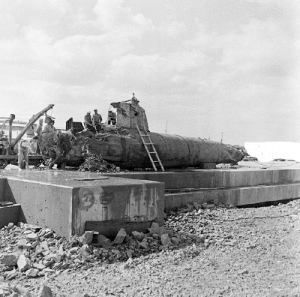
U.S. Navy personnel inspect the salvaged Japanese mini-submarine which was sank by USS Monaghan during the Pearl Harbor Attack.