Sept. 2: Seadrift VFD and Port Lavaca FD dispatched to assist Port O’Connor VFD with a grass fire; cancelled while en-route.
Sept. 5: Seadrift VFD and Port Lavaca FD responded to assist EMS with a bee call off of Sanders Road.
Sept. 5: Seadrift VFD and Port Lavaca FD responded to a two-vehicle accident on Hwy 35 near Garza Road.
Sept. 16: Seadrift VFD responded to a one-vehicle accident off of Harbor Road.
Sept. 19: Seadrift VFD and Six Mile Community VFD dispatched to assist Port Lavaca FD with a grass fire off of Hwy 35; cancelled while en-route.
Sept. 20: Seadrift VFD responded to assist EMS with a Life Flight Helicopter Landing on Bay Club Drive.
Sept. 20: Seadrift VFD and Port Lavaca FD responded to a grass fire off of Louie Walker Road.
Sept. 22: Seadrift VFD responded to Wittnebert Road for a vehicle fire.
Sept. 22: Seadrift VFD responded to a fire alarm in a residence off of Cleveland Street in Seadrift.
Sept. 22: Seadrift VFD responded to a one-vehicle accident off of Harbor Road.
Sept. 24: Seadrift VFD and Port Lavaca FD responded to a two-vehicle accident at the Hwy 185 / Hwy 35 intersection.
Sept. 24: Seadrift VFD responded to a lawn mower on fire at the Seadrift School.
Sept. 30: Seadrift VFD and Port Lavaca FD dispatched to assist Port O’Connor VFD with a vehicle accident on FM 1289; cancelled while en-route.
Oct. 3: Seadrift VFD and Port Lavaca FD responded to a grass fire off of John Tillery Road; Seadrift VFD cancelled while en-route.
Oct. 11: Seadrift VFD and Port Lavaca FD responded to a controlled burn that had gotten out of control off of Sonneman Road.
Oct. 11: Seadrift VFD and Port Lavaca FD responded to a controlled burn that had gotten out of control off of Sonneman Road.
Oct. 15: Seadrift VFD and Port Lavaca FD responded to a grass fire off of Hwy 185 North of Seadrift caused by a downed power line.
Oct. 17: Seadrift VFD and Port Lavaca FD responded to a grass fire off of Hwy 35 near the River Bottom.
Oct. 20: Seadrift VFD responded to a grass fire off of West Cleveland Ave. in Seadrift.
Oct. 21: Seadrift VFD and Port Lavaca FD responded to a fire alarm in a building off of West Broadway Ave in Seadrift.
Oct. 24: Seadrift VFD responded to Assist EMS on West Oakland Ave in Seadrift.
Oct. 24: Seadrift VFD and Port Lavaca FD responded to a two-vehicle accident on Hwy 35 near the River Bottom.
Oct. 26: Seadrift VFD and Port Lavaca FD dispatched to assist Port O’Connor VFD with a grass fire in Port O’Connor; cancelled while en-route.
Oct. 27: Seadrift VFD responded to Assist Port Lavaca FD and Six Mile Community VFD with a Grass Fire off of Hwy 35 near FM 2541; Magnolia Beach VFD also responded
Oct. 28: Seadrift VFD and Port Lavaca FD responded to a Grass Fire off of Hwy 35 near FM 2541; Magnolia Beach VFD also responded.
Oct. 29: Seadrift VFD and Port Lavaca FD responded to a one-vehicle accident on Hwy 35 near Jesse Rigby Road.
Oct. 29: Seadrift VFD responded to a grass fire off of East Broadway Ave in Seadrift.
Oct. 30: Seadrift VFD and Port Lavaca FD responded to a one-vehicle accident on Hwy 185 near Wilson Road.
Oct. 31: Seadrift VFD responded to Assist EMS on West Oakland Ave in Seadrift.
Oct. 31: Seadrift VFD and Port Lavaca FD responded to a two-vehicle accident on Hwy 185 near Ineos Nitriles.
Seadrift Volunteer Fire Department Response Report
What’s Happening at First Baptist Church? by Doyle Adams
Everyone at the Church has been busy the past several weeks. The BIG EVENT for all our Churches in Port O’Connor was Sunday Evening, November 13, when we celebrated our Annual Joint Thanksgiving Service with all three of our local Churches. The Big Service this year was at First Baptist Church. The service was held last week and if you missed it, you missed a Big Blessing!
The Thanksgiving message was delivered by Father Tommy Chen. The First Baptist Church Choir sang a beautiful inspirational song and Kelly Gee sang an outstanding solo.
A Special love offering was taken to help in filling the Thanksgiving and Christmas Food Baskets for Port O’Connor needy families. I will give a more complete report on this outstanding Annual Port O’Connor Event in the next Dolphin Talk.
On Saturday, November 19, from 1:00 to 3:00 p.m., we will be saying “Farewell” to Barbara and Jimmy Crouch in our Fellowship Hall, with a “Come and Go” party. Everyone is invited to this very special event. Come and enjoy the fellowship and refreshments.
On Sunday Morning, December 18, at our 11:00 a.m. service we will observe the ordinance of the “Lord’s Supper” and our Choir will present their Christmas Music Program. Everyone is invited to attend this Special Service.
On Sunday Evening, December 18 at 6:00 p.m., in Fellowship Hall, the Church will Celebrate the Quarterly “Birthday Bash”, celebrating all Birthdays in October, November and December. After the Birthday Celebration, we will have the Annual Church Christmas Party. The Party is a White Elephant Party and a lot of fun, food, and fellowship!! Bring some outlandish wrapped gift and come prepared for a fun time!
See you in Church Sunday!!
Port O’Connor Service Club Chronicles by Kelly Gee
There is no harder task than to thank someone who serves others wanting no recognition or repayment. Those people feel their reward is in the task and do it for how it makes them feel and not for the notice of those around them. The women of the POC Community Service Club are very much like that. They enjoy the projects and programs they provide to our community because they love our community. They work hard all year long to raise money, cook, plan, produce, complete and clean up from one project after another. All of the projects are great and benefit our little paradise, but one project is a monumental effort.
The community garage sale is a monstrous undertaking. From the collection and sorting, transporting and displaying, pricing and selling mountains of donated items that others might have considered junk, all the way to the repacking and donation to others of the leftovers of the sale, these women work hard. Club members, their husbands, sons, daughters, grandchildren, recruited friends and enlisted labor joyfully give their time and their strength to make the garage sale possible. The three days of conscripted labor surrounding the sale are just part of the picture.
Picking up donations, managing the storage site, making signs and publicizing the sale as well as the calculations that allow funds raised to make awarding of scholarships and completion of projects possible all goes on before and after the week of the sale. The hours and hours involved will never be truly known because these ladies never count them; they consider them time well spent in service to others.
So, again I want to thank each and every club member, their family and extended family, the Coast Guard, 4H members, and other volunteers in our community for another great garage sale. I can confidently report that we will fund new scholarships this year and we will complete some planned projects because of your work. I am humbled by your sacrificial service and I am privileged to be a part of your efforts. I will not specify names as one might be missed, but you are truly appreciated. Thank you each and every one!
Our next project was helping put on the BBQ Cook-off on November 12th. We enjoyed being a part of this effort to raise funds for a new library in our community.
Our annual POC Service Club Community Christmas Lunch is Friday, December 2, 2016. Seniors, retirees and their guests are invited to this special event. Your personal invitation is printed in this issue. If you are unable to get out and join us, we will deliver your lunch in POC. Just call Kelly Gee at 817-929-2564 to add your name to the list for lunch deliveries. It’s sure to be delicious.
We are again collecting gently used items for our next community garage sale coming early in 2017, but please do not leave them at the county barn. We are utilizing another storage site for donated items. Please call Diane Cooley at 903-467-6335 and ask for assistance in donating items. Thanks so much.
If you would like to be a part of our giving group, come visit a Service Club meeting each 1st and 3rd Thursday at 10:00 a.m. in the back room of the Community Center. You are sure to feel welcome.
So until next time, be safe, live simply, love openly, forgive generously and remember this quote by the late, great funny lady of laughing wisdom Erma Bombeck who said, “Volunteers are the only human beings on the face of the earth who reflect this nation’s caring, patience, and just plain loving one another.” Come be a part of the reflection of good things!
Edward Fred Knipling Historical Marker Dedication and Unveiling November 19, 2016
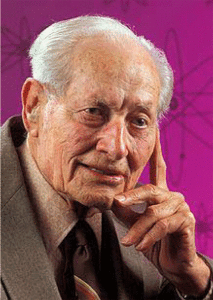
Dr. Edward Fred Knipling
1909-2000
Edward Fred Knipling
by John Foester
Prior to Dr. Knipling’s work, livestock production in North America was plagued by enormous losses each year due to infestations of Cochliomyia homnivorax, commonly referred to as the New World screwworm fly. These flies had been present in North America from ancient times and more recently had spread to many of the warmer parts of the world. In the 1950’s, cattle losses due to screwworms in the U.S. alone were estimated at over $200 million annually.
While many flies deposit their eggs in necrotic tissue (i.e. dead flesh), homnivorax (whose name literally means “man eater”) lays its eggs in the wounds of living warm-blooded creatures. When the larvae (or maggots) hatch, they dive head first into the wound, eating further into the tissues and deepening and enlarging the extremely painful wound. The flies were capable of killing cattle within 10 days of infection. Screwworm maggots were also known to parasitize human flesh. One individual from Calhoun County recognized the need to control these pests and became recognized world wide for his endeavors.
Edward Fred Knipling was born near Port Lavaca, Calhoun County, Texas on March 20, 1909. He was the ninth of ten children born to Henry John Knipling & Hulda Rasch Knipling. Knipling grew up in this German-speaking Lutheran household on a farm of 150 acres on Westerlund Grade Road in northern Calhoun County. The family grew cotton and corn, raised cows, hogs, and chickens and produced almost all of their own food.
As a young man working the fields and tending the family livestock, he witnessed the devastating effects of screwworms on living animals and of boll weevils on cotton, as well as that of many other insect pests. His reputation as a keen and thorough observer of nature no doubt started as a boy on the farm.
Knipling graduated from Port Lavaca High School at the age of 17. In college, he became interested in entomology while studying agriculture at Texas A & M University. He was struck by the realization of the enormous impact insects had, both good and bad, on the welfare of humanity, not only from the standpoint of food production but also with respect to human health.
Harkening back to his observations on the farm, he also formulated the vision early on of the need to manage insects to prevent damage rather than try to control the pests or treat their hosts after the damage had already occurred.
He continued his college education at Iowa State University where he met his future wife, Phoebe Rebecca Hall, who was also a doctoral student in the life sciences. They were married in 1934 and eventually had five children: Anita, Edward, Edwina, Gary, and Ronald. While at Iowa State University, he met Dr. E.W. Lockey from the USDA, who offered him a job on screwworm trapping and population monitoring at Menard, Texas, beginning in 1931. He worked at Menard on an intermittent basis over a period of nine years that was punctuated with continued graduate studies and duty assignments on screwworm in Georgia and other livestock insect pests in Illinois and Iowa. In 1935, at Menard, Dr. Knipling first met and began work with his long-time friend and colleague, Dr. Raymond C. Bushland. At the time, their research concentrated on treating cattle for screwworm maggots, or “wormies” as ranchers called them, after they had already invaded open wounds. Such treatments were called “smears”. While the scientists developed a smear called Smear 62 which could successfully treat infected animals, Dr. Knipling realized that you could never really control screwworms that way; what was needed was some measure to prevent adult flies from infecting the animals in the first place. Through careful observation of the screwworms, Knipling determined that during the first day of life as adults the flies frantically attempted to escape from the cage, on the second day they fed, and on the third and fourth days they mated. The males repeatedly attempted to mate with the females, but the females would not submit to a second mating. For Knipling, this was the key! If a method to introduce sterilized males into a population of the flies could be found, he theorized, any female flies that mated with them for their one mating would have no offspring. By repeating this process, each generation of flies would get smaller and smaller until they are finally gone. In this way livestock could be protected without having to treat wounds. Though it doesn’t sound too wild today, at the time it seemed a far-fetched idea to many colleagues. ‘’Forget this crazy idea and concentrate on more important things,’’ Dr. Knipling recalled one supervisor telling him, according to a 1975 issue of Current Biography.
While at Menard, Knipling refined this idea into an autocidal method of insect control which involved overwhelming the wild populations with genetically altered or sterile males to either suppress or eradicate the total population in an ecologically isolated region. He developed a mathematical probability model to predict the decline of the wild population due to a given number of released sterile males. This controversial method became known as the Sterile Insect Technique (SIT). It would take a number of years, however, before this idea would take form and be realized as World War II soon diverted the scientists’ work.
During the war, Dr. Knipling’s research was diverted to support U.S. Army efforts to repel and control insects that threatened Allied troops with diseases including typhus and malaria. Credited with leading the USDA team that saved millions of lives by developing MYL & DDT as an effective control of body lice and weapon against typhus, Dr. Knipling won the 1947 U.S. Medal of Merit and the 1948 King’s Medal for Service from the United Kingdom for these achievements.
After the war, Dr. Knipling received a Ph.D. in entomology from Iowa State University and moved to Washington, D.C., to lead USDA entomology research. In this capacity, he continued working with Dr. Bushland to complete the development of SIT in the early 1950s. By the early 1950s, the screwworm had become a major concern. Knipling asked Bushland to search for chemicals which might induce sexual sterility in the screwworm. However, Bushland did not find a useful chemical sterilant. Unknown to both scientists, a method to induce sexual sterility in insects using X-rays had already been devised in 1926 at the University of Texas by Hermann Joseph Muller, who was awarded the Nobel Prize in Physiology or Medicine in 1946. In 1950, Muller published a popular article in the American Scientist, which was immediately brought to Knipling’s attention. Using Knipling’s theory and Muller’s sterilization technique, Bushland completed a successful experiment. He showed that irradiated males were fully competitive with untreated males in mating with females in cages, and verified Knipling’s theoretical model of suppression of screwworm reproduction by the release of irradiated males into cages containing both fertile males and females.
Next came field experimentation. In 1951, the scientists conducted an experiment on Sanibel Island in Florida which proved one could drastically reduce the screwworm fly population by releasing irradiated, sterile males into the population. In 1953, a more isolated location was selected for another experimental test. 150,000 flies per week were released over Curacao, a 176 sq. mile island in the Antilles with a severe screwworm infestation. Within 3 weeks and 4 fly generations, the screwworm was eradicated from the island. Seeing this success, the experiment was soon put into production, eradicating the screwworm fly from Florida in 1959, and then the entire United States by 1972. Finally, through international partnerships, the screwworm fly was eradicated as far south as Panama by 2001. Screwworm outbreaks on other continents have been successfully treated as well.
SIT technology has been adapted to combat other pests including the Mediterranean fruit fly and the Japanese melon fly which damage fruit crops, and the tsetse fly which carries the lethal African sleeping sickness.
Dr. Knipling remained at USDA until 1973, eventually serving as the top entomological researcher in the USDA Agricultural Research Service. For 27 years thereafter, he remained active as a USDA consultant and collaborator, contributing significantly to new principles of pest insect management.
Dr. Knipling passed away on March 17, 2000, in Arlington, Virginia, where he and his wife of 66 years, Dr. Phoebe Hall Knipling, also a biological scientist and educator, had raised their five children and were active members of the community.
Dr. Knipling published over 225 articles in his career, was inducted into the National Academy of Sciences, received the 1966 National Medal of Science, the 1992 World Food Prize, and the 1995 Japan Prize for his novel approaches to pest control, and was listed in Esquire magazine as one of the “100 Most Important People in the World” in 1970.
Since 1999, the Knipling-Bushland Southwest Animal Research Foundation at Texas A&M has supported research and education in the area where food producers around the world continue to feel his influence today.
It is amazing to think one man, a Calhoun County, Texas native, could do so much for the advancement of humankind saving millions of lives from insect borne diseases during the war and saving the lives of our livestock from lethal insects. Dr. Edward Fred Knipling literally changed the world for the better.
The New York Times Magazine proclaimed on January 11, 1970, that “Knipling…has been credited by some scientists as having come up with ‘the single most original thought in the 20th century.’”
The Texas Historical Marker for Dr. Edward Fred Knipling will be a visual reminder to the Calhoun County ranchers and farmers and an inspiration for the 4-H members who are always eager to learn about the past and excel in their performances.
Judge Nancy Pomykal Appointed Associate Seadrift Municipal Judge

On November 7, 2016 Judge Nancy Pomykal, precinct 5 Justice of the Peace was sworn in as Seadrift Associate Municipal Judge. Mrs. Pomykal accepted the appointment as Seadrift Associate Municipal Judge to have the authority to exchange benches with Judge Wesley Hunt in situations where he must recuse himself from a municipal case for any reason.
In the State of Texas, a Justice of the Peace may exchange benches with another JP, but cannot exchange benches with a municipal judge unless the JP is a municipal judge or an associate municipal judge.
Judge Pomykal has been serving Precinct 5, Calhoun County as JP for 25 years. While serving Precinct 5, she was appointed by commissioner’s court and completed an unexpired term of Precinct 4, Judge James Dworaczyk who passed away while in office.
Judge Wesley Hunt was elected precinct 4 Justice of the Peace in November of 2014 and was sworn into office on January 1, 2015. He was appointed Seadrift Municipal Judge when the office was vacated by Judge Janet Rosenboom who relocated to Fort Worth in the fall of 2015.
“ We don’t for see having to exchange benches very often, but it is required by law, if a Judge has any personal reason he or she cannot preside over a particular case, they must step down and let another Judge sit in for them. This procedure was adopted in the early years of forming the Texas Judicial system in order for us to remain fair, impartial and to avoid any appearance of impropriety. I am honored by the confidence Judge Hunt and the city of Seadrift have shown by appointing me.” Judge Pomykal said.

