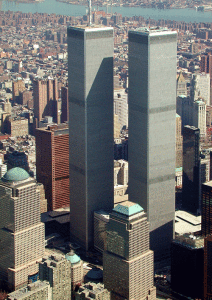
World Trade Center, March 2001
On the morning of September 11, 2001, Americans and people around the world were shocked by the destruction of the World Trade Center in New York City, and the damage done to the Pentagon in Washington D.C. after three passenger aircraft were hijacked by terrorists and flown into the buildings. There was also a fourth hijacked aircraft that crashed in a field in Pennsylvania after heroic actions by the passengers which averted further tragedy. Fifteen years later our world has been permanently changed by these terrorist attacks.
The collapse of the twin 110 story skyscrapers of the World Trade Center (WTC), with the loss of over 2,700 lives has drawn a lot of scrutiny since the Sept. 11 attacks. Some reports have criticized the design of the WTC Towers. With this article I’ll talk about the design and collapse of the twin towers.
The Twin Towers of the WTC complex was designed by an Engineering Team led by Minoru Yamasaki who passed away in 1986. Yamasaki was considered one of the most prominent architects of the 20th century. Prior to the 1960’s, most skyscrapers, such as the Empire State Building were built using the “steel frame” method, which can be best described as a large steel box with many small steel boxes inside it. The WTC Twin Towers used a method of skyscraper construction which is called the “tube-frame” design. Tube-frame designed skyscrapers use high-strength, load-bearing perimeter steel columns that are spaced closely together to form a rigid wall structure, with a core structure of steel columns housing the elevator shafts and utility shafts. One big advantage of the tube frame design was that it allowed for fewer interior columns, creating more usable space per floor. Each floor of the 110 story Twin Towers consisted of a four-inch thick concrete slab poured on a fluted sheet metal deck supported by a truss structure attached to the exterior walls and the core. (A truss is a structure comprising one or more triangular units constructed with straight members whose ends are connected at joints.) Included in the design was another truss structure called a “hat truss”, which was built into the top three floors. The hat truss was designed so that a large communication antenna could be fitted to each tower, but only one of the towers ever had an antenna added. Each Tower was split into three sections, with each section having a floor called a sky lobby and a floor dedicated to technical services. The sky lobby was designed so that people would take an “express” elevator to the sky lobby for their section of the building, then they would take a “local” elevator to their specific floor in that section. The technical services floors contained climate control equipment, electrical breakers, communications equipment, and elevator machinery. Each tower also had three stairways for use during emergencies.
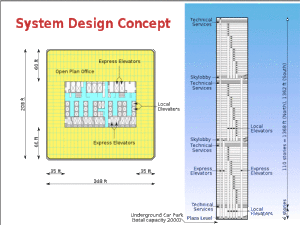
WTC Floor & Elevator Arrangement
The WTC engineering team also considered the possibility of an airplane crash due to the height of the towers. In 1945 an Air Force bomber lost in the fog had hit the Empire State Building. A design study was done where it was calculated that the towers should survive an impact from a Boeing 707, which was a first generation narrow-body jet powered passenger airplane.
Construction of the World Trade Center Towers began in 1968. The North Tower was called WTC 1, while the South Tower was called WTC 2. Both towers were completed by July of 1971. An estimated 20,000 people went to work daily at the twin towers. This total also included building technicians, engineers, custodians, security, delivery, and safety staff.
September 11, 2001 was primary election day for the City of New York, so many workers planned on showing up late for work that day so that they could vote. There were only around 8,900 workers in the Twin Towers by 8:45 a.m. that morning. At 8:46 a.m., hijacked American Airlines Flight 11, a Boeing 767 wide-body passenger airplane, flew into WTC 1 at an estimated speed of 440 miles per hour. Flight 11 carried 87 passengers and crew, had over 10,000-gallons of highly flammable jet fuel, and impacted between the 93rd and 99th floors of WTC 1. The impact damaged and/or sheared almost every exterior column on the North side of WTC 1. It also started many fires, severed the elevator shafts and all three emergency stairways trapping over 1,000 workers above the impact. Most occupants below the impact immediately started using the emergency stairways making their way to the main building exits at the ground floor. Many occupants of WTC 2 also started evacuating despite orders from building management, who assumed the plane crash in WTC 1 had been an accident, to stay put.
At 9:02 a.m., hijacked United Airlines Flight 175, also a Boeing 767 wide-body passenger airplane, flew into WTC 2 at an estimated speed of 540 miles per hour. Flight 175 carried 60 passengers and crew, had over 9,000-gallons of jet fuel, and impacted between the 77th and 85th floors of WTC 2. The damage was somewhat different than WTC 1 as Flight 175 impacted WTC 2 at an angle, leaving a portion of the building core with one emergency stairway intact. The overall damage was greater however due to the increased speed of the plane, and the damage to exterior columns on two sides of the building.
In both Twin Towers the hat trusses had the unintended function of redistributing the structural loads due to the damage to the exterior columns of both buildings. The jet fuel from the planes penetrated far inside the towers, igniting many large fires simultaneously over a wide area of the impacted floors. The fires also ignited the contents of the buildings. The fires were hot enough to weaken the core steel columns and cause some of the affected floors to sag, pulling perimeter columns inward and reducing their ability to support the mass of the building above. A large rescue operation was put into operation, with hundreds of New York City Firemen (FDNY) and Police Personnel from both New York City (NYPD) and the Port Authority (PAPD) responding.
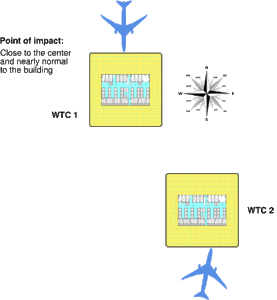
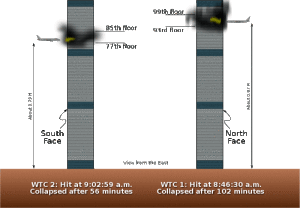
WTC Impact Locations
In all, 2,092 building occupants perished, along with 343 firefighters, 60 police officers, and 18 other rescue workers. The total killed at the WTC complex was 2,749; this total includes the passengers and crew of the planes and 35 others who were bystanders or occupants of nearby buildings. Almost 6,800 occupants of the Twin Towers were able to evacuate before the Towers collapsed.
n the time since the attacks, studies have been done which suggest that the Twin Towers were flawed in their design. In 2005 the National Institute of Standards and Technology (NIST) issued a report which suggested that the towers would not have collapsed if the fires had not weakened the remaining steel supports. The NIST report also stated that the blast from the impact of the planes blew away most of the fireproofing on the floor trusses in the affected areas allowing the fires to further weaken the floor supports. As each Tower began its collapse, the floors collapsed within the towers, one on top of the other in what is called a “pancake collapse”. The NIST report also included 30 recommendations for improving building and occupant safety.
One must consider that almost three-quarters of the building occupants in the Twin Towers managed to evacuate and survive, a large number considering the magnitude of the attacks that day. Also before the September 11 attacks, no skyscraper was designed to survive the high speed impact of a large modern airliner carrying thousands of gallons of jet fuel.
In addition to the heroes who gave their lives in the attacks of September 11, 2001, the Twin Towers should be praised instead of criticized, for staying up long enough for many occupants to escape.
Assistance with the writing of this article must be credited to the National institute of Standards and Technology (NIST) World Trade Center Disaster Study published in October of 2005 and numerous other written sources.