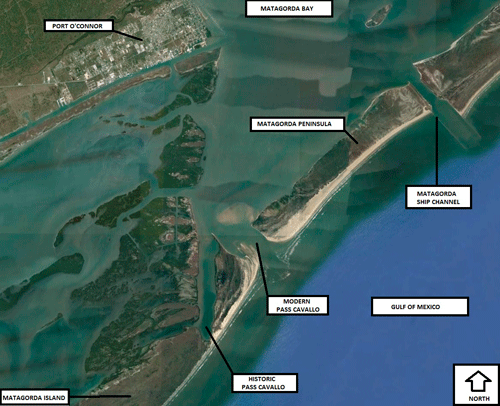
Satellite Picture (Google Earth) of the Pass Cavallo Area in 2016
One of the popular places in our area to visit by boat is Sunday Beach off of Matagorda Island. Many visitors do not realize that the main beach area is right on top of an historic ship channel, Pass Cavallo, which is the historical pass between the Gulf of Mexico and Matagorda Bay. Originally this natural channel had depths of up to 30 feet deep, but an ever shifting sandbar at the Gulf entrance would prove treacherous to many ships.
In 1965 the U.S. Army Corps of Engineers built a new ship channel cutting through the Matagorda Peninsula that was reinforced with rock jetties. This new inlet was named the Matagorda Ship Channel and dramatically changed the water flow between the Gulf and Matagorda Bay. The original Pass Cavallo channel began to “sand in”, eventually becoming blocked off from the Gulf as the sand around Pelican Island connected with Matagorda Island creating what is now called Sunday Beach.
Before the Matagorda Ship Channel was dug, a good number of ships and smaller boats were lost over the years trying to get into Pass Cavallo. In this series of articles, I will briefly describe the ships lost in the 280 year period before the Matagorda Ship Channel was dug, the history of the Pass Cavallo area, and the shipwreck searches that occurred in the Pass Cavallo area from 1998 to 2001.
French Explorer René Robert Cavelier Sieur de La Salle arrived off of Pass Cavallo in December of 1684. La Salle was on a mission to establish a French Colony on the Gulf Coast near the Mississippi River. Due to navigation errors, he had missed his intended target by a few hundred miles, and mistakenly thought that Pass Cavallo was part of the Mississippi River. La Salle attempted to send his supply ship L’Aimable through the Pass, but the ship grounded on the sandbar at the entrance. The wreck of the L’Aimable broke up in the surf and most of the cargo was lost. Another La Salle ship, the La Belle made it through the pass successfully and a colony was established called Fort Saint Louis. The La Belle later sank in Matagorda Bay and La Salle himself was killed by one of his own men in 1687 during an overland search to locate the Mississippi River. Fort Saint Louis was later attacked by Karankawa Indians and destroyed in 1688 with only a few survivors.
In 1687 a Spanish Expedition to find the rumored French Colony arrived at Pass Cavallo. At the time, Spain claimed the area that would become Texas as its own. While some shipwreck debris was found on Matagorda Island, the L’Aimable shipwreck was not seen and was probably completely sunk by then. Some smaller boats were sent through the Pass and the wreck of the La Belle was found partially above the water in Southern Matagorda Bay. Fort Saint Louis was not found during this expedition.
Louis Michel Aury, a Pirate who operated in the Gulf of Mexico and Caribbean in the early 1800’s, had established a Pirate base on Galveston Island in 1816. Sometime later he left with several ships for Mexico to assist in an attempt to overthrow the Spanish at Soto de Marina, Mexico. On his return to Galveston Island, Aury discovered that Jean Lafitte had taken his place as leader of the Pirate base. Jean Lafitte was another Pirate who had received a legal pardon from the U.S. Government for helping defend New Orleans against an attack by the British Navy in the final battle of the War of 1812. Aury then left Galveston with his ships and entered Matagorda Bay through Pass Cavallo in early 1817, and directed his men to build a makeshift town on shore consisting of log cabins. In late 1817 Aury abruptly decided to abandon the Pirate base in Matagorda Bay. He salvaged what items he could, loaded the ships, burned the log cabins, and prepared to leave Matagorda Bay. On the way through Pass Cavallo to the Gulf, one of Aury’s ships with a cargo of armaments wrecked in the Pass and quickly sank.
In the late 1700’s through the early 1800’s the Spanish and later Mexico (after Mexico gained its Independence from Spain in 1821) maintained several forts in Texas. Supplies for the Presidio La Bahía in Goliad were transported by ship through Pass Cavallo and unloaded near present day Port Lavaca. These supplies were then transported by ox-cart to Goliad. Early in 1830, two Mexico Navy Ships were sent on one of these supply missions; the Constante, carrying supplies, and the General Bustamente, carrying supplies & troops. The Constante sailed through Pass Cavallo without incident, but the General Bustamente ran aground. The crew and soldiers survived the sinking, but most of the equipment for the soldiers was lost after the ship broke apart in the waves. The survivors were stranded on Matagorda Island for a few days before being rescued.
During the Texas Revolution, three ships were lost in or near Pass Cavallo. In August of 1835, the San Felipe was transporting munitions for the Texas Revolution from New Orleans to Matagorda. While approaching Pass Cavallo, the Mexico Navy ship Veracruzano was sighted. The San Felipe unfortunately ran aground east of the Pass Cavallo Gulf entrance while pursuing the Veracruzano. Lost in the wreck were dry goods, rifles, and ammunition. The top deck of the ship remained above water for a few days after the sinking, and some cannons were salvaged. Some of the salvaged San Felipe cannons were sent to San Antonio and used in the historic defense of the Alamo in 1836.
The Hannah Elizabeth was another Texas Revolution supply ship that was carrying trade supplies and munitions from New Orleans to Matagorda. Some of the shipment was for Colonel Fannin and the newly formed Texas Army in this area. On November 19, 1835, a Mexico Navy ship, the Montezuma, sighted the Hannah Elizabeth along the Texas coast. During the ensuing chase the Hannah Elizabeth became stranded on a sandbar as the ship attempted to enter Pass Cavallo. The crew of the Hannah Elizabeth, realizing their ship was about to be captured, threw most of the cargo overboard. This cargo included 500 rifles, 2 field cannons, and ammunition. The Montezuma briefly captured the Hannah Elizabeth until severe weather forced the Montezuma to set sail for deeper waters, at which time a Texas ship, William Robbins, recaptured the Hannah Elizabeth. An attempt at a salvage failed when the Hannah Elizabeth suddenly rolled over and broke up in the waves.
In early 1836, the Texas Navy Ship Liberty arrived off of the Port of Sisal in Mexico and captured the cargo ship Pelicano Campeache. After capture, the Liberty crew discovered an immense cargo containing 300 barrels of flour, chests of expensive dry goods, high quality dishware, musical instruments, and gold and silver coins. In addition the Pelicano was found to be armed with three brass cannons, very valuable at a time when most cannons were made out of iron.
With a Texas crew on board the Pelicano, both ships sailed away from Mexico towards the Texas coast and arrived off of Pass Cavallo in February 1836. With the Liberty leading, both ships entered the Pass. The Liberty successfully entered Matagorda Bay while the larger Pelicano ran aground. Before the Pelicano broke up and sank, a quick salvage effort resulted in the recovery of several barrels of flour, and some of the chests containing dry goods. It was discovered later that each barrel of flour had a bag of gunpowder hidden in the middle, and the recovered dry goods chests were found to have false bottoms that contained jewels. Additional gold and silver coins were also found hidden in the recovered cargo. The Pelicano broke up and sank before the salvage effort was complete. The Texas Army led by Sam Houston, used some of the recovered gunpowder from the Pelicano flour barrels at the Battle of San Jacinto in April of 1836 when Texas finally gained its independence from Mexico.
In the next Pass Cavallo article, I will write about the towns of Indianola & Saluria, Fort Esperanza, and Pass Cavallo’s role in the Civil War.
Many thanks for assistance in writing this article go to Amy Borgens with the Texas Historical Commission, Steve Hoyt, formerly with the Texas Historical Commission. Henry Wolff Jr. of Victoria, and the U.S. Navy Historical Center for assistance in the research for this article. Additional thanks to Gaylen Youngblood, Elmer DeForest, and Kenny Finster.
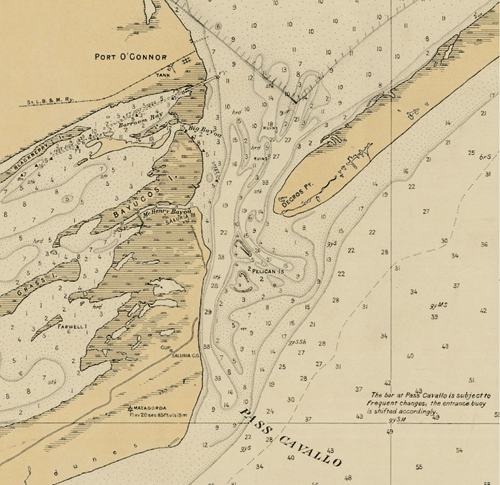
Map showing Pass Cavallo in 1931 before Sunday Beach was formed, this was before the Intracoastal Waterway and the Matagorda Ship channel were built, and it also shows the old town of Saluria and the Saluria Coast Guard Station – Map Source Author’s collection