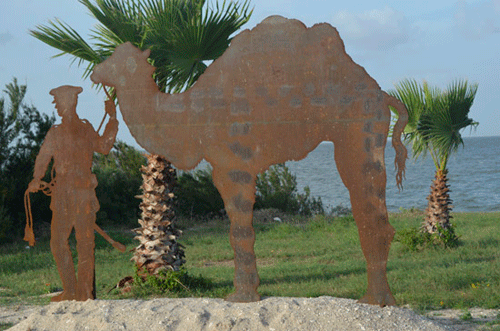
Of all the immigrants who became Texans upon arriving in old Indianola – German,Czech, Polish and more – perhaps none were more exotic than the seventy-five that came ashore in 1856 and 1857 from Algeria, Tunisia, Egypt and Turkey. But these new arrivals weren’t to be added to the census. They were camels.
Following the end of the Mexican War in 1848, the Treaty of Guadalupe resulted in the United States purchase of a vast Mexican territory, much of it spanning the southwestern U.S. from New Mexico to California.1 Before the time trains and even roads ran through this area, a creative means was proposed for traversing this harsh frontier. In what would become known as “The Great Camel Experiment”, Secretary of War, Jefferson Davis, proposed to Congress the using of camels as pack animals in the desert Southwest. Congress approved the request and appropriated $30,000 “to be expended under the direction of the War Department in the purchase of camels…to be employed for military purposes.”2
As early as 1836, the year Texas fought for and won its independence from Mexico, politicians, military men and diplomats were already considering the importation of camels for use in North America’s desert wastelands. It wouldn’t be until 1853, though, the year Mississippi Senator, Jefferson Davis, ascended to the position of Secretary of War, that the project was given a much-needed boost. Davis had seen the harsh desert conditions first hand when he served as an officer in the U.S. Army and recognized the military potential of the camel. Although Davis was unsuccessful in his initial attempt to receive the blessing and funding from Congress for his bold experiment, the appropriation bill for the purchase and importation of camels was approved on March 3, 1855.
After a three-month voyage from the Mediterranean, on April 29, 1856 the Supply dropped anchor in the Gulf of Mexico off the Pass Cavallo bar at the mouth of Matagorda Bay. It was preplanned that its unique cargo would be transferred to a smaller steamer, the Fashion, which could cross the bar and land the camels at Indianola, then referred to as Powder Horn. After several days of heavy swells in the Gulf and one attempt to transfer a camel between ships was aborted for safety reasons, it was determined that the Supply and Fashion would rendezvous in calmer waters inside the Southwest Pass of the Mississippi River to effect the transfer.3
After a successful transfer of the cargo, the Fashion returned to Matagorda Bay on April 13th and landed the camels at the wharf at Powder Horn. On that May day in 1856, thirty-four camels: two Bactrians, the two-humped variety, thirty-one Arabians, the more common, one-humped version, and one hybrid-cross of the Bactrian and Arabian came ashore. Major Henry C. Wayne, in charge of the camels, wrote in his journal, “…the camels were so wild to again feel solid Earth beneath them, they became excited to an almost uncontrolled degree, rearing, kicking, crying out, breaking halters, tearing up pickets and by other fantastic tricks demonstrating their enjoyment of the liberty of the soil.” 4
American taxpayers might be forgiven if they doubted the Congressional appropriation, had they witnessed the camels’ less-than-graceful entry into Texas.To the residents of Indianola, the camels created quite an impression and “the sight of the camels being led through the streets of Indianola, bells tinkling, was an experience to be remembered by the spectators for the balance of their years.”5 Years later, Mrs. Amelia Lewis recalled that day: “Yes, we remember the first camels. They were decorated with red blankets. My sisters and I ran after them. Where did they come from? I don’t know. We were girls, only little girls. We could not appreciate what it all meant. O! How the people were scared of them. On Sundays, the people would walk to Huck’s Garden, to the Lake. Everybody looked at the camels. A great sight!”6
By February of 1857, a second government shipment of forty-one camels would arrive in Indianola, more than doubling the herd, and military camel caravans became common in the Texas Hill Country between the camels’ home of Camp Verde (near modern Kerrville) and San Antonio, which was the headquarters for the Texas Department of the Army at that time. Camels routinely carried supplies, along with their military coworkers, the mule, horse, donkey and ox, but a true test of its capabilities had yet to be undertaken. In the summer of 1857 that would all change.
Still following the Gold Rush of ’49, immigrants were flowing west, but they required protection from Native Americans and lacked reliable routes. Lieutenant Edward F. Beale was given an assignment to survey the “Great Wagon Road” between Arizona and California. It was also decided Beale should utilize twenty-five camels along with the requisite number of traditional livestock on the expedition.7 The route Beale successfully surveyed would later be known as historic Route 66 and includes parts of modern US Interstate 40.
In 1859 and 1860 camels were used twice for reconnaissance in West Texas, surveying routes to the US/Mexico border, putting the camels in some of the harshest terrain they’d see on this continent. Lieutenants Hartz and Echols of the US Topographical Engineers were in charge of the two expeditions and both commented on the hardiness of the camel. Hartz related, “A rougher, more rocky, more mountainous, and rugged country, can scarcely be imagined. Descending by very steep slopes into the beds of the ravines, tumbling about for awhile among the rock in their beds, climbing the steep hillsides, forcing a way through thickets, and crossing an eminence of an unusual height…the performance of the camels was all that could be desired.”8 Unfortunately, there were forces far greater than nature conspiring against the camel and its chance at becoming fully adopted in America.
In 1861, upon the Federal forces withdrawal from Texas at the outbreak of the Civil War, Confederate troops found themselves in possession of all U.S. military assets in Texas, which included the camels at Camp Verde.9 Sea trade between the South and the rest of the world was blockaded at all Southern ports except Brownsville, Texas. The camels hauled salt and cotton between the Texas Hill Country and the southern tip of Texas, but the US Civil War was enough to doom the project. Even before, Colonel John “Rip” Ford, who acquired command of the camels, didn’t have much use for them. Ford wrote in one report, “The camels have been sent to Guadalupe for corn. Two are reported to have died on the way. They can live best on grass; it is not certain they will live on corn.”10
Upon cessation of the Civil War, the camels were auctioned off and they found themselves in private hands, used for freighting. Many labored building the railroads that would ultimately put the camel out of work. Some of these camels were subsequently sold into circuses and traveling menageries.11
According to Brownson Malsch, author of Indianola – The Mother of Western Texas, “The choice of Indianola as the landing point for the camels gave her a place in history of unique importance. On her soil there began one of the most extraordinary experiments in the history of the War Department…”12
Although the beginning of the Civil War effectively brought an end to this chapter of camel history in the U.S. – still, today, from Indianola to Camp Tejon, California, historical markers and monuments mark the way of this bold experiment across the American West that started at the frontier seaport of Indianola, Texas.
Documentation:
1 John D. Eisenhower, So Far From God: The U.S. War With Mexico, 1846-1848,
(University of Oklahoma Press, 2000), 369-370.
2 Report of the Secretary of War, Communicating, in Compliance With a Resolution of the Senate of February 2, 1857, information Respecting the Purchase of Camels for The Purposes of Military Transportation, United States Congress, Washington,
D.C., A.O.P. Nicholson, Printer, 1857
3 Chris Emmett , Texas Camel Tales, (Steck-Vaughn Company – 1969), 18.
4 Eva Jolene Boyd, Noble Brutes, Camels On The American Frontier, (Republic of Texas Press, 1995), 46.
5 Brownson Malsch, Indianola – The Mother of Western Texas, (State House Press, 1988), 104.
6 Emmett , Texas Camel Tales, 22.
7 Ibid., 118.
8 Eva Jolene Boyd, Noble Brutes, Camels On The American Frontier, (Republic of Texas Press, 1995), 115.
9 Chris Emmett, Texas Camel Tales, (Steckcamel-Vaughn Company), 151.
10 Murphy Givens, Camels Thrived in South Texas, (Corpus Christi Caller Times, March 10, 2010)
11 Emmett , Texas Camel Tales, 200.
12 Malsch, Indianola – The Mother of Western Texas, 103.