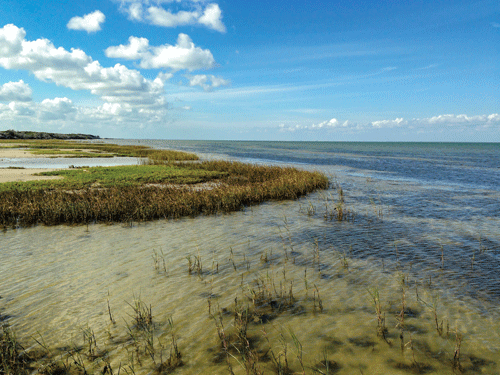
Coastal marsh shallows on Matagorda Bay at Powderhorn Ranch. -Jason Singlehurst TPWD
New Fishing Survey & Park Acquisition in Calhoun County
Excerpts from “Nurturing Nature Makes Dollars and Sense” by Cindie Powell. Reprinted with permission from Texas Shores magazine, (c) Texas Sea Grant College Program
With its outstanding natural beauty and ecological diversity, the Texas coast is a nature-lover’s paradise. While the conservation of Texas’ coastal natural areas will create an important legacy for future generations, it also makes economic sense today. In Texas, nature tourism spending in 2010 totaled $57.5 billion, supported 529,000 jobs that earned $16.5 billion, and generated $7.6 billion in tax revenues. In-state wildlife-related recreation in 2011 had 6.3 million participants who spent $6.2 billion in the state. A 2006 study found Texas saltwater anglers alone generated about $981 million in retail sales that year for a total economic output of $1.8 billion.
“We’ve got two trends going on right now in society that impact everything, but nature tourism specifically,” says Miles Phillips, Assistant Professor in the Department of Recreation, Parks and Tourism Science (RPTS) at Texas A&M University and an Extension Specialist in Nature Tourism with the Texas A&M AgriLife Extension Service. “One is that, as a general rule, people realize that they really value and want a quality environment, some because they want clean air and water, and some because they value the wildlife experience and the outdoor experience, like hiking or hunting.”
At the same time, the vast majority of the population now lives in cities instead of farms or other rural areas and doesn’t have opportunities for day-to-day experiences with the natural environment. “In terms of nature, public and private lands have more value than ever in providing these services,” Phillips says. “There’s more economic opportunity because of the law of supply and demand. We have more people and more demand, and we have less open space and wild animals, we have less dark sky, we have less quiet areas, so if you have them or can create them from what you have, there’s an opportunity.”
All tourism, if poorly managed, has the potential for detrimental effects. “There are definitely examples of places that have been improperly managed and therefore damaged because a lot of people were visiting them for the outdoor, wildlife-related experience that the place provided,” Phillips says. From large sections of the Great Barrier Reef damaged by careless divers to the trash left on Mount Everest, improperly managed nature tourism can leave more than footprints.
Ocean and coastal tourism is among the fastest-growing types, but these environments can be particularly sensitive. Visitors in too great numbers or too close proximity can disturb birds and marine animals, boat motors can tear up seagrass beds, and development to support tourism — construction of hotels, restaurants and other amenities — can increase runoff pollution, freshwater diversion and dredging. In many cases, visitors may not be aware of the negative impact their behavior can have on the environment, and educating tourists, local residents and especially the tourism industry to the connection between their actions and the long-term health and sustainability of the coastal environment is one of the keys to addressing the problem.
Phillips directs the Nature Tourism Development program at Texas A&M AgriLife Extension. Focusing on adventure tourism, agritourism, fishing and hunting, the program offers resources on its website (http://naturetourism.tamu.edu) and conducts training to help communities, businesses and nonprofit organizations that are both economically viable and ecologically sustainable. He calls the approach “market-based conservation.”
Periodic national- and state-level surveys give the big picture (of the economic impact of nature tourism), but studies at smaller, more local scales are done less frequently if at all, even though knowledge about the economic importance of natural areas can be crucial in local decision-making. A study now under way in Calhoun County is gauging the importance of recreational fishing to the economy there.
Agricultural Economics Assistant Professor and AgriLife Extension Economist Dr. Rebekka Dudensing is working on surveys of saltwater anglers in Calhoun County to determine the economic impact of sportfishing there at the request of and with help from Rhonda Cummins, Texas Sea Grant’s Calhoun County Coastal and Marine Resources Agent.
“Everyone knows that we have a lot of recreational fishing and fishing tournaments in Calhoun County, and everyone assumes that they bring in a lot of dollars, but no one has ever measured the economic impact. This is long overdue,” Cummins says, adding that the surveys are intended in part to quantify the extent that the area, and in particular Port O’Connor, has changed from a historically commercial fishing economy into a recreational fishing one.
Dudensing says the surveys will help local residents better understand the changing economy of their community. “When we look at the decline in traditional fishing on the Texas coast and nationwide, there has to be something to pick up the slack in these rural areas,” she says. “A lot of times that is tourism, so understanding how that industry is working is very important.”
The surveys will focus on the expenditures of recreational anglers, including sales and hotel occupancy taxes, and include the number of jobs and labor income that result for people living in the area. Dudensing says it is important to quantify the economic benefits like tax revenues for local leaders so they can make more informed decisions, but it is equally important for average residents to be aware of the positive impacts from tourism in their area to offset the perception of negatives like increased traffic. Though it is not always the case, she says, economic surveys can also sometimes pinpoint new business opportunities.
More changes are in store for Calhoun County after a surprise announcement in late August of a major land acquisition for a future state park and wildlife management area a stone’s throw from Port O’Connor. A coalition of conservation and natural resource organizations, including the Texas Parks and Wildlife (TPW) Foundation, the National Fish and Wildlife Foundation (NFWF), The Conservation Fund and The Nature Conservancy, funded the purchase of the 17,351-acre Powderhorn Ranch for $37.7 million, the largest amount raised for a conservation land purchase in the state.
For decades, the conservation community had been eyeing the Calhoun County property, one of the largest still mostly untouched tracts of coastal prairie, but lacked the resources to purchase the land. Coastal property values continued to rise, making the possibility of preserving the habitat more unlikely. Enter the 2013 plea agreements by BP and Transocean from the 2010 Deepwater Horizon explosion and oil spill, which resulted in the two companies’ funding more than $2.5 billion over a five-year period for NFWF’s Gulf Environmental Benefit Fund to support projects intended to benefit species and habitats impacted by the spill.
From the fund, NFWF was able to commit more than $34.5 million over three years for the Powderhorn Ranch purchase, making it the largest land acquisition in the nation to date using BP spill restoration dollars. Meanwhile, TPW, a nonprofit organization that raises funds to help the Texas Parks and Wildlife Department (TPWD) meet its management and conservation goals, was raising funds through private donations. The Nature Conservancy of Texas and The Conservation Fund also each provided $10 million in interim funding and will be reimbursed by TPW, which will be the sole owner of the property by 2016; it will ultimately give the property to TPWD for development and management.
“In years to come, after the Texas Parks and Wildlife Foundation turns it over to the Texas Parks and Wildlife Department, we will go through a public master planning process,” says Tom Harvey, Deputy Communications Director for TPWD. “We will get stakeholder input, hold public meetings and develop a plan for managing, opening and public use of Powderhorn as a state park and wildlife management area.”
The property is important in part because of its size. “The bigger the piece of ecology it is, the more functional it’s going to be,” says Dr. John Jacob, Texas Sea Grant’s Coastal Community Development Specialist. “That’s not to say that small, 100-acre pieces aren’t important, but it so much more important to save big pieces like this.”
The property includes forests of coastal live oak and thousands of acres of freshwater wetlands and salt marshes. “This is an area that’s never been plowed, never been land-leveled,” Jacob says, calling the land’s ecology “world-class unique.”
Powderhorn Ranch sits on the Ingleside Sand, an ancient former barrier island dating back 100,000 years or more. “This landscape has been there long enough that the mastodons stomped around on it,” he says. The coastal prairie on the ranch consists of a complex pattern of prairie potholes, or freshwater depressions, and pimple mounds, which are small knolls or humps of land one to two feet tall; their close proximity to each other creates an area of short-range habitat complexity.
“You just walk five feet and the environment changes,” Jacob says. “Some of these potholes might be wet for six months out of the year, then you’ll walk through areas that are intermediate, and then there’ll be pimple mounds that will be semi-arid or arid. You go from very wet to very dry in a very short range.”
In addition to the coastal prairie and live oak forests, Powderhorn Ranch boasts more than 11 miles of tidal bay frontage, roughly half on Matagorda Bay and the other half facing Powderhorn Lake, a tidally influenced secondary bay off Matagorda Bay. Four miles front Live Oak Bayou. Port O’Connor is to the southeast, and the property is also bordered by FM 1289 and State Highway 185.
The property is surrounded by several other public and private preserves, wildlife refuges and wildlife management areas, including the Aransas National Wildlife Refuge, which has one unit only three miles away across Powderhorn Lake and the main unit 25 miles to the southwest. The main unit is the primary wintering grounds for the world’s only wild migrating flock of endangered whooping cranes, which have been expanding their winter range in recent years and recently have been seen on Powderhorn Ranch. The property’s conservation can provide additional wintering grounds for the species.
Cummins maintains a kayak trail around Powderhorn Lake. She says the purchase provides a great opportunity for future public access to the previously privately owned waterfront. “Public access is a huge issue, because there are too many places that the public can’t go. With the Texas Parks and Wildlife Department managing it, people will have more shoreline and more places to fish, kayak, sail and go birding.”
This article provided through the assistance of the Mid-Coast Chapter Texas Master Naturalists.
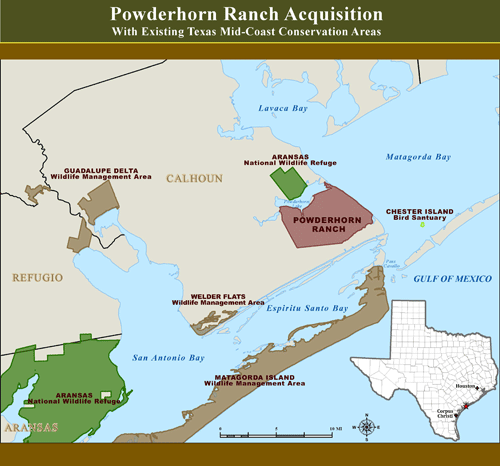
Map of Powderhorn Ranch Acquisition
by Earl Nottingham, TPWD