The Endeavor by Larry Wegeman

Archived in the category: Fishing Reports, General Info
Posted by Joyce Rhyne on 18 Dec 14 - 1 Comment

Ten of the best years of my life concluded just before Thanksgiving Day when the 52’ wooden boat called Endeavor rolled a hull 180 degrees to an upright position. Now, it looks like a boat, but in December of 2004 it was more of a dream. A nine foot tall stern was cut using several pieces of marine plywood; screwed and glued to form the first complete component of Endeavor. The craft has since come a long way. The building site was changed, the hull was lengthened, and the design was set to that of a World War II PT boat.

The keel was laid and the stem attached to a transom of solid mahogany. Fourteen frames were added between the stem and transom, strengthened by longitudinal stringers from bow to stern. This took six years. At this time, the boat weighed 8,055 lbs., was right side up (with the keel down) and needed to be rolled so that the hull could be constructed.

Don Haynes of Action Welding came to the rescue with a 15 ton crane and several men. In a few hours the boat was rolled and a new phase of hull construction began. This consisted of adding longitudinal stringers to the bottom (could not be done as the boat was resting on the bottom) and by adding four thicknesses of 3/8” marine mahogany plywood. As I added the plywood, I figured the weight. It became clear that when the hull was to roll again, it would weigh 17,000 lbs.

The 3/8” marine mahogany plywood comes in 4’x8’ sheets. Ripping the sheets into 8” wide strips (or planks) provides six planks per sheet. Strips are necessary to insure taking the boat’s contours properly, without fracturing or resisting the accuracy of the bend. Total plywood is 140 sheets, or 840 planks. At 45 pounds per sheet, the weight adds up, and this does not include the hardware or epoxy. And the hull is still not ready for painting.

The final protective measure is fiber glass. It does not weigh as much, but needs to be filled with epoxy and left to set four days before final sanding and painting. Once the epoxy sets up, four coats of marine, epoxy paint is added and two coats of red anti-fouling bottom paint on top of that.

All along, I knew the boat would need external protection to roll. Otherwise, it would destroy itself. On rainy days I worked underneath, adding athwart ship stringers to support the post and starboard shears, but this would not be enough. Five square wheels were built externally, around the entire boat. This would enable the boat to roll 90 degrees at a time, but would add even more weight.

Friends keep in touch, and Don Haynes of Action Welding drove by almost daily. One day he asked me how much the boat weighed. I answered very close to 20,000 pounds. He wondered how he could be of help.

The task of rolling the boat weighed heavily.

But, where there is a will, there is a way.

Boating people are a close knit bunch, and several friends of mine transport sailing vessels from Europe, or wherever, to wherever. One such friend is Fritz Ficke of Tuscon, AZ and glad to say that I have known him and his wife Leah for more than twenty years. They follow my progress faithfully and were eager to know how I plan to roll the boat. I mentioned Don Haynes and also the prospect of bringing in a crane from Victoria. However, as I learned on the first boat rolling, a crane only lifts the boat. It cannot do the rolling.

Fritz and Leah told me to give them two weeks’ notice and they would come to Port O’Connor.

Don Haynes stayed in touch, so when Fritz and Leah arrived, Don was right here. Fritz had ideas on rigging the roll, and Don Haynes gave us the use of chains, hydraulic jacks, and chain come-a-longs, but he could not get the crane close enough to ensure a safe lift.

It did not take long to realize that Fritz knew what he was doing. We attached chain come-a-longs forward, mid ships, and aft, to the pylons that run the length and on each side of the boat. Two more chain come-a-longs were hung over the top of two pylons for lifting and dragging the high end, but to get the boat started, two hydraulic bottle jacks fore and aft were needed. The boat lifted a half inch at a time.

Soon a rhythm was established; pull the come-a-longs fore to aft, one at a time and jacking simultaneously. It took three days from dawn to dusk. As the boat rose, blocking was placed underneath for safety. Rain on one day did not stop the work, and the next day we worked in mud. Working the equipment against the square wheels and never placing a come-a-long or jack against the boat, the work finally came to fruition. On the final 90 degrees of roll, the boat settled on the pylons and slid to rest. The transom was level as was the keel. The pylons will never be the same.

All the meals were furnished at Josie’s Restaurant and drinks, too.

Fritz refused any offer of money, even gas money from Tuscon – a distance of 1,100 miles. They say a friend is worth a million dollars, and that thanks is never required.

“No one has ever rolled this boat before. In fact, few people have ever rolled any boat,” Fritz said as they started the drive home.

*Editor’s Note: Larry Wegeman has been reporting on his progress in Dolphin Talk since November of 2010. When it is completed and launched, he plans to live aboard his boat.
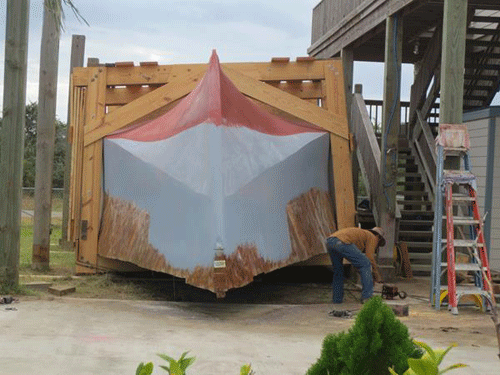
The Endeavor Upside Down
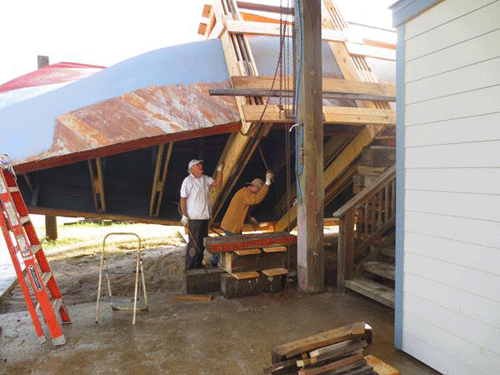

The Endeavor Turning Process
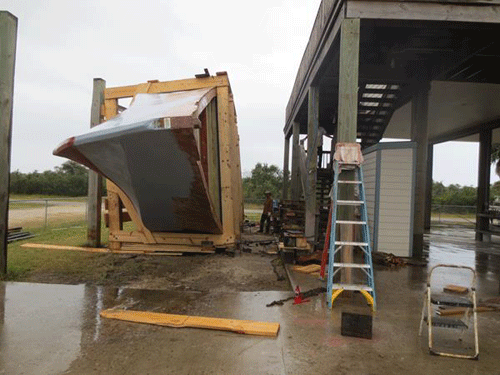

Turning the Endeavor
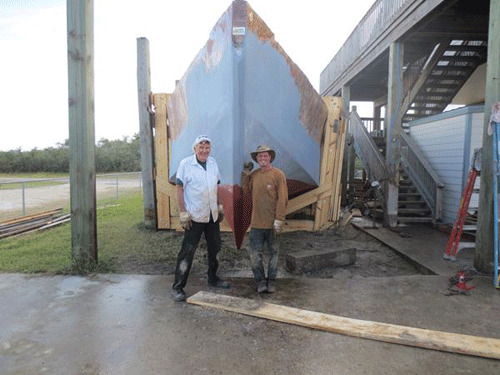

The Endeavor Upright
Saltwater Lodge Outdoor Report by Captain Jeff Larson

Archived in the category: Fishing Reports, General Info
Posted by Joyce Rhyne on 18 Dec 14 - 0 Comments

Capt. Jeff Larson


How was your 1st half of duck season? I just finished measuring my trigger finger; it was 15% larger than last year at this time, same dry splitting skin areas, but 5% smaller than the year before last. That’s how I measure my 1st half. I think its natural, but most hunters measure their success in number of ducks strapped. Common comments we hear are, “we limited out”, “killed limits”. My favorite is, “we shot a Port O’ Connor limit”. Do you know what that one means? The Port O’Connor limit is 2 pintails and 2 redheads. When we were younger the numbers measured the success of the hunt. The more we duck hunt, get older, hopefully wiser, the successful duck hunt definition changes; we begin to appreciate the days where we shoot near limits, pay closer attention to sunrises and sunsets, getting through the hunt without incident. That’s really how I measure the hunt or season, Not how many times I pulled the trigger; that was a joke. Speaking of an incident, I need to tell you about the accident that occurred last month.

The tides are receding, which most of you are aware of, it’s an annual phenomenon; hopefully you are making your boating adjustments and you are taking safer routes. The accident that was at the Fulghams Cut. It happens to even the best mariner. There were three fishermen coming back into the cut from a great day on the water.

The Fulghams Cut is silting in, plus with the low tides there is a very narrow channel that is only a few feet wide. There are PVC poles that are marking the cut but they are not as close to the deepest part of the cut as you might think. These fishermen missed the deepest part of the cut, running at a pretty good clip, slammed into the sand and one of the fishermen went OVERBOARD! The boat ran over the fisherman causing serious injuries. I was at the scene after he went to the hospital and watched the other good Samaritans pull the stuck boat to the channel so they could get to their buddy.

Over the years, this cut has been the scene for many accidents and I have been told of a fatality, years ago. The other cut that has been the scene of boating accidents is the entrance to Pringle Lake. These are the two trouble areas that when we get into the winter time low tides that you need to proceed with caution. That’s really the best advice I can give you other than if you are not familiar with this area, hire a guide, there are plenty of us who would like to take you fishing and show you the trouble spots in our area.

December has been a great month for fishing and catching. Whatever you target and however you target your fish of choice, fish catching should be good all month. If you are looking for a specific fish to target call Scott at the Lodge and he will hook you up with a guide that specializes in catching your fish of choice.

YES! Duckseason reopens and there seems to be plenty of birds from Matagorda to Mexico. So good luck this 2nd half.

Hog hunting is getting cranked up and with colder temperatures approaching they seem to be coming out during the day on a regular basis. The Lodge has some availability for duck hunts so don’t wait because the 2nd half is underway and it closes next month. Capt. Jake is killing plenty of specs, snows and blues. He had a great shoot the other day with customers Ron Smith and Bret Price. December is going to be rockin’ so book now and often.

Hope to see you on the water. Please be careful as you run through the channels and back bays. It’s OK to get stuck but getting thrown out of a boat usually results in someone going to the hospital.

The Saltwater Lodge reservation line is: 361-785-3825. Wishing you a Merry Christmas, Simms Waders, and a new shotgun with plenty of shells!!!

Captain Jeff Larson 281-217-0399.

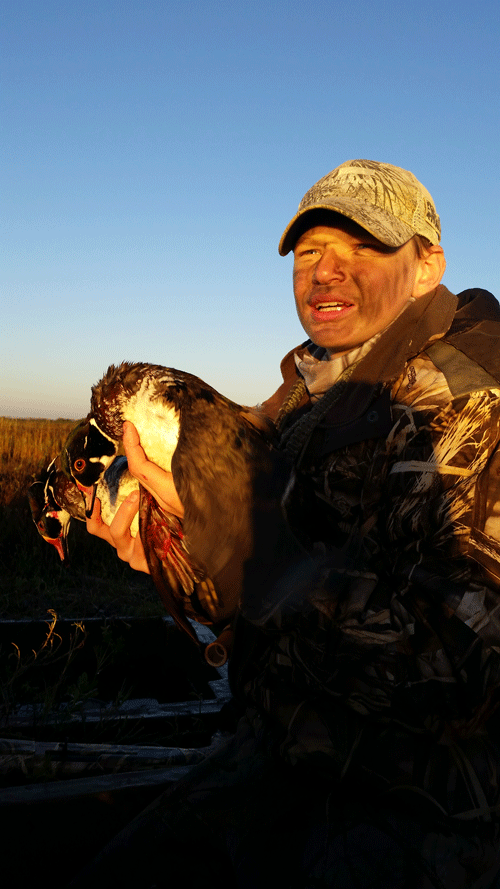
A pair of Wood Ducks that were lost after a cold front. Duck Calling Champion Brennen Larson bagged them Thanksgiving morning in the bay. Wow! Great Shot!

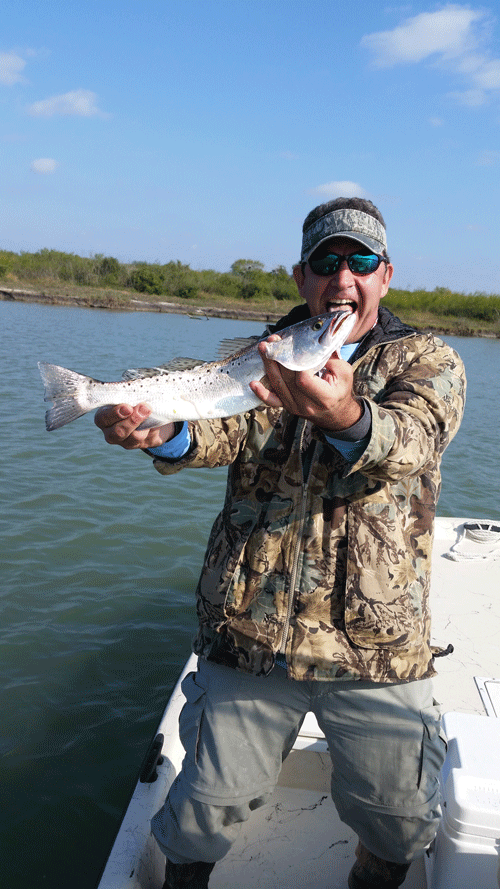
Ron Smith with a speck drifting mid bay reefs. Capt. Jeff Larson

Thou shall not covet another man’s duck blind By Robert Sloan

Archived in the category: Fishing Reports, General Info
Posted by Joyce Rhyne on 18 Dec 14 - 0 Comments

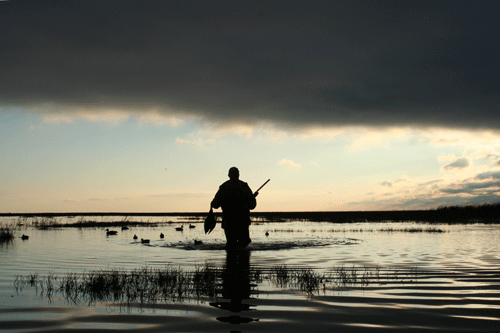
A steady stream of cold fronts has moved plenty of ducks down the Central Flyway, and here in Port O’Connor there are huge flights of birds that include redheads and pintails. Robert Sloan photo


The second split of the South Zone duck hunting season is open through Jan. 25, and based on what I’ve seen the past several days we definitely don’t have a shortage of birds on the bays, flats and marsh out of Port O’Connor. In fact, we’ve got redheads swarming like bats out of a cage; pintails seem to be plentiful, ditto that for scaup and bufflehead.

Duck blind poachers are worthless

Something that seems to be gaining in popularity here in Port O’Connor are the numbers of duck hunters that are too lazy to build their own blinds, and don’t hesitate to set up in just about any blind they can find. Last season I waded up to one of my primo duck hunting holes and found two grown men sitting in my blind. They politely informed me that they were on public water and had no intentions of leaving the comfort of my hard work. That’s about as low as a duck hunter can get. It’s akin to stealing in my way of thinking. Game wardens tell me that duck blinds built on public water are open for a first come first serve deal. However, they have also told me that it’s an unwritten rule that hunting in another person’s blind, without permission, is taboo.
Sky blasting is a waste of shotgun shells.

Aside from having no shortage of blind poachers there is also no shortage of sky blasters – a.k.a. duck hunters that will shoot at birds well past the range of steel shot. Shooting at ducks inside of 35 yards is fine and the way it’s supposed to be done. Conversely, shooting at ducks passing overhead at 50-plus yards is asinine, and does nothing but educate the birds.

The greatest thing a duck hunter can do is set up a good decoy spread, have a well camouflaged blind and be able to call birds within shotgun range for a sure kill. That’s the way it’s supposed to be done.

Calling all redheads

Just recently I had a duck hunter tell me that he didn’t use a call for diving ducks like redheads and scaup. His reason was that they don’t quack much. Even at that I can guarantee you that these ducks will definitely respond to calling, that is unless it sounds something like a predator call. The trick is to get their attention, then tone it down to nothing as they move toward the decoys. I’ll switch over from a duck call to a pintail whistle when the birds are just about within easy shotgun range.

Buffleheads by the thousands

One of the most abundant ducks on the middle Texas coast is a bufflehead, one that is often passed up by many duck hunters. Texas holds the record for the highest winter count of buffleheads of any state. The average number found in Texas, both on the coast and in the interior, has been recorded at 4,300. The daily limit is six.

A bufflehead is the smallest diving duck in North America. The name “bufflehead” is a direct reference to the duck’s large-headed appearance. The male is black and white with a large white patch extending from the eye to the back of the head. The female is dark brown above, paler below and has a small white cheek patch.

Nine times out of 10 buffleheads will fly low, as in 1 to 5 feet off the water, and will often swing into a spread of decoys when you least expect it.

Money Minnows for winter trout

Just recently guide Curtis Cash and I launched my 22-foot Mowdy and headed out to fish a flat adjacent to a channel. This particular area is about 5 feet deep and is a good spot to find trout just after a cold front moves through. We fished it on a low tide and used 3.5-inch Yum Money Minnows rigged on 1/8 ounce Bomber Shad-Head jigs. During two hours of fishing we boxed nine trout to 2-1/2 pounds. The best color combination was a yellow jig head on a pearl/chartreuse Money Minnow. The key was to slowly yo-yo the lure at about three feet deep. That water depth and that lure is a classic winter pattern for taking cold water specks.

Capt. Robert Sloan runs bay, jetty and duck hunting trips out of Port O’Connor. For details call 409-782-6796.

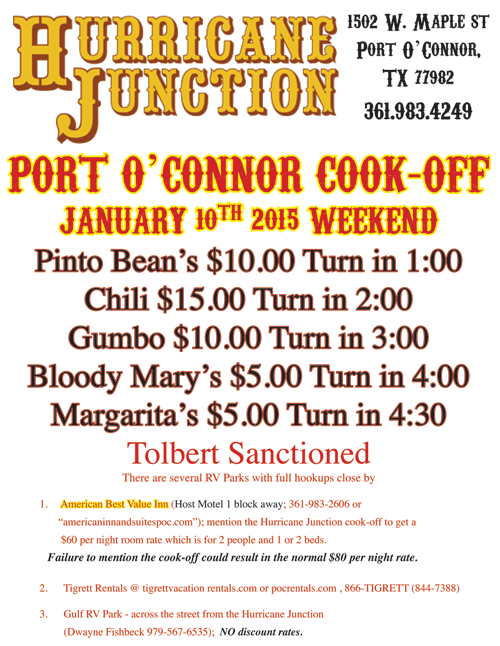
Cook Off at Hurricane Junction

Archived in the category: Announcements, Events, General Info
Posted by Joyce Rhyne on 18 Dec 14 - 0 Comments

Our Lady of the Gulf 4H News by John P. Hernandez

Archived in the category: General Info, Organizations
Posted by Joyce Rhyne on 18 Dec 14 - 0 Comments

Our Lady of the Gulf 4H started their year on October 3 by electing 4H Officers for 2014-2015. OLG 4H President is Ben Chen; Vice President, Erin Dent; Secretary, Jenny Pham and Reporter, John P. Hernandez.

The Calhoun County Fair was held in October from the 14th to 18th. Our members worked hard raising their animals for the Fair. Saturday, Oct. 18, in the evening, 4H and FFA had a Public Speaking contest at the Bauer Center. Congratulations to the winners!

On November 6, 2014, Our Lady of the Gulf had their second meeting and has started working on rockets! We expect to have a great time while learning.

Untitled Document