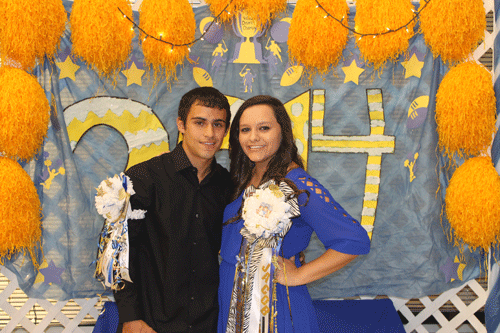
On November 7, 2014, Seadrift Middle School held their annual dance. Crowned King and Queen were Jacob Guerra and Krislyn Key.
On November 7, 2014, Seadrift Middle School held their annual dance. Crowned King and Queen were Jacob Guerra and Krislyn Key.

The City of Port Lavaca and the Calhoun County Historical Commission will be hosting the Lavaca Artillery Battery Silhouette Ceremony on November 22, 2014 at 11:00 a.m. at the Bayfront Peninsula Park in Port Lavaca. The public is invited to attend.
The metal silhouette represents the Home Guard firing on two Union gunboats that fired on this small town on October 31, 1862. Accurate fire from the shore batteries forced the ships to move outside the range of the smaller shore guns before resuming fire. The ships fired again on Lavaca the morning of November 1. A total of 252 rounds of shot and shell were fired by the Union navy, but caused no loss of life in a town suffering a yellow fever epidemic at the time.
“…nobly did both officers and men perform their duty, working their guns as coolly as though on inspection, while a perfect storm of shot and shell rained around them. And this, although yellow fever had decimated their ranks.” – Lt. and Adjutant George E. Conkin.
Calhoun County had a very active participation in the Civil War. The Green Lake area in the Guadalupe River Bottom housed all of the Federal Soldiers who had to leave Texas in 1861. Fort Esperanza and Saluria were destroyed and the Federal troops tramped/sailed past Port O’Connor to take over Indianola. On Christmas Eve 1861, the Battle of Norris Bridge took place and Federal troops marched into Lavaca on Christmas Day.
I moved to this county in 2006; never had I such a curiosity for a particular location. I’d always been surrounded by history and I was quite astute to history in the places I had lived, traveled or hoped to one day visit. However once you find yourself surrounded by history — down the rabbit hole you go.
Years later I’ve had the pleasure of interviewing numerous locals, historians and people such as myself, simply in search of knowing more about the people that walked the very same soil hundreds of years ago. Recently I’ve taken a fondness to reading books which can tell me more about the coast as it was a century ago. Often times these are reference books I can’t take out of the confines of the library. However my luck was about to change…
There I was buried behind a pile of new (to me) reference books. I skimmed their pages, reading about the Texas coast and then came to a section about the first (Calhoun) county government meeting held on September 22, 1846. That was all it took for the rest of the noise in the library to cease and other tasks I should have completed that day to be quickly forgotten by the tidbit of history I had just unearthed.
I read on for several pages and no other mention was said of our county or any establishments thereof. Disappointed I turned back to the section about the meeting and noticed a footnote. I scribbled the reference on a piece of paper I had tore off of my notepad and searched the library system for the book. It took me a bit, but I found the book they were referring to, Reminiscences of Fifty Years in Texas by John Joseph Linn. The book was published and copyrighted in 1883 and reproduced in 1935. It covers Linn’s memoirs from the early 1800s. AND it wasn’t a reference book; I could check it out and take it home with me!
John Linn was born on June 19, 1798 in Antrim, Ireland however immigrated to New York City two years later with his family. It took them two months to arrive in NYC and their family resided in the area for numerous years. It was not until July of 1829 that Linn aboard a friend’s schooner arrived via Corpus Christi Bay to sell tobacco to Mexico. While that journey did not go well for him; he did find his new home — Texas.
Following the unpleasant first journey to Mexico, he returned to Texas and fell in love with it’s rich, green countryside which was abundant with wildflowers. Nice to see that hasn’t changed! At the time, Linn exported goods from Louisiana and sold them to Mexican soldiers. He traveled all over Mexico, setting up stores and traveling to and fro Texas and Louisiana.
I greatly admire his tenacity to ensure that his book is known to be “recollections” of the past and does not claim them as “history.” There are many instances when he can, and in fact does, make note of past authors who have not written the history according to actual fact.
Linn became a resident of Victoria and would sail from Louisiana into Corpus Christi Bay, Matagorda Bay, Aransas Pass, Pass Cavallo and traveled via the Lavaca River. He was familiar with Victoria, Linnville, Long Mott, San Antonio and most of the Texas coast before many cities or counties were born.
At this time in the early 1800s, a cow and a calf were worth $10, a bull or heifer $5 and the main crops were cotton and corn. Soldiers carried shields made of dried rawhide, some of which could be dated back to 1734 AD.
This is a great read because it’s immersed in conversations with influential people from two centuries ago; I’m sure you will recognize many of the Colonels. In addition much of our spectrum is talked about. For instance, Major Kerr was surveying the land in our area in the fall of 1834. He along with six or seven others were camped out at Long Mott but prior surveying, they were informed that Carankua Indians were steadily approaching. The story tells that the Indians were told there were soldiers in the mott with a cannon and came to confirm the story. The men took warlike measures and the Indians retreated.
Once they stood down, Don Fernando de Leon invited one of the Carankua Indians for a parley. He was then able to form a petition with the Indians. They were to immediately cross to the west side of the bay where no colonists occupied the land and remain there in exchange for tobacco. The Carankuas agreed and retreated leaving Major Kerr able to survey Long Mott, the bay all the way to where Indianola is present day.
In many ways, I felt fifteen again, reading a book assigned as a project during Texas History. As I continued to read the pages of this 369-page book, I want to escape to these familiar touristy places; Washington-on-the-Brazos and the Alamo. I want to stand there and read the words there were published so long ago. Times were vastly different, difficult, strenuous and in the end I hope we can make those pioneers happy and proud about what has turned out thus far.
John Linn went onto be a very famous entrepreneur in our area. I’d like to tell you about that in the next edition of The Dolphin Talk. If you can’t wait until then you can read ahead, Reminiscences of Fifty Years in Texas, is available for purchase online at: http://www.amazon.com/Reminiscences-Fifty-Years-Texas-John/dp/0938349007. Till next time! Happy Thanksgiving!
Annual Thanksgiving Service held November 16 at St. Joseph Church
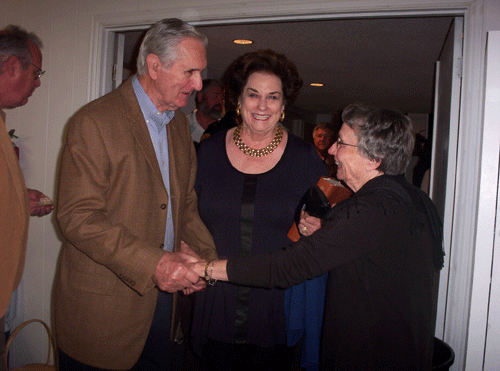
Clara Paulk (r) greets Kenneth and Grady Jean Clark at the Port O’Connor Community Thanksgiving Service on November 16.
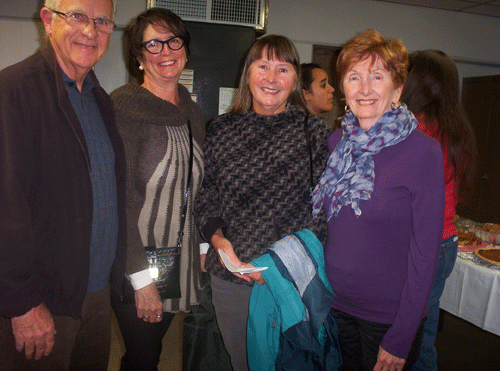
Joe Wiatt, Suzanne Eberhard, Petra Hockey, Vera Wiatt
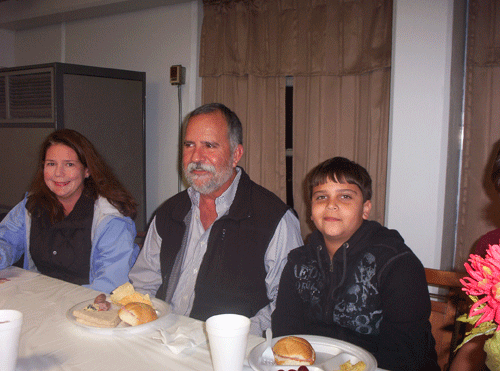
Shelly Hill, David Vasquez, Anthony Luna
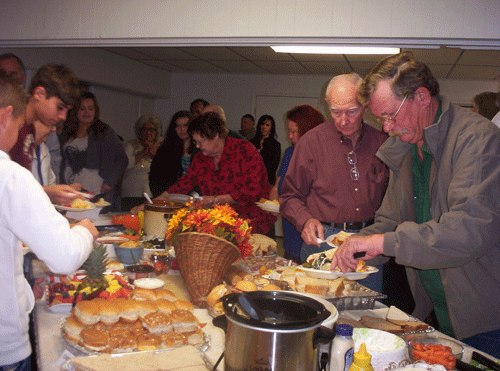
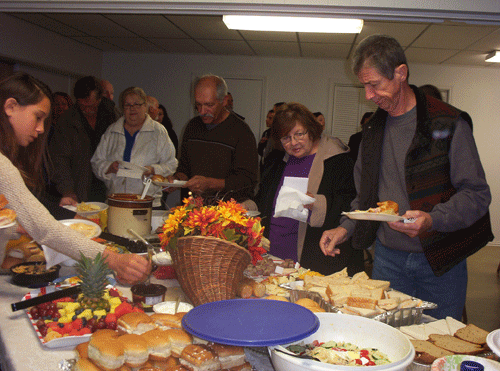
An abundance of great refreshments, thanks to St. Joseph ladies.
Thanksgiving- A Very American Eclectic Holiday
I conducted an unofficial and non scientific survey of how POC-ites celebrate Thanksgiving. The names have been deleted to protect the crazy, but local lunatics, fanatics and other opinionated persons have shared with us the traditional, nontraditional and downright goofy ways they celebrate thanksgiving.
One family remembers the corn of the first thanksgiving by putting candy corn on each plate and family members share one thing they are thankful for each time they eat a piece. An elderly lady said she taught her family to write thank you notes by having everyone write a thank you note telling what he or she is thankful for, and they are not permitted to write health, family or money. The notes are thrown into a bowl. Each person then picks and unfolds one paper and must guess who wrote it. A kindergarten grandson wrote to the chickens thanking them for eggs because that was all he knew how to spell, and a homesick college student wrote to ‘JetBlue’ grateful for cheap tickets home. A local family of German descent picks a different ethnic cuisine to try each year and everyone picks a dish to bring and share from that culture. Some have been a great success, but a few have been epic failures. The young lady said her granddad really hated Chinese cuisine for Thanksgiving, but thought the year they did Cuban food was great.
A man made me promise not to name his family, because people would now know they were all crazy. They hold a contest to see who can get a spoon to balance on their nose the longest. “I have no recollection of how that tradition began,” John says. “It’s a contest we’ve been doing for the past couple years and my mom is usually the winner, either because she cheats, or because her nose is distinctly shaped. Several fairly normal people act like crazy children and have a great time with a bunch of spoons.”
A young mother told me that her grandmother started the tradition of keeping last year’s wishbone to pull for wishes or dreams at this year’s family meal. They have done it for years. Her preteens asked if they would still get to draw names for the wishbone even though Memee went to heaven this year. She assured them they would. The tradition continues. A school boy told of a new tradition they are planning. They are making a ‘thankful tree.’ They will each write what they are thankful for on colored paper and decorate a small tree with the paper curls. They plan to keep it up through the holidays.
Quite a few families intend to usher in Christmas just as soon as the turkey is eaten. They are putting up lights, decorating trees and shopping, shopping, shopping. ‘Black Friday’ plans were mentioned by women while some men had hunting trips scheduled or fishing outings planned. Lots of women are going power shopping; almost everyone is planning to watch some football. Pies and cakes and cookies were anticipated, and surprisingly several people mentioned eating olives. One group of sisters has been sticking them on their fingers and eating them off one by one since they were children. The oldest sister said ‘I don’t think that is very unusual, but we ALWAYS picked out ten olives each, stuck them on our fingers, and somehow found that to be the funniest thing ever. We would laugh while we ate them off our fingertips. This quirky tradition found its way back every year, and it’s one of my fondest memories of Thanksgiving. I’m embarrassed to say that at least one of us still does it each year, now with the grandchildren…”
A blended large family draws secret Santa names for gift exchange at the Thanksgiving meal because they know that everyone will be there. A couple mentioned they like to play cards and board games together after they eat. It seemed like everyone had something that made the day special just for them.
While the tradition of the holiday may be old, it continues to adjust and transform as people observe and celebrate. John F. Kennedy said in one of his holiday speeches that our nation reflected the nature of its people and our holidays reflect the changes of our nation. More than fifty years after the death of President John F. Kennedy, many in our communities exemplify his Thanksgiving message, “As we express our gratitude, we must never forget that the highest appreciation is not to utter thankful words, but to live by them.” Happy Thanksgiving!
| Search |
 |
