Cooking With Seafood

Archived in the category: General Info
Posted by Joyce Rhyne on 17 Apr 14 - 0 Comments

The next Cooking with Seafood gathering will be April 21, 6:00 p.m. at Bauer Exhibit Building, County Fairgrounds. Leslie Hartman returns with a shrimp recipe to share along with information about this marine species.

May 19th will be the return of Jack La Barge as our volunteer chef. He will treat us to one of his kitchen favorites: Seafood Pizza using shrimp, crab and a white sauce. As you may know, Jack is also a baker which increases the odds that his pizza crust will be made from scratch.

Mark your calendars and join us for an informative and tasty experience.

Rhonda Cummins
Calhoun County Extension Agent – Coastal & Marine Resources

Save the Date –

Memorial Day Kids Fishing Tournament

Sponsored by Port O’Connor Chamber of Commerce

Kids Ages 3 – 12
Trophies & Prizes!

No Entry Fee – Bait Furnished

Saturday, May 24 – 9:00-11:00 a.m. King Fisher Beach

Registration starts at 8:30 a.m. at the beach on tournament day.

And don’t forget..
.
Kite Flying Contest
Begins at 1:00 p.m. on the beach

The time is right to catch big black drum. By Robert Sloan

Archived in the category: Fishing Reports, General Info
Posted by Joyce Rhyne on 17 Apr 14 - 0 Comments

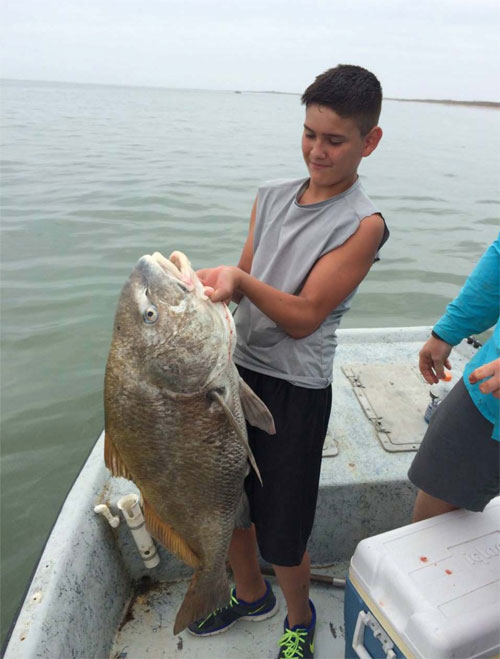
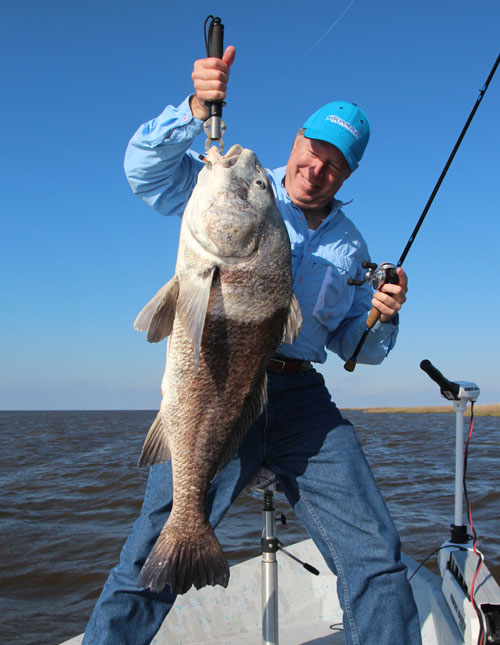
This 39 pound black drum was caught while fishing a Cotton Cordell Spot in three feet of water. For numbers of drum the best baits are cracked blued crabs and fresh dead mullet. -Robert Sloan photo

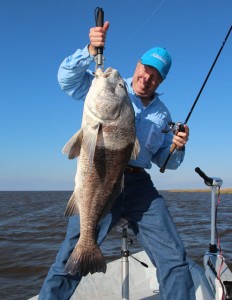
If ever there was a time to catch a big fish at Port O’Connor, I’m talking big as in 30 to 40 pounds, we are there. Black drum are all over the bays and jetties. This is the time of year when black drum spawn in big numbers. Black drum are definitely not the prettiest fish, but they are definitely angler friendly and can be caught on a number of dead, live and artificial baits.

The most notable drum harvests are the annual runs of “bull” drum. In February, March and April catches of these large fish attract a lot of anglers. Some compare landing a 40-pound drum with raising a sunken log, but many anglers are devotees of this kind of fishing in Texas. It is probably the best chance many people have to land a 30 to 40 pound fish.

Black drum do not grow to be heavyweights as quickly as you might think. According to the Texas Parks and Wildlife Department a length of six inches is reached in the first year, 12 inches the second and 16 inches the third. Increases of about two inches per year occur after that. The heaviest black drum on record weighed 146 pounds. The Texas record taken by a sport angler is 81 pounds, but most bull drum caught weigh 30 to 40 pounds.

The best tactic is to fish the jetties with half of a fresh dead blue crab. Other proven baits include half of a mullet or a whole pogie. They can also be caught on lures, and especially flies in places like Pringle Lake and the Army Cut.

No more than one black drum over 52 inches may be retained per person. The daily bag limit is five from 14 to 30 inches in length.

The black drum, a mainstay in the commercial fishery, has never been fully accepted as game fish by sport anglers. Annual harvest of black drum along the Texas coast is usually more than 1.3 million pounds by the commercial fishery and approximately three quarters of a million pounds by the sport fishery.

While some anglers prefer trout, flounder, reds or snapper many fishermen maintain that black drum less than five pounds, cleaned and prepared properly, may be better than many of these so-called “choice” fish. Many coastal restaurants noted for their seafood serve drum extensively. Fish taken in cold weather before spawning tend to be fatter and in better condition than those caught in summer after spawning. Drum weighing more than five pounds aren’t that tasty. Rather than eating the heavier drum, anglers are encouraged to release them to spawn and fight another day. Also, “spaghetti worms” common in speckled trout, are present in larger drum and, while unappetizing, they are not harmful to humans, according to TPWD.

For more information on Port O’Connor fishing adventures contact Capt. Robert Sloan at 409 782 6796, email at sloan288@aol.com or go to www.hightailangler.com. Capt. Robert offers jetty, bay and wading trips, along with boat trips to and from Matagorda Island.
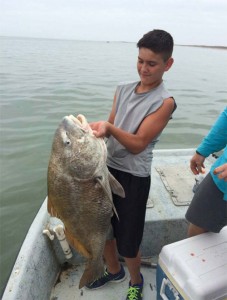
 

What a Catch! Gavin Gosnell of Port O’Connor
DU Sportsman’s Night Out

Archived in the category: Announcements, Events, Fishing Reports, General Info
Posted by Joyce Rhyne on 17 Apr 14 - 0 Comments

Calhoun County Ducks Unlimited Chapter  will be holding its annual Sportsman’s Night Out Event  on May 17, 2014. The event will be held at the Bauer Center in Port Lavaca, Texas starting at 6.00 p.m.

The Sportsman’s Night Out event is great time to enjoy an evening having fun with friends and other Sportsmen/Sportswomen in the area, have chances to win great prizes and support a great organization at the same time.

Tickets to the event are $35.00 for a single and $40.00 for a couple.  This includes a Ducks Unlimited membership, dinner, and  beverages.

Tickets will be available at the door or you may contact Albert Niccolai at 361-484-9495 for tickets or more information.

“Bait Magic” Guide Lines, by Capt. Chris Martin

Archived in the category: Fishing Reports, General Info
Posted by Joyce Rhyne on 17 Apr 14 - 0 Comments

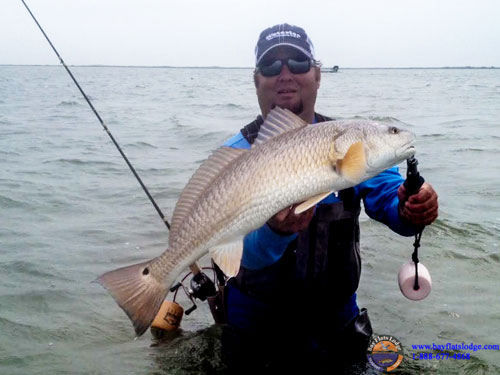
Guide Bryan Steubing lands a big red while guiding at Bay Flats Lodge early April.

One of the guides recently had an opportunity to fish with some very close friends of ours at the lodge that we hadn’t fished with in years. On the day they showed up at the Lodge, the wind was pumping out of the south at times in excess of 30-mph. There was a springtime cool front approaching over the course of the next day or two, but this was the only time we could all get our schedules together in order to all be in the same place at the same time, so they were going to make the best of whatever the weather was intending to throw our way. Everyone gathered out on the deck following dinner that evening to watch the disappearance of the sun below the evening’s horizon. As we took in the beauty to the day’s end, we sat discussing what the strategy would be for tomorrow’s outing. The guide told everyone that if we were trying to plan our trip based solely upon what the weather man was saying tonight, then we might as well get on a plane to Las Vegas because we would probably have better odds out there! Of course, he was just joking, but how many times have you found a Texas weather person to be absolutely correct in their forecast? The final input to the topic of tomorrow’s strategy was that we would simply need to find a place that would provide us with protection from the wind while, at the same time, offer us an ample amount of bait activity.

Everyone awoke the next morning to find that the wind had subsided substantially overnight. The wind was now blowing ever-so-slightly out of the southwest, so they wanted to take advantage of the moment by getting out on the water before the wind took a turn for the worse. They made the first stop of the morning along some exposed oyster beds that were silted with mud and sand in water that was anywhere from 1-foot to 6-feet in depth. The water around the reefs this morning was clean and green, and we just knew we were going to be in for a real treat atop the shell. As luck would have it, however, we were not into our wade for more than twenty minutes when the wind suddenly picked up abruptly and then switched and started blowing hard out of the north. It was so hard, in fact, that it literally only took a few moments to muddy the water where we had setup their first wade session over the shell. As frustrating as it was, it was still quite an impressive change to see take place so very quickly in front of our friends eyes. They packed up and headed across the water in search of wind protection and bait.

It was beginning to mist, which actually felt somewhat like sleet hitting your face while doing 40-mph across the bay in rough water. The weather was deteriorating, and so were their hopes of catching any mentionable fish today. I bet they spent the better part of two hours searching for a place that could give them wind cover that also showed all signs of active bait fish. The guide finally maneuvered his way to a shoreline that he had not fished for quite some years that offered a moderate bluff adjacent to the water itself that all but stopped the cold wind from blowing across the water. It was a tapering shoreline that dropped to seven or eight feet in depth within about forty to fifty yards off of the bank. The bottom consisted of mostly hard-packed sand with an occasional soft spot here and there. There were also brief humps of shell scattered haphazardly along the shoreline, both above and below the water line, and there were troughs situated in no specific pattern that mostly parallel to shore. But best of all, he witnessed mullet being chased to the surface every few minutes or so while they all stopped to examine the area before dropping anchor.

With the number of people they had fishing that morning, they were able to present a rather good selection of artificial baits to the fish. The crew had some top waters working, some slow-sinkers, some plastic paddle tails, and even one of the hard crank baits. I think everyone managed to catch fish on whatever they happened to be throwing, but the clear winning producer was the dark-colored suspending plastic bait’s. The fished really liked them!

I’m convinced that them finding active mullet that morning was the only reason everyone were successful in finding a bite in those conditions. Their results that morning after locating those active baitfish just further reiterates to all the importance of always looking for signs of fish, rather than just fishing a spot simply because you’ve previously caught fish there. Remember to practice CPR, “Catch, Photo, and Release”, whenever possible on trophy Trout and Reds…Guide Chris Martin, Port O’Connor/Seadrift region. www.BayFlatsLodge.com…1-888-677-4868.


Untitled Document