
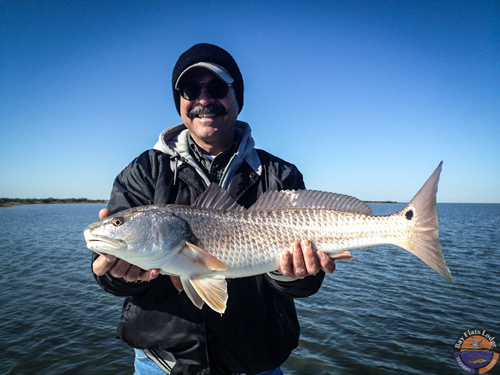
Landscaping Company Inc. enjoyed landing trophy reds with Bay Flats Lodge Guide Harold, March 1, 2013.
I don’t think there is another time of the year when I truly enjoy fishing more than I do in March. It’s a time of the year when everything seems to be undergoing a change of sorts. Bay waters once again come alive with the obvious presence of marine life that hasn’t been visible the past couple months. Underwater blooms of saltwater vegetation that were absent in colder conditions are now starting to burst into growth out of the bay floor. And changes in the weather spark a long-awaited warming trend for bay waters that will soon, in turn, signal to the trout and reds that the beginning of spring is now upon us.
Change is often accompanied by challenges, and this month will definitely be no exception to that rule. March anglers can probably count on just about as many changes in fishing patterns as there are days in the month. Well, maybe not that many, but there will certainly be a lot!
Wind is one good example. Wind is a major player this time of the year which contributes to the make-up of challenging patterns right now. This month will bring fluctuating winds in an environment where the recent norm has been winds blowing out of the northeast. We will now begin seeing a southeasterly flow emerge which will only continue to increase in strength and dominance as we progress throughout spring. But don’t get me wrong, we’ll still see the occasional cool front with north winds this month, but these fronts will be weakening as we move forward into spring.
Of course the wind might also decide not to blow on occasion, and you might just awaken to the presence of a heavy fog on any given March morning. What are you to do when this happens? The answer for me is pretty simple, but the choice is yours. Whenever I’m faced with impossible fog at the first appearance of daylight in the morning, I generally prefer to wait-it-out at the dock. I really don’t want to be running across the bay in thick fog if I can at all help it. Doing so is very dangerous, and it can prove to be downright deadly in certain circumstances. If you do choose to go out in the fog then please remember to go slow, stop often to shut-off your boat engine to listen for other vessels, sound a horn, wear your life vest, and be careful. And don’t be foolish enough to rely on your GPS unit to provide you with the same capabilities as that of a radar unit, as this can only spell trouble for you in any situation, but especially in foggy conditions. It’s only a guess of mine that the fish will still be there whenever you’re able to get out there safely, so always reconsider your options before risking danger to yourself or to others.
Along with changes in the wind this month will be the changes in the tides and the climate. History shows us that March will give us higher tides over those we’ve become accustom to during the winter months. Tides that have been either extremely low or that have not had much movement over the past few months will now start to become increasingly more active as the days go by. Climate changes, too, are often more noticeable to us this month in that they tend to be somewhat alternating on almost a daily basis. We’ll awake to cooler mornings, but will often end each day with much more warmth than we’ve been experiencing over the course of the past few months. This can often torment anglers when they’re attempting to make up their mind as to where it is they should fish on any given day, and it is why I tend to begin implementing certain changes in strategy this month.
A very prominent strategy difference for me in March is the time of the day that I prefer to be fishing. Being a professional fishing guide doesn’t always allow me to be out on the water only at the time I wish to be, but whenever I have a say in the matter I choose to fish during the afternoon hours this month, all the way up to sundown if possible. Why? Because my past fishing records tell me that the morning bite is not always as good as it has been in the afternoon (historically) once the sun and air temperature has had an opportunity to warm the water by a few degrees over the course of the day. As the waters warm throughout the day, baitfish activity often increases as a direct result.
On those days in March when it is necessary for me to be fishing really early in the day, I’ll adjust my tactics throughout the morning until the day warms a bit. The morning will probably start out cool, so I’ll start my wading session in deeper water over mud and grass, just as I did in past winter months. As the air and the water begin to warm, I’ll transition my efforts to flats areas wherever I notice any concentrations of baitfish – specifically mullet right now.
I’m a huge believer in working the mullet, especially in March when the trout are looking to satisfy an appetite they’ve had for quite some time. Trout eat a lot of finfish, and mullet are one of the more popular on the list. It’s for this reason that you’ll find me fishing this month wherever I happen to find mullet. I won’t be looking for the big pods we see in summer, but instead any small school or just a few that may be swimming together. I’ll adjust my bait presentation according to the mullet. If the mullet are rafting on the surface, I’ll throw one of my favorite top water baits. If the mullet are lurking below the surface, I’ll use a slow sinker or plastics. If the mullet are moving fast, I’ll use a faster retrieve. If the mullet look to be barely moving, I’ll slow my retrieve…and so forth.
After all is said and done, however, probably one of the most important changes coastal anglers need to make note of right now is the fact that spring is here, and this means that there will certainly be more boat traffic on area bays. Meaning also that everyone needs to be safe, and give each other plenty of working space while fishing – there’s plenty of room for us all out there!
Capt. Chris Martin, Bay Flats Lodge
www.bayflatslodge.com
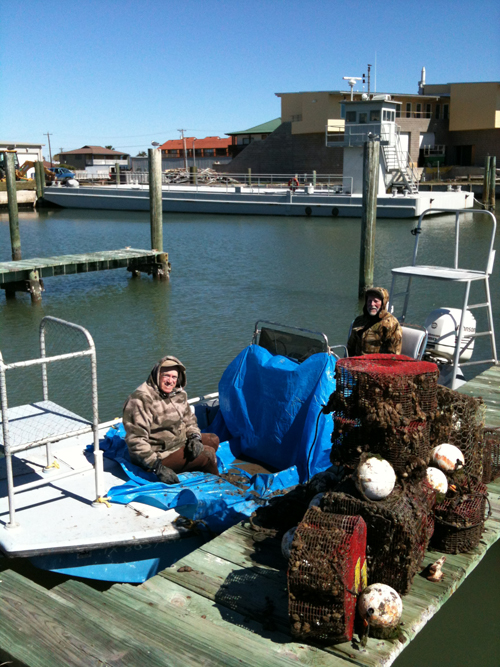
Carl Ray and Lefty Ward were the first in during the February 16 Crab Trap Removal. They brought in 11 abandoned traps. -Photo by Maxine Sharp
More than 30,000 traps removed since program began.
Art Morris, Fishery Outreach Specialist for TPWD, reports that more than 100 volunteers removed 862 crab traps from Texas waters during the February 16 Crab Trap Removal. Eighty percent of the traps came from the Galveston and San Antonio Bay systems. In San Antonio Bay, 274 traps were removed this year.
The yearly Crab Trap Removal Program began in 2002, and since its inception, 30,414 crab traps have been removed – the most removed by any state with a similar program.
Each year, the Texas Parks and Wildlife Department (TPWD) closes crabbing in all Texas waters for a 10-day period in February. Any trap left in the water during those ten days is considered “litter” under state law and is susceptible to being removed.
Abandoned crab traps result in the inadvertent death of several aquatic species including, but not limited to, blue crabs, estuarine sport fish, stone crabs, birds, diamond-backed terrapins, river otter, and–if found on land–terrestrial animals as well. Not only are abandoned traps hazardous to wildlife, they are unsightly, problematic for fishers and boaters, and can even smother seagrasses.
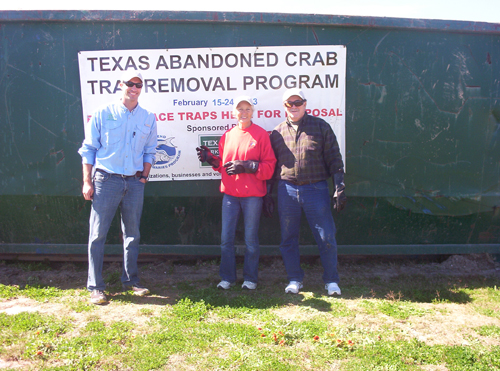
Working to dispose of the abandoned crab traps were Wally Bubley of Texas Parks and Wildlife Department and CCA members Susie Onishi and Mike Sharp.
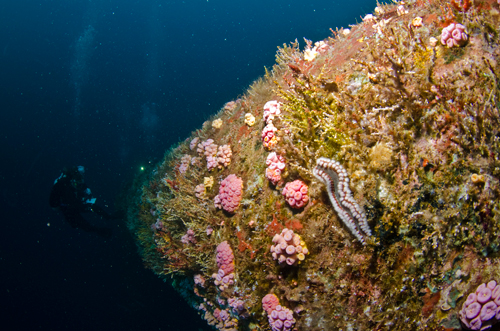
Life on a former oil rig, by Chris Ledford, TPWD
Texas Artificial Reefs Launch New Website, Facebook Page
For more than thirty years, the Texas Artificial Reef program has generally run silent and deep – deep in its positive impact on marine ecosystems, recreational fishing and diving and coastal economies, silent because it’s probably largely unknown to most people. Texas Parks and Wildlife Department scientists hope that will change soon with a major website overhaul and new Facebook page.
Since it started in 1990, the Texas Artificial Reef Program has become one of the largest such efforts in the nation, with 68 reef sites in the Gulf of Mexico ranging from 40-to-360 acres in size.
The new web pages feature an animation showing how an oil or gas production rig can be turned into an artificial reef. Also new online are a marine species identification page, the latest program news and an interactive map to reef locations. Looking for red snapper? Try the interactive map for some possible offshore hot spots. Got a military vessel or a few hundred tons of concrete you want to donate? The new site tells you how to get started.
Artificial reefs personify recycling Texas-style. The program focuses on three types of materials: decommissioned drilling rigs in the Rigs-to-Reefs Program, highway bridge materials and other types of concrete and heavy-gauge steel in the Nearshore Reefing Program, and large marine vessels in the Ships-to-Reefs Program. In waters ranging from 50 to over 300 feet deep, petroleum production platforms (jackets), scrapped concrete culverts, barges and a variety of decommissioned water craft (including, famously, the Texas Clipper) become undersea oases for a wide range of marine species.
The Gulf of Mexico teems with thousands of plant and animal species that need hard surfaces to cling to for part of their life cycles. Yet the Gulf floor is mostly flat mud, with almost no naturally occurring reefs. Man-made structures like artificial reefs give invertebrates like barnacles, corals, and sponges the hard surfaces they need to thrive. Energy then flows up the food chain, supporting snapper, grouper, mackerel, shark and other fish species.
But it’s not just the fish that benefit. Seven artificial reef sites within nine nautical miles of shore offer nearshore fishing and SCUBA diving opportunities, with more nearshore reefs on the way. The most accessible sites are six to 30 miles from major Gulf ports.
The Texas Artificial Reef program is funded through donations from private and corporate partnerships and government grants, not from general tax revenue. Corporate partners in the Rigs-to-Reefs Program donate their post-production rigs, thereby saving substantial costs of moving and dismantling obsolete rigs onshore. The amount of money a company saves varies. Sometimes a company reefs a rig at no savings to itself, while other companies may save upwards of $700,000. Participating companies invest in healthy marine ecology by contributing 50 percent of their cost savings to the artificial reef program. In turn, these dedicated funds go to construct more underwater habitat that supports the commercial fishing industry, diving and sport-fishing tourism and the overall health of the Gulf.
Find the program on Facebook to see videos and updates from Dr. Brooke Shipley-Lozano, Texas artificial reefs chief scientist. See the new Office in the Ocean video profiling the work lives of artificial reef scientists on the TPWD YouTube Channel.
Have you ever thought much about the story of Jesus riding on a donkey into Jerusalem? Most who hear this story, probably don’t see the greatness of it. Let me tell you a little more about it.
At the time Israel was under the Roman rule, and wasn’t an independent nation. It had fallen due to the rejection of God’s word 560 years prior, to King Nebuchadnezzar of Babylon which is Iraq.
In God’s word, for those who read it, learned of a king who will reinstate Israel. And the king will come through the line of King David. So for those who believed Gods word, they were expecting a king sent by God.
In Zechariah 9:9, God’s word says to Israel; “Say to the daughter of Zion; see your king comes to you, gentle and riding on a donkey, on a colt, the foal of a donkey.”
You might pick up he’s on a unbroken animal, but he’s the king who is going to reinstate Israel! A man doesn’t come to town on a donkey without weapons and a giant following to overthrow the existing powers of Government, on a donkey!
Herod, Pilate, and Roman guards were there, and they enjoy making examples of anyone who wants a piece of them!
In Mathew 21 is this story. After Jesus entered through the Golden Gate, He went directly to the money changers tables, made a makeshift whip and overthrew those in charge!
Not Rome, Pilate, Herod, but those who SOLD sin forgiveness!
God works in a way the world doesn’t understand!
All who believed were expecting, a earthly king like David, they expected the king God was to send would act in a way of the world. Riding in with weapons and strength. Ready to fight and die for the cause! But not on a donkey and attack the religious money changers! This surely isn’t the way a new king and government comes to town.
You need to know that the religious of the temple area exchanged your money at a lower rate for temple money at a higher rate. Then sold you at a inflated value doves or lambs so you and your family can let a priest kill it in front of you. Then the priest keep it and sell it back to you for something to eat for more temple money. And they have the gall to look at you and tell you, your sins are forgiven, and don’t you feel better now! Now you get to go home considerably broker, and carry the same guilt of sin you had before hand, and trying to believe what you did washed away your sins.
Since childhood, Jesus went every year to Jerusalem, for the Passover feast. He saw man trying to gain forgiveness from sin by this same fiasco every year. He felt compassion for man and just required men and women to simply ask forgiveness for their sins. Repent by turning away from their sinful lifestyle. And they can rest assured that He would remember our sins no more.
Yes. He rode in. Was ready to die and did. He was and IS, the expected King, foretold about in God’s word that they were all expecting. And He overthrew the dominating power in charge of ALL mankind, those who sold the forgiveness of sin.
He claimed and achieved Kingship that day! For Jesus Christ of Nazareth is the King who forgives sins for FREE! No other king could ever do this!
| Search |
 |
