Catfish, I guess, go back as far as man can recollect. Some mighty fine eatin’ and some, I wouldn’t touch with a 10-foot pole. All not the same, but most just as much fun to catch. I’ve stored up a few recollections of them whiker kritters. I’ll just sand up while I’m thinking on this one…

In the late fifties, I was shrimpin’ with Arthur Medolf on the Joe Thomas, working San Antone Bay not far out of Seadrift. We made our last haul and headed in, not having the trash shoveled overboard, which included hard heads not on the dead side yet. Coming up on the dock, throwing a line to the pier wasn’t all that hard, but takin’ a strain on that mooring line, slipping and coming down butt first was bout as hard as one could take it on the back side, especially sittin’ on a pile of prickly critters. Makes one numb and not just from the flop! I guess I sat there 30 seconds of a life time. I was worried more in that situation than I have ever been, in any given time or place. I don’t know if I was more embarrassed to find out I was stuck at all or taking that dive in public. But it sure felt good to get that numb off my butt. I can still feel a twinge just thinking on it.

Catchin’ hard heads when I was a kid around the docks was not a great feat. Any bait would do. I resorted once to using big blow flies when nothing else was available.

Back when women came down to the shrimp houses to head shrimp, there was always some two legged wharf rats to keep occupied while moms headed the catch. The not so elusive hard head helped fill the bill for kid-weary moms.

I get this idea once while watching the shrimp heads being dumped over the pier; you never seen so many catfish boiling in any one spot where the heads were dumped. One metal bushel basket, a piece of discarded rope and a bucket of heads for bait. Just lowered this contraption down a few feet, count to 10, and come up as fast as you can. A easy half bushel of hard heads as you’ve ever seen.

Working out of Port Lavaca on the Joe Thomas was another story. I was takin’ a nap, tryin’ to stay in the shade when Mr. Medolf let me know it was time to haul in, beings them boards just closed up is less time than any haul yet. He says we just cut across the corner of the most god-awful black spot in the bay you ever did see (I think he did it a purpose). “Gaff top sails” we shook them fin-sticking things down the net, very carefully swung them aboard, (always my job to open the sack). This time very cautious – splat – fin city.

About that time, who comes down the channel, Joe Thomas Medolf, the boat’s namesake, on a tug. We just ease up together, cinch up and sit down to headin’ gaff top. The help was a blessing.

Time we pull in to Port Lavaca, we had just over 700 pounds of gaff top tails. Wasn’t much a pound, but sure covered the fuel.

I guess I wasn’t much older than 15 workin’ with Uncle B. Sanders on the Jane. I like the Jane. Seems like that boat was always tryin’ to tell you something.

Anyways, we were working some nylon strike nets (it was legal then) somewhere outside the channel near Beacon 21. We had some luck on specks and was headed in when we seen this bunch of birds workin’ a muddy spot on the flats off the channel. It was right near where Mr. Edwards kept that big house boat (which my Uncle Bernie DeForest ran for him). Anyways, Uncle B. Sanders says, “Let’s give that a try.”

We did that, dropped the hook, takin’ the net skiff circling that bunch of birds with that fine nylon net. Uncle B says we’ll just strike it once and see what we got ‘afore we work it down. Thank God for that, (hard heads) occasional rat or tow, too small to keep. Ever see a few hundred catfish in a nylon net? Took us come dark time to get them out. I guess if that net still existed, it would still have fins twisted or cut off in it. Catfish and nylon still don’t mix.

I’ve had some experience with catfish, but this one really takes the cake and should I say, other things. Anyways, it was my privilege to serve in Vietnam, most of the time on the river. We on occasion were sent up the Vente Canal off the Mekong River to a listen outpost (monitoring sensors placed in strategic positions) for support purposes.

Anyhow, there were no indoor facilities…just the outside kind, and you wouldn’t call them outhouses, either. Most cases just a railing that covered the lower most portion of one’s extremities. Now that wasn’t the case at Tinbin, ‘iffin I’m spellin’ it right. We had to build our own on 55 gallon drums and placed it on a catfish pond, for what purpose I found out.

Needless to say, I had to go one time or another and at what expense I’m not for sure. Most people say they just sit and relax and wait for mother nature.

Now take a few hundred catfish all waiting for the same thing coming down that chute. Seems them 55 gallon drums made this certain kind of ripple when one sat on the throne. *#!?##*! I’d swear to it nothing hit the water. Things kind of got wet under there. Never was that regular after that first time, but one must go…it’s inevitable to think otherwise. Come dry season, it’s told there was a bumper crop of big cats otta that hole!

Talk about eatin’ fish. I’ve eaten fish in some odd places, but heck, that’s another story…
Pastor Returns From Second Missions Trip

Archived in the category: General Info
Posted by Joyce Rhyne on 25 Oct 12 - 0 Comments

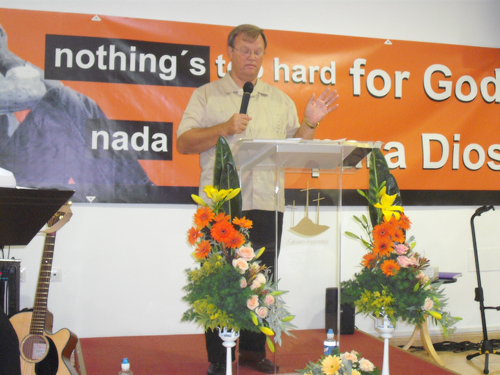
Pastor Tim Smith preaching during a missions trip to the Canary Islands in October 2012.

Pastor Tim Smith of First Assembly of God in Seadrift returned from a Missions Trip to El Fraile, Tenerife, Canary Islands, Spain on October 9th. Pastor Smith was in the Canary Islands for nine days. It was his second trip to the Islands in two years. He spoke eight times to four different congregations.

He was invited by Missionaries Mark and Kelly Baumgartner to speak at Calvary Assembly International Church for their 8th anniversary revival services. He also spoke at El Farro Assemblia de Dios, Calvary Deutsch Assembly of God, Iglesia Christiana de Canarias and to students at the Bible Institute of the Canary Islands.

Pastor Smith said that seven persons received Christ as Savior, over twenty rededicated their lives to Christ, four were filled with the Holy Spirit and over thirty were refilled with the Holy Spirit. Smith said the services were lively with a lot of singing and praise and worship. Pastor Smith was assisted by interpreters in each of the four churches. Seven services were interpreted into Spanish and one was interpreted into German. Mark and Kelly Baumgartner are the founders and Lead Instructors at the Bible Institute of the Canary Islands. The Institute is the only Evangelical Bible School in the City of El Fraile.

The Canary Islands have a population of 1.3 million people with ½ of 1% being Christian believers. The Bible Institute graduates about twenty students a year. Each student completes classes that are required for a person to receive minister credentials with the National Assemblies of God of the Canary Islands.

The Baumgartner’s have helped start two churches with graduates of the Bible Institute as the pastors of the new works. The latest church is a congregation of German speaking believers.
Pastor Smith said the people of the Canary Islands are very hospitable and friendly people. “They are hungry for God and are very enthusiastic to attend church and to learn of God. It was a great honor for me to travel to the Islands and preach at the four churches and to speak to the Bible School students,” Smith said.

First Assembly of God in Seadrift helped him to go on the trip. “I could not have gone without their help,” Pastor Smith said. “The Seadrift Church understands the Great Commission. We are all called to reach the lost. It is not an option, but an urgent necessity,” Smith explained. Pastor Smith is planning more trips. He is making contact with missionaries about opportunities to preach in other countries of the world. Smith said, “Everyone deserves to hear the gospel, everyone deserves to hear about the saving grace of Jesus Christ.”

Exhibits at the Museum of the Coastal Bend

Archived in the category: Events, General Info
Posted by Joyce Rhyne on 25 Oct 12 - 0 Comments

Cattle Boom! Ranching in Victoria and the Texas Coastal Bend, 1845 – 1929 Cattle Boom! tells the story of ranching families, cattle drives and ranching culture through artifacts, historical photographs, documents and maps from regional collections. This exhibition is organized exclusively for the Museum of the Coastal Bend and will not be seen elsewhere. Cattle Boom! will be open to the public through Dec. 15, 2012.

The La Salle Odyssey
exhibit tells the story of the first European settlement in Texas- the French Fort St. Louis, and the archeological excavation of the French ship La Belle in Matagorda Bay.

Fort St. Louis and Rene Robert Cavelier, Sieur de La Salle This exhibition explores several subjects relating to the first French settlement in Victoria County and the first European settlement in Texas. From French explorer LaSalle’s early expeditions to life at Fort St. Louis and the archeological research on these subjects, each segment of this amazing story is told through informative scholarly written text panels, photographic images, and original artifacts found the site.

The Cannons The centerpiece exhibit in the Museum’s gallery is the exhibit of seven of the eight cannons brought to Texas by French explorer La Salle. The eighth cannon is on exhibit at the State History Museum in Austin. The Fort St. Louis cannons are the focal point of MCB’s exhibits.

La Belle artifacts Artifacts recovered from La Salle’s ship La Belle which sank in nearby Matagorda Bay, including munitions and personal items from the explorers such as this small glass fica, possibly worn as a charm to ward off evil spirits.

The Museum of the Coastal Bend is open Tuesday – Saturday, 10 a.m. – 4 p.m. Closed major holidays.

Museum Dollar Days: $1 admission per person 3rd Saturday of each month.

Museum of the Coastal Bend
2200 East Red River Victoria
361-582-2511

Whooping Crane Migration Watch Gets Under Way

Archived in the category: General Info
Posted by Joyce Rhyne on 25 Oct 12 - 0 Comments

Endangered whooping cranes have begun their annual 2,400-mile fall migration from Canada to Texas. As the rare birds approach Texas, a new citizen science initiative is inviting Texas residents and visitors to help collect sightings of whoopers.

Texas Whooper Watch (http://www.tpwd.state.tx.us/whoopingcranes/) is a new volunteer monitoring program that is a part of Texas Parks and Wildlife Department’s Texas Nature Trackers program.   According to Lee Ann Linam, biologist in the Wildlife Diversity Program, Texas Whooper Watch is being developed to keep track of an ever-expanding population of whooping cranes.

Since beginning their slow recovery from a low of 16 birds in the 1940s, whoopers have, with few exceptions, always wintered on the Texas coast on and near Aransas National Wildlife Refuge.  However, in the winter of 2011-12, several groups of whooping cranes expanded their wintering areas to include more coastal areas and even some inland sites in Central Texas—patterns that surprised crane biologists.  “Texas Whooper Watch is a program that asks the public to help us discover more about where whooping cranes stop in migration and to be ready to learn more about these potential new wintering areas,” according to Linam.

This year biologists expect about 300 whooping cranes to start arriving in Texas in late October or early November.  According to surveys on the nesting grounds in Wood Buffalo Park in northwestern Canada, the flock may contain as many as 34 chicks.  Linam notes that Texas Whooper Watch will also help improve the accuracy of surveys on the wintering grounds, as the growth of the flock has made traditional census methods more difficult.

Whoopers usually follow a migratory path through North and Central Texas that includes cities such as Wichita Falls, Fort Worth, Waco, Austin, and Victoria.  During migration they often pause overnight to use wetlands for roosting and agricultural fields for feeding, but seldom remain more than one night.  They nearly always migrate in small groups of less than 6-8 birds, but they may be seen roosting and feeding with large flocks of the smaller sandhill crane.  They are the tallest birds in North America, standing nearly five feet tall.  They are solid white in color except for black wing-tips that are visible only in flight.  They fly with necks and legs outstretched.

Citizens can help by reporting sightings of whooping cranes and by preventing disturbance of cranes when they remain overnight at roosting and feeding locations.  Sightings can be reported to whoopingcranes@tpwd.state.tx.us or 512-389-TXWW (8999).  Observers are asked especially to note whether the cranes have colored leg bands on their legs.  Volunteers interested in attending training sessions to become “Whooper Watchers” in order to collect more detailed data may also contact the TPWD at whoopingcranes@tpwd.state.tx.us or 512-389-TXWW (8999).

Additional information, including photos of whooping crane look-alike species, can be found at http://www.tpwd.state.tx.us/whoopingcranes/ and at http://www.whoopingcrane.com/report-a-sighting/ .

Celebrating 50 Years Of Sundown (Chester) Island!

Archived in the category: Announcements, General Info, Organizations
Posted by Joyce Rhyne on 25 Oct 12 - 0 Comments

Chester Island photo by Diane D. Nunley

Audubon is celebrating 50 years of Sundown Island! Originally built in 1962 from dredge spoils, this seventy-acre island is one of the most important rookery sites for Brown Pelicans in the state, and is widely credited as one of the sites that saved brown pelicans from extinction in Texas.

Today, Sundown is home to 18 species of birds and continues to be an important site for Brown Pelicans. Audubon wardens manage Sundown and other islands – monitoring bird colonies, patrolling for predators, and enhancing habitat.

Sundown Island was recently renamed in honor and memory of long-time warden Chester Smith.

Be sure to visit the Chester Island website: http://www.sundownisland.org.

For more information or to sign up as a volunteer contact: Tim Wilkinson, Chester Island Sanctuary Warden at twsword1@comcast.net


Untitled Document