
Port O’Connor CCA enjoyed a successful annual banquet on October 20th. Shown above, CCA President Bill Moore presents a plaque to Port O’Connor artist Carolyn Pond for her many years support of the CCA.
Port O’Connor CCA enjoyed a successful annual banquet on October 20th. Shown above, CCA President Bill Moore presents a plaque to Port O’Connor artist Carolyn Pond for her many years support of the CCA.
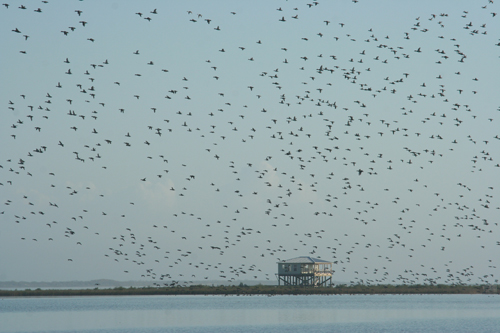
This photo from last season is proof that duck numbers in Port O’Connor are some of the best ever. Book your hunt with Capt. Robert Sloan right now. - Robert Sloan photo
Duck populations have hit all-time record highs, according to the U.S. Fish and Wildlife Service. Mallards, blue-winged teal, green-winged teal, gadwalls, canvasbacks, northern shovelers and scaup are all up significantly from last year, with both species of teal and shovelers at all-time highs.
The U.S. Fish and Wildlife Service has just released its report on breeding ducks and habitats, based on surveys conducted in May and early June. Total populations were estimated at 48.6 million breeding ducks in the surveyed area. This estimate represents a 7 percent increase over last year’s estimate of 45.6 million birds, and is 43 percent above the 1955-2010 long-term average. This year’s estimate is a record high and is only the sixth time in the survey’s history that the total duck population exceeded 40 million.
“This is the highest duck count since we started the survey in 1955,” says Dr. Frank Rohwer, Delta Waterfowl’s scientific director. “We had excellent wetland conditions in 2011, the second-highest pond count ever. So last year, we made a pile of ducks. This year, we’re counting on them.”
Blue-winged teal are estimated at 9.2 million, green-winged teal number more than 3.4 million and shovelers now top 5 million.
Mallard breeding numbers sit at 10.6 million, a 15 percent increase over 2011 and 40 percent over the long-term average.
Gadwall increased 10 percent over last year, and now total 3.5 million. The population is nearly double the long-term average for gadwalls.
Wigeon are up slightly to 2.1 million, but are still 17 percent below their long-term average.
Scaup numbers are up 21 percent to 5.2 million, the seventh-straight year that the bluebill count has gone up. Scaup are at their highest breeding population since 1991.
Redheads declined slightly to just under 1.3 million, but still registered the second-highest population estimate in the history of the survey. Canvasbacks jumped 10 percent to 760,000, the fourth-highest count on record.
“All in all, this is a great duck count,” says Rohwer.
Drier conditions may account for the one species that shows a significant drop in the survey area. Pintails are down more than one million birds, from 4.4 million birds last year to 3.4 million. One possible explanation is that pintails didn’t like the look of the drier conditions and just kept flying north.
“Pintail numbers increased in northerly habitats such as Alaska,” says John Devney, Delta’s senior policy director of U.S. policy. “This suggests sprig over-flew the prairies this spring. Research has well documented that in average or dry conditions, many pintails head north to the boreal forest. The survey’s ability to detect them is reduced.”
The overall pond count is still 9 percent above average, but as the prairies dry out, you can expect a direct impact on hunting, says Joel Brice, Delta’s senior director of conservation.
“Let’s not forget that we hunt the fall flight, not the spring count,” says Brice. “Lots of ducks jammed into fewer wetlands negatively impacts breeding success. There’s a good chance we won’t see as many juveniles as last year, and those are the birds that are easiest to decoy. Still, it promises to be a great year. We may just have to work a bit harder.”
To book a duck hunt with Capt. Robert Sloan give him a call at 409-782-6796 or email him at sloan288@aol.com.
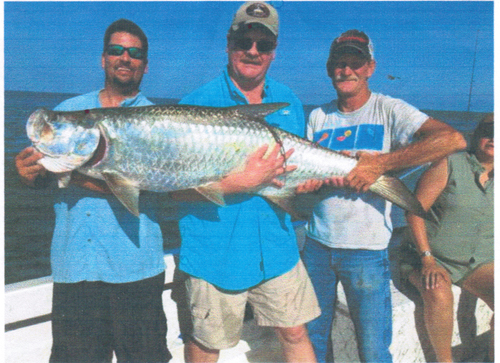
Donald and Devon Kissel from Odessa, Texas enjoyed a great fishing trip with Captains Keith Gregory and Billy Hemphill. This 5’ 7” tarpon, estimated at 75 lbs., was caught at Port O’Connor’s south jetty using 15 lb. test. It took approximately 45 minutes to land this beauty.
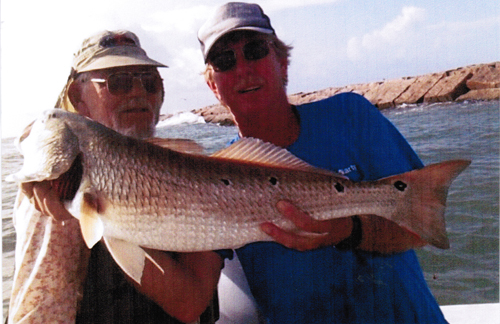
Norman D. Posey (left) with one of the reds he caught on a recent trip with Captain Marty.

It looks like Fall has finally settled in. Cooler nights, cooler water and higher tides have made things a lot more comfortable for everyone. The crowds at the boat launch parking lots are beginning to thin out. Trout fishing is certainly improving.
The back bays are getting much better for trout and reds. I haven’t been finding many big trout yet but the numbers are there. The reds are showing up in the lakes. Drifting with live shrimp has been a good bet. San Antonio Bay has been my best bet but like I said, the fish aren’t very big; 16 to 18 inches for the most part.
The Jetties are holding lots of fish. The only problem has been the wind. My last two trips to the Jetties have been a bit slim because I really couldn’t get to the spots I wanted to fish due to the heavy seas. Reds, Drum, lots of Mangrove Snapper and a few Flounder have been the main attraction.
Capt. Bob Hill
Port O’Connor Charters
(281) 984-0015 www.fishportoconnor.com
Hunters are generous people. More than 11 million meals were provided nationwide to the less fortunate through hunters’ donations of game meat in 2010. As a reminder to all hunters to consider sharing their harvest this autumn with those in need, the National Shooting Sports Foundation (NSSF) has developed a new video and webpage that encourage making venison donations to food banks and other charitable meal providers. Programs like Hunters for the Hungry and others are active in nearly every state, including Texas, so hunters have plenty of opportunities to participate in a donation program. NSSF’s new Hunters Feed website (http://www.nssf.org/huntersfeed/) provides information on how to contact the many active groups that accept game meat donations.
| Search |
 |
