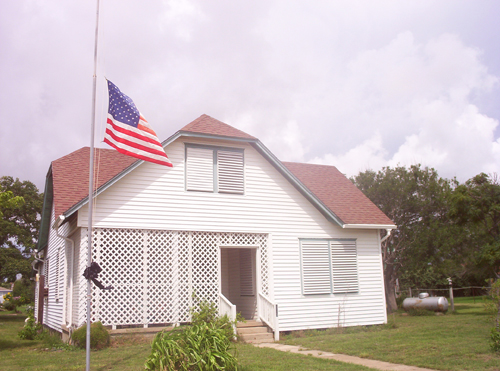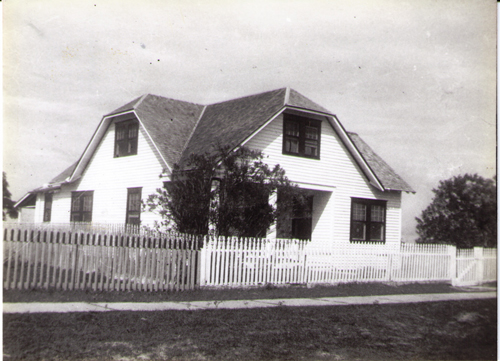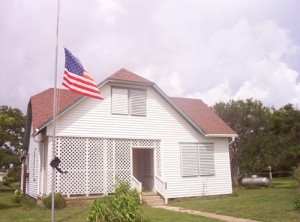
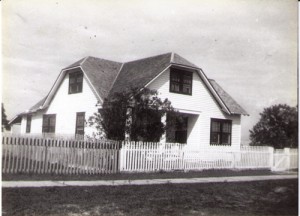
The Edward Whittaker Home. built in 1912 in Port O’Connor, bids farewell to its last resident, Lucille Whittaker, who was born here 89 years ago, and passed away July 14, 2012.
Lucille Whittaker was born in Port O’Connor on October 14, 1922. She grew up in the family home at 403 N. Washington Blvd. and, after pursuing her career in San Antonio, returned there, where she resided amidst the memories of her beloved family for many more years.
She enjoyed telling stories from her childhood: how the town was then, the simple pleasures she and her friends enjoyed growing up in this small community, playing on the sand dunes, enjoying games amongst themselves, and even make-shift dances at Boggy.
Lucille wanted her family and old-time Port O’Connor to be remembered, so when the Port O’Connor Centennial Celebration was being planned for September 19, 2009, she eagerly joined in. She wrote about her family history, the history of Saint Joseph Church, and a short biography of her sister Edna. Searching the family albums, she provided many photographs to accompany her stories.
As a tribute to Lucille Whittaker and to other Port O’Connor natives, living and deceased, we are proud to print Lucille’s story of the:
Edward Timothy Whittaker Family
by Lucille Whittaker
Edward Timothy Whittaker was born July 10, 1878 to Martha M. Clark and John Whittaker in Port Isabel, Texas.
John Whittaker, at the age of 18, came to America from England as a stow-away, landing in Maine and then on to Port Isabel. He was a ship’s pilot, loving to sing and entertain. He met Martha M. Clark. They married, and together they had five children: a baby boy, Christopher, who died in infancy; a little girl, Texana, who died of yellow fever when she was five; Edward; George; and Mary. Mother Martha died of yellow fever when the three surviving children were still young.
Aunt Lizzie (Elizabeth) and Aunt Grace were George and Edward’s Godmothers. Aunt Tessie (Theresa) was Mary’s Godmother.
There was a Presbyterian orphanage in Tennessee that sent for all children that had lost their parents from yellow fever. Aunt Tessie thought Mary would have a better education there so she sent Aunt Mary there where in later years, she met my uncle, married and stayed there.
George Henry did not go to public school. His two aunts, Elizabeth and Teresa Clark, were public school teachers and they taught him. He learned to speak and write in five languages. He was used a lot as an interpreter up and down the coast. That is what his two aunts wanted him to do for a living.
He played the banjo and French harp. Edward played the French harp and steel guitar.
The melodeon is a small reed organ with a five- or six- octave keyboard, most often housed in a piano-like case. It was so popular in the United States and throughout the world 100 years ago that its sales surpassed those of the piano, which was more complex and costly to produce.
The Clarks and their five daughters had a melodeon and they all could play it. In later years, Aunt Teresa had the melodeon and Aunt Mary bought it and had it redone, turning it into a beautiful piece of furniture. Aunt Mary’s daughter, Margaret Smith, was a concert pianist.
George and Edward left home at an early age and fished this Texas coast. While they were very young they owned a fish house in Port Lavaca under the name of Whittaker Fish House. They went broke and lost the fish house because, as we have been told, they would not cheat the Mexican people on fish prices.
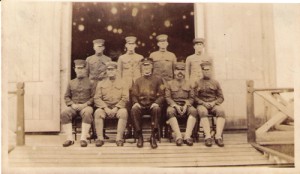
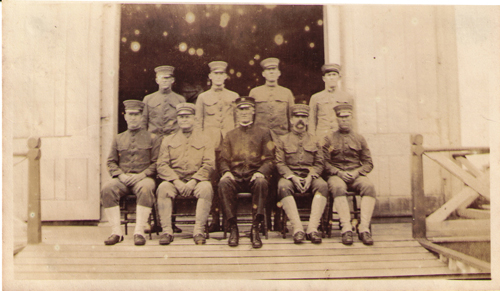
US Coast Guard. Far right, standing: Ed Whittaker
The Coast Guard station on Matagorda Island was built in 1879. The island bordered Pass Cavallo on one side and Matagorda Peninsula on the other. The pass is said to be the most treacherous pass in the United States where numerous shipwrecks have occurred, including the LaBelle.
The station, if I remember correctly, had a nine (9) man crew. The clock was quite a distance down the beach, so the servicemen had to walk that distance in order to punch the clock. A stanch stitch in the Coast Guard was three (3) months and the government provided little houses for the servicemen’s families.
The bottom room of the station was huge and that is where they kept their boats.
Since the two boys had lost their business, they decided to enlist in the Coast Guard, which they did.
Aunt Ida’s family were vacationing on the island and they met Edward and George. They became very friendly, so much so that George married Aunt Ida and they had four children. Uncle George remained in the service until he was stricken with cancer and the service let him go.
Edward remained in the service and while visiting the Velasco station on Surfside, he met my mother, Theresa Ann Schuster.
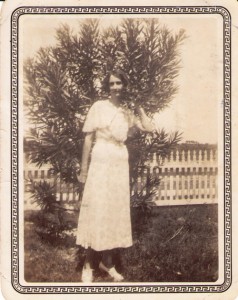
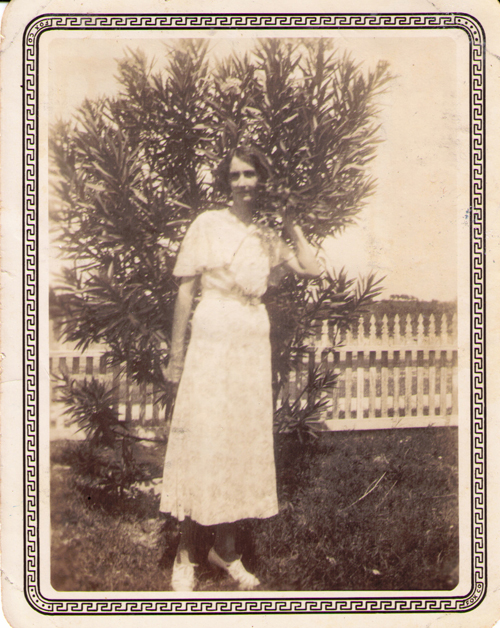
Theresa Ann Schuster
On January 2nd, 1914, Edward Whittaker and Theresa Ann Schuster were married by Father Montrocili.
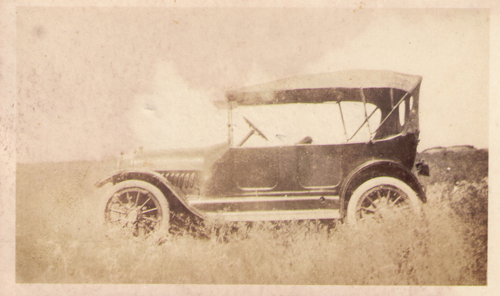
Edward moved his new bride to Matagorda Island and they lived in one of the government houses until he finished building her a new home and brought her a new car.
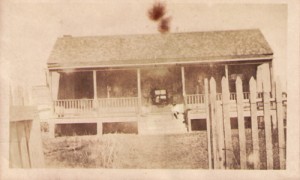
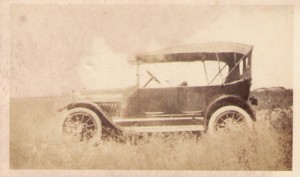
Edward and Theresa’s home on Matagorda Island and their car
Periodically, the Coast Guard would send their boats over to pick up the wives, families and friends and take them back to the station. Some of the boats they would move out, but they kept the life boat in and pushed it to the side.
The kids were put on the life boat to watch or sleep while our mothers and fathers danced all night. The men had dance cards filled out to who they would dance with next. My dad cheated and filled in Tracy (my mother) every other dance.
March 6, 1915, Raymond Henry was born. Mother’s sister, Aunt Rose, came and stayed with her for quite a long while. Aunt Rosie, with a laugh, often told us that Raymond had a rolli-polli and was so afraid of it. When she came to visit Mother and she tried to sew on the machine, the only way she could sew was to keep rolli-polli next to the machine and when he came near, she would kick rolli-polli and Raymond left. His birth certificate shows Saluria, Texas.
February 20th, 1917, Edna Theresa was born. Mother’s sister, Aunt Mary, came to stay with her and Raymond had a playmate, no more rolli-polli.
Daddy bought them a cow, “Molly”. Edna’s birth certificate shows Matagorda Island.
Shortly after Edna was born, Edward and Theresa bought a home in Port O’Connor from Mr. Wallington, who had built the shell, but had not completed it. Edward, the fine carpenter he was, added a room and completed the house.
The 1919 Storm struck Port O’Connor destroying most of the homes, but God bless, the Whittaker home stood. George Whittaker’s home lost its roof.
Raymond and Edna continued to thrive, living on the island and playing with their neighbors, the Hawes kids (Buck and Evelyn Claire) whose father was also in the Coast Guard. The kids played in the sand, rolling down the big sand hills next to the station and under the shade of the big platform with the station number on it.
There were no lights on the island and the houses were dark. Mama and Daddy always kept a kerosene lantern burning on the floor so the kids could go to the potty. Since there were no inside bathrooms, a slop jar (as they were called) was kept in the bedroom. One night Mother and Daddy were awakened to the sound of a bumping noise. To their horror, it was Edna squatting over the lantern; each time she would sit down it would burn her and she would jump up. She won. She put out the lantern.
One morning Daddy got up to go to work and as he put his foot in his boot, it was all wet. Raymond had used his boot as the pot.
Edna and Buck Hawes were the best of playmates and Daddy had a big grind stone operated by foot pedals. One day they were playing and Edna was quite good at operating the grind stone. No one knows how, but she ground Buck’s stomach in the grind stone.
Moving to Port O’Connor, leaving their friends, their sand dunes and a different way of life was a real heart-breaker for these two kids.
The school was a white, two story building with a red roof. Downstairs was a large room that was the auditorium where they had all of the town meetings and anything else pertaining to the town. Upstairs were the school rooms. There were two large rooms.
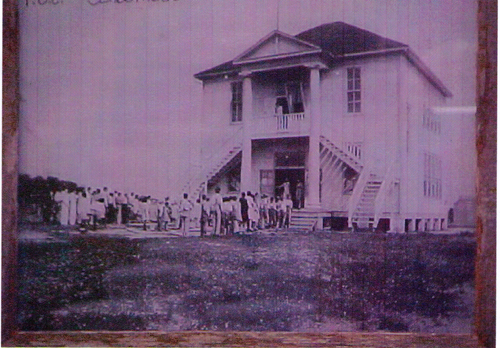
Port O’Connor School, early 1900’s
Raymond and Edna both had been home schooled, so when they started, Raymond started in the second grade, spent one day there and was moved to the third. Edna started in the first, but was moved to the second.
Edna came home every day, stood at the front door and cried for her home on the island. She hated Port O’Connor.
Daddy knew all the Spanish people from Port Isabel, all down the coast. He spoke the Tex-Mex fluently. He mentioned to John Ortiz that his son was starting to school and would John’s son, Smilo, sort of look after him. Smilo, a big Mexican boy, tried his best to look after Raymond, but instead of helping, he scared Raymond to death. Raymond came home from school and his pants were wet. Mama got after him and asked why. Raymond told Mama he was scared because that big Indian was after him.
While at one of the Coast Guard dances, Raymond was sitting on the sidelines with his foot all bandaged as he had stepped on a prickly pear causing the thorn to lodge in his foot. Evelyn Clarie got mad at Raymond and stomped his foot, causing the thorn to go into the bone. Mother kept doctoring it, but it got worse.
Daddy ran into Dr. Landeu and asked him to look at his foot. Doctor did and said, “I am taking this boy. You all come later.” He operated, taking five (5) bones out of his foot. After several days in the hospital and quite a while at home, it healed. Raymond’s foot was never detected by any of the doctors who examined him in the service.

Coast Guard Station 1937
Time marched on until October 14, 1922, when Rosie Lucille was born and that made up our family. Daddy started calling me “Sweetie” but Edna and Raymond having to take care of me, didn’t think that was so good, so they changed it to “Weedie” which stuck, until I was grown, and still some call me that.
Lewis Ray Madden lived behind us and he and I were good buddies. He had a big brother, Arthur, who teased him a lot and since my name was Weedie, he called Lewis Ray “Weedie Ray”. Little kids don’t know and this wrong calling caused Lewis Ray to hate me and he tried to hurt me by throwing bricks at me until Daddy was with me one day when this occurred. Daddy made short work of Arthur, but we never were friends again until we were grown.
I had another little friend, Howard Gee Schultz, and we played together real well. Edna and Raymond would get sticks and make me whip Howard Gee. This, of course, caused Howard Gee to quit playing with me. How did I ever grow up?
Edna was about four or five when they visited my grandmother in Freeport. Edna was out playing and saw a flower right under the porch. When she reached for it, a ground rattler bit her between her fingers, wrapping itself around her arm. She screamed. Mama and all inside came running. Mama had to unwrap the snake and by that time all the kin were there and they had a doctor in ten minutes. What he did, I don’t know, but they put her hand and arm in kerosene. Her hand and arm turned black and she was terribly sick for a long time, but she has no scars or problems from it. Mother always told us it was the power of prayer.
The Canion kids and Whittaker kids grew up inseparable. There was Kenneth and Raymond, Irene and Edna, Berdie, Joe and me. We all went through the whooping cough, measles and chicken pox at the same time.
Mr. Canion was on the railroad here and remained until the thirties. Mrs. Canion and Mama were the greatest of friends.
The old coast Guard station closed in 1929 and all the men were transferred to different places. Daddy was transferred to Galveston and was the only old crewman who would come back when the new station was built on Saluria. Two months before the new station opened, Daddy died in 1932.
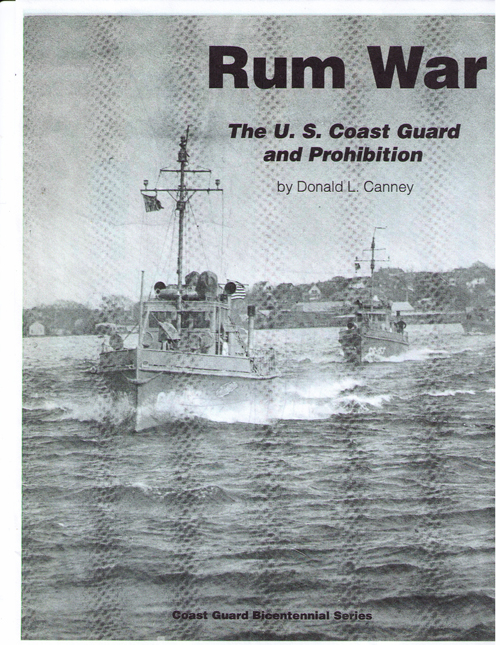
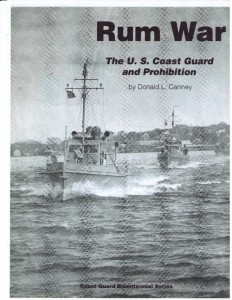
In the late twenties during prohibition days, since the Coast Guard station was closed, they put a big cutter down here named the “Star”. Daddy was transferred to it since his family was here. The Star lay at the foot of Fisher’s Warf. They would go out at night and if they saw a suspicious boat, they would blow the siren. If it did not throw the contraband over they would blow again, and if no response, they were fired upon.
The Christmas before Daddy died (1932) was our biggest and greatest. Raymond got his first shotgun; Edna a bicycle; and me a tricycle. Together we got a Victrola phonograph, the one with the big horn with the dog on it and a big bucket of divided candies. Daddy was home; Mama had baked for days, pies, cakes and a turkey – a great, great Christmas.
Daddy’s death changed our lives completely. The shock of his death caused Mother to become quite ill. Her arms dropped and she could not raise them higher than her waist. We kids had to help her dress and do all the work she had done. Raymond rigged up a white flag for the back porch that Mama could raise or lower. We kids went to school always watching home for the white flag. If the flag was up we had to come home. Mother’s legs hurt her so badly that we kids had to take turns at night rubbing them. Due to the medication she had to take, her teeth got real bad and she had to have them pulled. We had a place on the wall where we would mark as her arms came up.
Raymond, at the age of 17, begged Mama to sign papers so he could go into the Coast Guard. She didn’t want to as she said she couldn’t do without him. Times were tough and it took a good year for Mama to start getting a pension from the Coast Guard so she had to support us on what she had saved, but Raymond, as young and good as he was, kept our table supplied ducks, quail, doves, oysters, crabs, and fish.
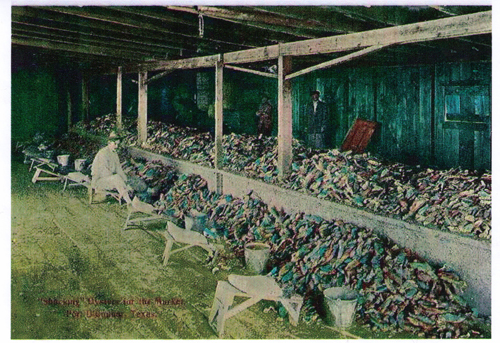
Shrimp was plentiful at that time and the two biggest shrimp boats, the Morning Light and the Sterling, owned by the two Stapp brothers (Bill and Howard) left early in the morning. Since there wasn’t any noise except the ice plant and the pump house, we could hear the two boats as they left the docks. From the banisters on our front porch we could see the boats coming in, and Edna, Raymond and I, with the Canion kids, would walk down to the back bay and head shrimp. We got $1.00 for a big #3 tub.
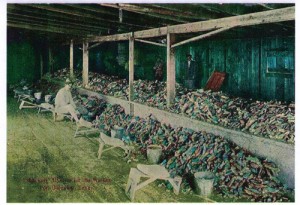
Shrimp at Clark’s Fish House
Porter Vincent hired Raymond and Kenneth to pack boxes for the San Jacinto Inn in Houston. He paid them $1.00 a box.
Aunt Grace came to live with us and Mother sent Raymond, Edna and I out to cut and bring in wood. Edna was elected to hold the log on the saw horse. Raymond and I were to cut it. Well, Raymond and I were using a big cross cut saw, him on one end, me on the other. We were cutting along when Edna turned white and started to faint. We yelled for Mama and she and Aunt Grace came running. We had almost cut Edna’s finger off. They rushed her in and put her hand in kerosene. Her finger healed and has never bothered her.
About this time, the Fossatti kids came to town. They had an old Model T touring car with a sheet their mother gave them. They tied it to the top to keep out the sun and away they went with Frank (Pots) as the driver.
The next year they had a station wagon. All of us kids piled in and rode all over town. One evening late we were riding down Park Street (it turned at the loop). Pots was driving a little too fast and over we went. We all jumped out, flipped it up, piled back in, and away we went.
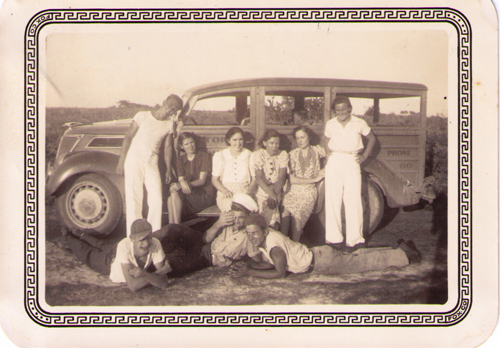
The Fossattis’ Station Wagon Standing at Left: Pots Fosatti; Standing at Right: Berdie Canion; Sitting, 3rd from Left: Lucille Whittaker; Sitting, 2nd from Right: Edna Whittaker
At night we would play all kinds of cards, Spoon, Smut, 42, Tripilac and Monolopy. Often times we would push back the chairs, wind up the old phonograph and dance. A wonderful time we had, and no trouble.
Mother decided to sign Raymond’s papers so he could go into the Coast Guard, which he did.
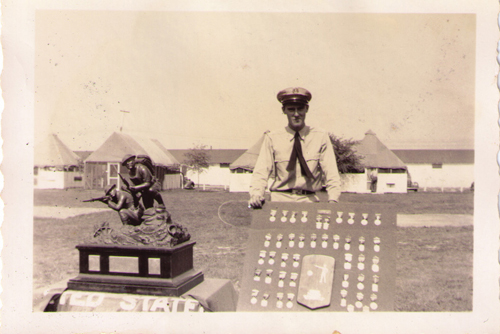
Raymond Whittaker, US Coast Guard Marksman
Edna was so young, but went to work at Sidney’s. She did everything – stocking the shelves, cutting meat, tending the gas station and waiting on all the customers. She went to work early and stayed late for only $5.00 a week, but with it she clothed herself, helped me, and bought gas for the car.
In 1934, Edna and Mary Nell Goode Hawes, the only two in their class, graduated from Port O’Connor High School. It was the last class in the Port O’Connor High School and the last graduation class here.
The war broke out and Raymond was transferred to the transport ship, the U.S.S. McCarley. He served aboard that ship until Capt. Panser had him transferred back here and put in communications. He and his crew built the lines all down the coast to Padre and St. Jose.
Raymond attended a dance while working in Aransas Pass and went back to the boarding house where he stayed and the next morning he told Mrs. Allen (owner of the house), “I met the girl I am going to marry last night.” He did just that and married a beautiful girl, Jewell Ervin. Together they had two lovely children.
Capt. Pansar knew that Raymond was a marksman in both rifle and pistol, so he entered him in all the matches in the country. Men shot for what they called “legs” and you had to have three legs to get the distinguished medal. Men shot sometimes 10 or 15 years for only one leg. Raymond got the medal after two years. He brought home so many medals and, of course, the distinguished medal, from the big shoot at Camp Perry, Ohio.
By this time, I knew enough about bookkeeping that I kept books for the ice plant as Milton Reagan had taken over the water works.
In 1947, Mr. Brewster (co-owner of Larson-Brewster, Co.) came down and asked me to go to work for them in Port Lavaca. I did and after three years, Linda Wallace, who worked with me, and I decided to move to San Antonio. A dear friend priest of ours was from there and had a good friend who owned an apartment complex. He got us an apartment there and Mrs. Anna P. Mowen moved us there.
I went to work for Ranger Pontiac Co. and stayed there until the factory made Mr. Clark give up his metropolitan franchise and move to the outskirts of town. He said he would sell or shut the dealership down, which he did, but before doing so, he left, the office manager and myself to close it down. Two weeks before we closed for good, the office manager at Spires Buick called and asked me to join them. I did and after six years we built a beautiful dealership on I-10 North and we moved there. I stayed there until I retired at the end of 1987. I bought me a new car just before coming home.
Edna, after working for Sidney, moved to Freeport to live with two of my aunts, since there was no work here. She went to work for a 10-cent store until a friend asked her to go to work for the telephone company. She worked for the telephone company until a good friend asked her to go to work for the post office since there was an opening. Edna went to work there and at that time Dow Chemical was just starting up in Lake Jackson. They had to have a post office there, so they opened a trailer and Edna worked it until she was called back to the main office. There she stayed until our postmaster (Mrs. McClure) was retiring. She asked Edna if she would like to come home as she would ask her superior to let her have the job. She did and Edna took the job here. She was so happy but the war ended and the veterans were promised jobs. This office came up and although Edna beat the veteran by three points, he was given five, and therefore bumped her. It killed her.
After the war ended, Edna was given a chance to buy an Army barracks from the peninsula. It was a 60 by 40 and she had it moved over here, put it on the corner of Second and Main Street, on property she had bought many years ago. She had the building divided into a grocery store and a post office. Carla came along and completely destroyed it.
Edna was asked to go to work at the court house in Port Lavaca. Edna loved it and stayed until she retired at the end of 1987.
Mother passed away December 30, 1974, breaking our hearts.
We lost Jewell to cancer on May 29, 1981.
We lost Raymond on February 9, 2003.
Losing these three has broken our family, but thank God, He has left Raymond and Jewell’s son Tim who cares for Edna and me and has made it so that we can still stay in our home.
-Lucille Whittaker, 2009
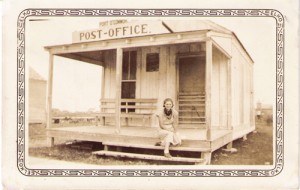
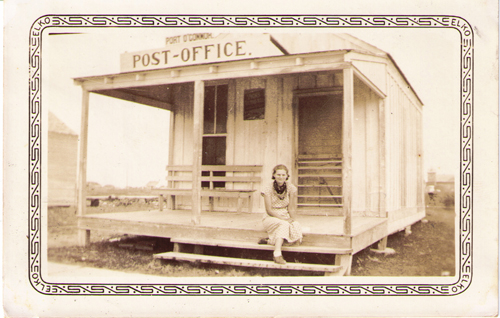
Edna Whittaker at the Port O’Connor Post Office where she worked. Edna Whittaker passed away on December 20, 2010. She would have been 93 years old on February 20, 2010.
Do you have a story to tell about the “old days”?
If you, or someone close to you, is considered an “old timer” and has a story to tell about life in Calhoun County in earlier times, we would like to hear from you.
You may contact Joyce in Port O’Connor at 361-983-4667; or Jasmine in Seadrift at 361-218-5459.
Old photos of Port O’Connor, Seadrift, and the surrounding area are also welcomed. E-mail to: dolphin1@tisd.net