The Tejano Monument

Archived in the category: General Info, Organizations
Posted by Joyce Rhyne on 27 Jul 12 - 0 Comments

Photographer Phil Thomae of Port Lavaca with his photograph of the Tejano Monument.

Twelve years of work by Hispanic leaders came to fruition with the unveiling of the Tejano Monument.

This monument is a significance figure in Texas and Mexican history; it can make the Hispanic people feel proud of their heritage. The south lawn of the Capitol of the State of Texas bares the important role played by Tejanos. They were the state’s Spanish-speaking pioneers who were the first to bring European culture to what would later become the Lone Star state. After 500 years, Texans of Hispanic ancestry are officially recognized by the state of Texas.

Tejanos brought the cattle industry and culture to North America, pioneered the wool and mohair industry that exists in Texas today, exposed Anglo Texans to mounted law enforcement—which they copied to form the Texas Rangers—and even served as an example to the United States legal system, which copied Spanish Tejano homestead and community property laws
Everything that Texans brag about is Tejano – the Texas Longhorns, the Texas Mustangs, Texas chili, just to name a few.

At 525 square feet, the monument will be among the largest on the Capitol grounds. Mounted on a 250-ton slab of pink granite, bronze statues depict a Spanish explorer, a vaquero on his mustang, a longhorn bull and cow and a family of settlers. A series of plaques will tell the story of Tejano history

Mr. Russel Cain, a strong supporter and resident of Port Lavaca, commissioned Mr. Phil Thomae, also of Port Lavaca, to photograph the historical monument so it could be viewed by Calhoun County residents and visitors to our community. This historical monument portrait may be seen at the Port Lavaca Bauer Community Center, 2300 Highway 35 South, and also a duplicate copy was presented to Commander Eddie Rendon of the American GI “Howdy Leal” Forum Chapter located on Highway 87.

-Rose Pena
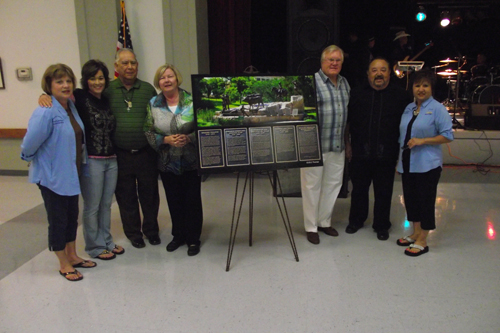
Presentation at the Bauer Community Center (l-r): Chamber Ambassador Melissa Sterling; Tina Crow, Port Lavaca Chamber of Commerce Director; Joe Pena, member of the Calhoun County Culture and Cuisine; Jan Regan, Calhoun Co. Museum President; Russel Cain, Main Street President and donor of the photograph; Robert Ojeda, Calhoun Co. Culture and Cuisine Entertainment Chairperson; Josie Amejorado Chamber Ambassador.
Fish Out of Water, by Thomas Spychalski…

Archived in the category: Featured Pets, Fish Out of Water, General Info
Posted by Joyce Rhyne on 27 Jul 12 - 0 Comments

Texas Travels

Texas, as you may have heard, is a pretty big place.

It covers a landmass that has multiple environments and wonders, some natural and some man made by the population of this huge state. Deserts, big cities, miles of beautiful coast and open farmlands and oil fields make up a diverse collection of areas that combine to make something definitely more then the individual areas alone.

Recently I had the opportunity to make a trip away from the water and into the heart of the state, all the way into Dallas as a matter of fact. This got me to thinking about how much there is to see in the state, as well as the people that populate those areas.

The first thing I saw as I snaked my way through towns like Bay City was the miles and miles of enchanting coast land that make our local area. Also, depending on the town, there were the architectural wonders of the past, the like of which is closer then you may think if you head over to the buildings on Port Lavaca’s Main Street area or the remains of days gone by in Indianola. These are buildings and dwellings that have stood the test of time, some for close to a hundred years.

All of those sights were followed by miles and miles of open land as I approached Houston, which besides being the place the astronauts used to call when they had a problem is also the largest city in Texas as well as the fourth largest in the country. Houston is one of four entries the state makes in the top ten biggest cities in the union, a feat that really displays the vastness of the Lone Star State.

Houston itself was as busy as any other big metropolitan city I’ve seen, like Chicago or Phoenix, but dealing with the people there you also still got that sense of Texas charm and style that makes the former republic so unique in it’s ways. It was also a bit of a culture shock when coming from a town with a population of thirteen thousand or so people, even for a guy who came from right outside Chicago. I guess seven months of peace and quiet is enough to make sirens and planes rattle anyone’s nerves.

From H-Town it was on to Dallas, but of course if you have ever looked at a map of our favorite state then you will know that the drive between Houston and Dallas is a bit of a trek in and of itself. Going along I-45 through such towns as Huntsville and Corisicana, the state makes it gradual shift from coastal paradise to an open expanse of farmlands and ranches that at one time were forests and plains. If you have yet to experience a cross country trip by car or bus then you are missing out on the slow drive that causes you to really reflect on how small you are compared to the rest of the world and how many places there are yet to be explored.

Arriving in Dallas was a very exhausting leg of my trip but I have to admit that I am glad I did it at night as my arrival was in the heart of the downtown area of the Big D, right off Main Street across from the Bank of America tower, glowing green with it’s Argon tubing. It felt like I had arrived in the future from an old science fiction film, everything aglow.

This is where my most recent (but surely not the last) journey through Texas ends, but I cannot feel properly finished describing Texas’ diversity and complexity of climates without noting that in high school I had the pleasure of living in the city of El Paso Texas, which many of you may know is much further west, right on the edge of the western panhandle on the border between the United States and Mexico.

Here you find yourself in an environment of sand and heat, with a culture much more influenced by it’s close relationship with Mexico. For me it is a testament to the way that Texas really can surprise you with what you may find within it’s borders. Remember when they say things are ‘bigger in Texas’, they mean it and mean it well.

Prayers for Clint

Archived in the category: General Info
Posted by Joyce Rhyne on 27 Jul 12 - 3 Comments

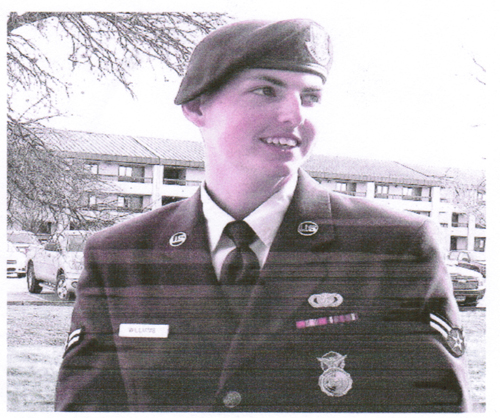
Clint Williams

Clint Williams lived in Port O’Connor and graduated from Calhoun High School in 2011 and joined the Air Force in 2011. He is stationed in Germany and was in a terrible motorcycle accident on July 21, 2012.

He has a cracked skull, brain bleeding and swelling, bruised lungs and has been in a coma since.

I, his brother Kyle Williams, and the rest of our family are simply asking anyone who reads this to please say a prayer for Clint’s recovery.

Thank you for all of the support.

Sincerely,

The Williams Family

Footprints & Rusty Hooks by Sue Kubecka

Posted by Joyce Rhyne on 27 Jul 12 - 0 Comments

BUNCO! Would you believe that the next Bunco is gonna be Tuesday, August 7th?   What’s that saying, “Time flies when you’re having fun!”  And that is the way the evening is spent.   Bunco will begin at 7:00 p.m. in the back meeting room of the Community Center, and play will commence following the usual array of delicious foods.  We welcome all interested women on that evening; if you are new to our area, this is a good way to meet others.  And if playing Bunco is something you’ve never had time for, well, you will certainly enjoy yourself, so come check us out.  You could go home a winner too!

There were many winners at the July meet including the winner of Most Games, Alaine Hardt with Sally Jones coming in a close second.  And a new player, Agnes Hannen was the recipient of the prize for the Least Games.  Most Buncos was won by Evelyn but the Floating Bunco prize as well as the 2nd most Buncos were won by Pat Ekstrom.  And June Westling went home with the Booby Prize. Call Shirley Gordon at the Library for further information, 983-4365.

Have you seen the new 4-legged lawn mowers being employed on Maple Street?  And they don’t need gasoline to get going!  Actually, there are several horses and one or two donkeys being used to keep the grass in check on several vacant lots.   Hmmmmmmm!

Poco Bueno was here and surely conquered this area once again with visitors, fishermen, and many others to take part in this incredible annual fishing tournament.  It became quite exciting down at the Fishing Center as we watched the leader board for more news of marlin being caught.  And there were three with the last one coming in later Saturday evening; the boat was DonaKen out of Seabrook.  And the successful angler was Ryan Smith, an eighteen year old who has been fishing since learning how to walk.

But the joy for me was just watching, with some envy, the entry parade of boats into slips at Caracol.  But, I guess the fun part, was really watching them hit the gas docks at the Fishing Center.  Those registers went round and round and round as the fuel was being put in the large tanks.  Guess I’m really not that envious after I saw the total bill.

At last count there were 99 offshore boats competing in the tournament, and as of Monday morning, only about 25 remained.  Perhaps they will be fishing in the coming tournaments this weekend or were just taking a welcome rest.  As Sunday afternoon was the mass exodus of vehicles for the return home for the coming work week, the only remnants of Poco Bueno early on Monday morning were a few remaining barricades and the overflowing dumpsters and garbage cans.  But just wait till 2013 as I understand preparations or at least the mental planning has begun!

New on the scene for fishing tournaments is one being sponsored by the Cancer Association of Garwood, Texas.  Tentatively set for sometime in October when the fishing will really be good, this will bring in some very interesting and dedicated people.  I understand that some help is being provided by a local organization too.  Interesting how far and wide the joys of Port O’Connor have spread.
One of the many aspects of life in Port O’Connor is the weekly necessity of driving to Port Lavaca or Victoria for goods and services.  And, now with the work being done on 1289, you get to wash your vehicle more often because of the gravel and mud.  Oh, well, just think how nice it will be when finished.

Service Club members:  A reminder, again only one meeting in August which will be Thursday, August 2nd!  But our regular schedule will start again on September 6th when we elect officers for the coming year.  If you think you’d like to serve as an officer, please contact Janet Johnson, President or the Nominating Committee.

kubeckasue@yahoo.com
361 798-0560

If the reader wishes to add any news at any time to this column, please contact me at the above address or telephone number.  And thanks in advance for reading.

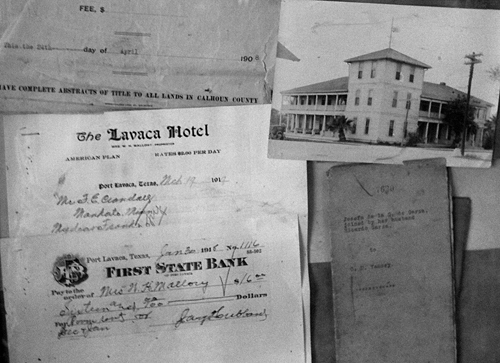
Hotel receipts from 1910.

We are all creatures of habit; travelling to and from work, school and many habitual locations until something or someone ignites a spark of interest in a subject we are unfamiliar with. I don’t know about you, but I always want to find out what the scoop is. This all came about as it always does, a simple conversation with a friend about historical markers. And as always, I was intrigued. It instantly took me back to one of the first times I strolled down Main Street in Port Lavaca, camera in hand — it had been a while so I felt the need to return.

As I pulled up and parked alongside the turquoise building, it loomed before me. The sea breeze was fresh as rain. In tune with the new trend, it had fallen not more than an hour ago, the air remained crisp and the gravel churned beneath my feet. I drive by this particular building at least once a day. It has peaked my interest before; I’m glad I finally stopped to peer inside the Seascape Apartments.

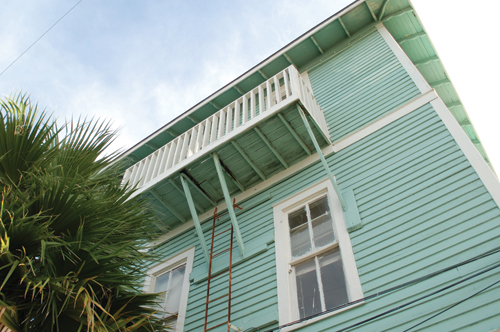
Once upon a time the apartment home was a hotel with approximately thirty-three rooms, now it houses nine apartments and a furniture store. At one point, it was a restaurant.

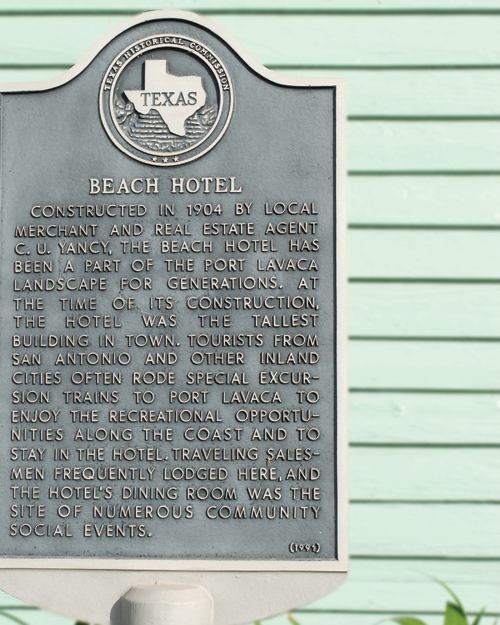
The hotel, once known as the Beach Hotel , is one of forty-five historical markers located in Calhoun County.Historical marker #345 reads as follows: Constructed in 1904 by local merchant and real estate agent C. U. Yancy, the Beach Hotel has been a part of the Port Lavaca landscape for generations. At the time of its construction, the hotel was the tallest building in town. Tourists from San Antonio and other inland cities often rode special excursion trains to Port Lavaca to enjoy the recreational opportunities along the coast and to stay in the hotel. Traveling salesmen frequently lodged here, and the hotel’s dining room was the site of numerous community social events. (1991)

No wonder the building seemed to encompass the corner appropriately, positioned at the corner of Main and Commerce Street, it is a busy intersection. Not only today, but back in its heyday as well. The railroad, Southern Pacific Lines, offered weekend excursions to Port Lavaca from San Antonio until the 1930s. Southern Pacific bought the San Antonio & Mexican Gulf Railroad in 1884. Chartered in 1850, the San Antonio & Mexican Gulf Railroad was one of the first railroads in Texas.

As I entered into the hotel, I could already envision how popular it was in the early 1900s. The hotel had a certain energy surrounding it, I walked through the first floor hallway, I stopped and peered upstairs from the beginning of the staircase, my imagination soaring.

I reached the end of the hallway which lead towards an exit to the bay front. Following the signs I walked to the building next door, Davila’s Repair Shop. There I found Alex Davila. He explained the building had gone trough several reincarnations, and is currently owned by his father, Ray Davila. Ray purchased the hotel on July 20, 1978 from the Bauer’s. At the time they lived in Brookhollow Estates on Seascape Drive. As a symbolic gesture, he and wife, Tina, renamed the hotel Seascape Apartments. Isn’t that something? Thirty-four years ago, almost to the exact date and as Alex said, “It seems like a week ago.”

The Davila’s have records from as far back at 1904 documenting the building’s origin. As I glanced over the historical documents I saw a receipt which stated rates in 1910 were $2.00 a day, even a $16.00 check from the First State Bank of Port Lavaca for a week’s stay. As I chatted with Alex I learned much about what was once known as the Beach Hotel. The building has withstood the test of time including Hurricane Carla in 1961.

As the afternoon grew later I was eager to learn more about the famous politicians that stayed in the hotel in the early 1900s. With promise to return that week, I left feeling like Nancy Drew on a mission to learn more about the landmarks I cross each day. With an approximate count of thirty historical markers in Port Lavaca I knew I’d unearthed a honey pot. Till next time!

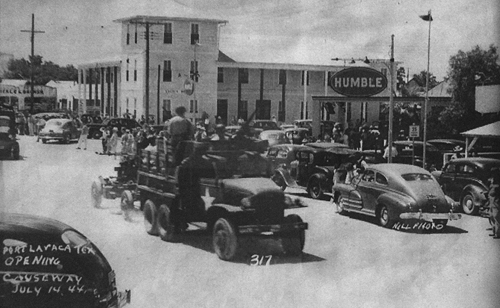
A photograph taken on the opening of Port Lavaca’s wooden causeway on July 14, 1944 with the Beach Hotel in the background.

Once the tallest building in Port Lavaca, the Beach Hotel, now named Seascape Apartments, still stands over one hundred years later.

Historical marker #345, which was posted in 1991 with the help and research of Fred Rhodes.

Untitled Document