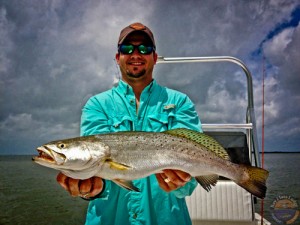
Trophy Gator Trout released somewhere in the upper 25-inch class; guests of Scott H. from Houston; Bay Flats Lodge Guide Jonathan Hill, 5/31/12, Back Lakes.
June signals the end of spring into the early stages of summer time fishing. I want to cover fishing shorelines, inlets and bayous, and the presents of glass minnows and pinfish to land Gator size trout.
Time and time again you have read articles from me about “Find the bait find the fish.” But, let me walk you through areas that hold more concentration of bait. First, let’s look at shorelines characteristics such as points, coves, sand bars, and proximity of depth to color change. When looking for points on area shorelines key in on grassy points that attach to coves. These points normally hold more bait because current forces bait into and around washout areas. Look for sand bars that have good grass cover and steep guts. These undulations are underwater highway for large mullet, crabs, and pinfish. Keep an eye open for deep pockets of sand; I call these pockets sand saucers. Trout like to lay down in these saucers and ambush bait that swims through the grass over the saucer. You will notice where these deep pockets are located by color change. This is what I mean when I say, depth to color change.
Second, I would like to cover fishing inlets and bayous. I will always park my boats up wind of a bayou and wade fish downwind towards the inlet with top water lures. Work tight to the grass casting to nervous mullet. If possible, walk over the shoreline and get up wind of the bayou. As you stand on the bank, cast a top water lure into the bayou where bait is active. I will slowly wade into the bayou from the grass shoreline to get closer to active bait and work more areas. The majority of these bayou grass banks are very muddy, but once you get into the middle of the gut where the water is waist to chest deep, the bottom is normally firm. For first timers, wade-fishing bayous can be intimidating due to a new and different environment that offers mud, sand, shell, grass, and looks like alligator country. So far, I have never encountered any gators. While looking back at last years logs, we had 15 days with sustained winds over 20 mph. These bayous and inlets offer protection from gusting winds. Not only do I catch healthy trout, but also large redfish use these bayous to travel from shorelines to back lakes. On an outgoing tide, fish the head of bayous and inlets on the bay front side. Mullet will be stacked at the mouth of the bayou. On an incoming tide, fish the mouth of the bayou that empties into an area lake.
Third, let’s discuss the presence of glass minnows and pinfish. Look for small explosions on the water surface. These explosions can be the result of trout coming underneath a glass minnow, or small pinfish. Smaller baitfish will attract pinfish on both shorelines and area reefs. In turn predator fish like redfish and trout will follow pinfish. Middle to late afternoons is the best times for glass minnows to move. Look for groups of diving brown pelicans and nervous jumping glass minnows. I prefer to fish areas where bait is forced through a reef or shoreline. For example, if you take the First Chain of Island Reefs in Espiritu Santo Bay. Look for areas where pelicans are diving and bait is active. In the past years, May has offered many great trips in this area.
As of late, we’re still catching good size trout that are pushing into the 7 lb class. Most of these larger trout are being caught over shell in 3 to 5 feet of water while wade fishing. I am using a slow steady straight retrieve over solid shell to catch these bigger fish. The majority of my trips have included plum chartreuse TTF red killers. Over the past two weeks I cannot ever remember experiencing such violent strikes while slowing retrieving these lures. Some of these strikes have been less than 6 feet away. I suggest reeling the lure all the way back to you if you are receiving close strikes.
In closing, the past 90 days we have seen some great fishing, and hopefully June will be no different. With more tournaments and vacations ahead, be courteous on the water and remember to approach wade fishermen while idling slowly or pass them with good distance. One thing I will leave you with, if you’re scaring bait you’re scaring trout and redfish.
Always practice CPR when possible on big trout and redfish, catch, photo, and release…guide Chris Martin Port O’Connor/Seadrift