Fishing Tournaments

Archived in the category: Fishing Reports
Posted by Joyce Rhyne on 07 Jun 12 - 0 Comments

To list your Fishing Tournament in Dolphin Talk, E-mail:
dolphin1@tisd.net

May 26-Labor Day CCA Texas STAR Tournament
http://www.startournament.org/

July 6-7 Pescado Grande – Port O’Connor
The Harbor 361-676-8548

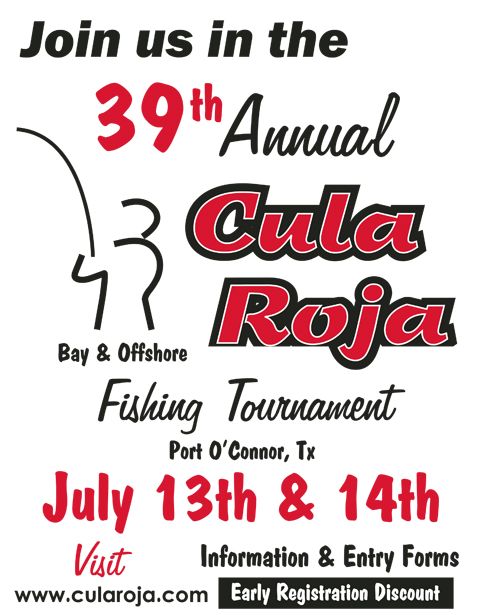
July 13-14 Cula Roja – POC
www.cularoja.com

June 22-23 ABC Tournament
361/572-0299

July 18-21 Poco Bueno
weigh in at The Fishing Center, POC

July 20-22 Cabela’s Redfish Series – The Sanctuary www.saltwaterseries.com

July 24-29 Lone Star Shootout – Caracol
www.thelonestarshootout.com

July 28 Nails and Tails Tournament
Builders Association of Victoria
361-578-7711 kristi@vctbuilders.org

August 3-4 Readin’, Ritin’ & Reelin’ Tournament
(361) 894-4136, 655-2658, 649-0459

August 4 Possum Invitational Invitational
www.possumfishingtournament.com/

August 11 Speedy Stop Kids Fishing Tournament

Oct. 5-6 P.O.C. Grand Slam
361-935-8745


With the official start of hurricane season, there are a number of proactive ways you can help minimize the risk of damage to your boat from heavy storms. Even a Category 1 hurricane can inflict severe damage to boats that are improperly prepared or left unattended. Don’t wait until it’s too late, as many people have been impaled during a hurricane tending to their boat. Here are 10 ways to prep your boat for the dreaded hurricane season.


Remove your boat from the water.

Securing a boat on shore is much more advantageous than leaving your boat anchored in water during a hurricane. The best place for your boat if it must be out in the water is in some sort of hurricane hole – an inlet, a cove, or an area with some surrounding protection like strong trees or anchoring points. If you have a tow-able boat, the safest thing is to put it in a covered garage.
Get a heavy, durable anchor.

If your boat must be kept in the water, make sure that the bottom of your boat will hold strong to a heavy anchor, reducing movement during the storm. Using more than one anchor is ideal to resist against strong wind and bigger waves.

Disconnect the electric and charge the battery.

To lower the risk of electrical damage, disconnect all electricity, water, and other dock connections including fuel lines. Fully charge the battery on your vessel so bilge pumps may be used when you need it (to dispel water or combat fire).

Remove all loose items.

Any area left exposed, especially the deck area, should have all loose items removed; this incudes canvas, plexi-glass, or plastic coverings, antennas, and all outriggers. Any remaining loose items on board should be safely stowed away.

Protect your engine.

Water has a knack for finding its way into even the smallest openings. This is only increased during a severe hurricane, so be sure to protect your engine by covering the engine room vents. You can even use duct tape to temporarily add more coverage and seal any small openings. Also plug exhaust pipes at the stern or screw a piece of plywood over the vent and tape over the edges for added protection.

Seal all openings.

To make your boat even more watertight, seal any crevices in the exterior. This includes windows, hatches, and doorways. Duct tape is a good solution to make all seams withstand against wind and water.

Prepare your boat’s interiors.

Boats with cabins should have all loose items removed. If you have a refrigerator, remove its contents, as the strong motion of the boat may cause the door to swing open. The same thing goes for drawers and cabinets. Any cloth-like items like drapes, blankets, and cushions should also be removed as they may become soaked from leaks.

Secure your boat in its moorings.

The best position for our boat to face during a storm is directly into the wind. When securing your boat, be sure to double the mooring lines to account for unpredictable winds. Also be sure to allow enough line as possible to account for high rising tides.

Cover electronics.

Important electronic devices like instrument gauges should be covered. Take portable electronics and store them in a safe place, far off the ground.

Secure your boat trailer.

If you’re lucky enough to be able to secure your boat on land, make sure you secure the trailer by deflating the tires (about halfway) and putting blocks in front and behind the tires. It also helps to place something heavy between the frame of the trailer and the turning axle to resist movement and strong winds. Then, strap your boat down to the trailer and secure the trailer to a sturdy object.
Hurricane Season

Archived in the category: General Info
Posted by Joyce Rhyne on 07 Jun 12 - 0 Comments

June 1 marked the start of the 2012 hurricane season. A near to below normal Atlantic hurricane season is expected in 2012 even though 2 named storms have already formed in late May this year (only the third time in history this has happened). Early activity does not usually indicate latter season activity.

The official NOAA forecast calls for:
9-15 named storms
4-8 hurricanes
1-3 major hurricanes (category 3 or higher)

Several factors are coming together to potentially reduce the number or storms for the 2012 season compared to both 2010 and 2011 which had 19 named storms.

1). Atlantic sea surface temperatures in the region between Africa and the Caribbean Sea are running 1-2 degrees below normal for this time of year which suggest cooler than normal water in the Atlantic. Tropical cyclones feed off of warm water, so cooler than average conditions usually indicates a potential for less activity and less intense storms.

2). Forecasted sea level pressures across the entire Atlantic basin are forecasted to run between 50-80% above average during the peak of the 2012 season which again points toward negative conditions for development.

3). The forecasted development of El Nino (warmer than average waters by .5C in the central Pacific). ENSO forecasting models show the current neutral conditions warming to El Nino conditions by late summer. How fast this happens could have a major impact on the Atlantic hurricane season, as El Nino is a major hindrance of Atlantic basin tropical activity due to increased upper level wind shear. If El Nino forms quicker than currently expected, the number of tropical cyclones will probably be toward the lower end of the forecast (9-12).

As with any hurricane season, it is not the number of storms, but where they impact that is important. Current patterns for 2012 support “close-in” development in the Gulf of Mexico and off the SE US coast with potential for quick impacts. I remind everyone that it only takes one storm to make a bad year in your particular area (1983 only had 4 tropical systems the entire season, but one was category 3 hurricane Alicia, the last major hurricane to strike the upper TX coast).

Now is the time to review your hurricane preparation plans, prepare a hurricane kit, plan you evacuation route if a public evacuation is needed, and review your insurance policies….remember home owners insurance DOES NOT cover flood damage and flood insurance takes 30 days to go into effect. Prepare NOW!

In coordination with the National Weather Service (NWS), GBRA will add new river stage forecasts for the Guadalupe River and its tributaries in South Central Texas and the Hill Country. Beginning May 25 the new daily forecast services will help inform interests along the Guadalupe River system. A full range of forecast flows, from baseflow to flood conditions, will now be available on the Guadalupe River system. Daily forecasts will be available at 15 locations on the Guadalupe River, including the Blanco and San Marcos River tributaries. These forecasts may be monitored online with the United State Geological Survey (USGS) streamflow data at this link: http://www.gbra.org/conditions/data.aspx
“The addition of daily forecasts to our river forecast responsibilities will provide enhanced decision making information for the recreation industry, ranchers and other interests in the Guadalupe River basin,” said Joe Arellano, meteorologist-in-charge of the Austin/San Antonio office.

The Austin/San Antonio forecast office provides all weather services for 33 counties in South Central Texas. The office collects meteorological data; prepares and disseminates weather forecasts, river and flood forecasts and warnings; and issues severe weather watches and warnings to the public.

“This new forecast service on the Guadalupe River basin is an invaluable tool,” said Thomas Donaldson, hydrologist-in-charge of the West Gulf River Forecast Center. “Daily river stage forecasts across the entire spectrum of river flows will be available to decision makers and the general public through the Advanced Hydrologic Prediction Service.”

NOAA’s mission is to understand and predict changes in the Earth’s environment, from the depths of the ocean to the surface of the sun, and to conserve and manage our coastal and marine resources.

The GBRA was established by the Texas Legislature in 1933 as a water conservation and reclamation district. GBRA provides stewardship for the water resources in its 10-county statutory district, which begins near the headwaters of the Guadalupe and Blanco rivers, ends at San Antonio Bay, and includes Kendall, Comal, Hays, Caldwell, Guadalupe, Gonzales, DeWitt, Victoria, Calhoun, and Refugio counties.

State Agencies Undergo Sunset Review Process

Archived in the category: General Info
Posted by Joyce Rhyne on 07 Jun 12 - 0 Comments

In order to identify and eliminate government waste, duplication and general inefficiencies in state agencies, the Texas Legislature established the Texas Sunset Advisory Commission (Commission) in 1977. The Texas Sunset Advisory Commission is a legislative body which is made up of six Texas Senate members and six Texas House of Representative members.  The Commission is tasked with reviewing the policies and programs of more than 150 state agencies.  The sunset review process is designed to review each of these agencies every twelve years. This review is done by taking up a certain number of the state agencies each session when the Texas Legislature convenes.

In reviewing the various agencies, the Commission examines the continual need for the agency. A review is made of duplication of policies or programs with other agencies.  Also, the review looks at new and innovative was to improve each agency’s operations and activities. During the sunset review process, the Commission holds public hearings, and allows the public to provide their thoughts, ideas and general perception of the agency’s need.  After each agency is reviewed, the Commission then recommends actions to the full Texas Legislature.

One of the agencies currently in the sunset review process is the Texas Board of Architectural Examiners (TBAE).  The TBAE is setup as a multi-professional regulatory agency that oversees architects, interior designers and landscape architects.  The agency was established in 1937 by the 45th Texas Legislature.  The Legislature established the agency after an explosion at the New London School killed 295 students and teachers. The agency’s mission statement is to “to ensure a safe built environment for Texas by regulating the professions of architecture, landscape architecture, and interior design.”

The TBAE duties and responsibilities are outlined in Subchapter B of the Occupation Code, Chapters 1051, 1052, 1053.  The agency is overseen by a nine-member Board which is appointed by the Governor of Texas and confirmed by the Texas Senate.  The Board is made up of four architects members, one interior designer member, one landscape architect member and three members who represent the public, of which at least one is a person with a disability.  The day-to-day  operations of the agency are handled by the staff, and overseen by the executive director, who is hired by and serves at the will of the Board.

If you would like to learn more about the TBAE agency and their functions, you can go to www.tbae.state.tx.us .  On their site you can learn about the agency’s regulatory laws and enforcement responsibilities and other information.

Over the coming weeks, I will take the opportunity to outline and present to you other state agencies currently undergoing the sunset review process.  If you would like to learn more on your own about the Sunset Advisory Commission or other agencies undergoing the sunset review process, you can go to www.sunset.state.tx.us .  Some of the agencies that that I will be outlining are the Texas Education Agency, Texas Lottery Commission, Texas Ethics Commission, Texas Higher Education Coordinating Board, State Commission on Judicial Conduct, Texas Railroad Commission, State Preservation Board,  and the Texas Commission on the Arts.

-State Representative Todd Hunter

Untitled Document