Explore the Bay Paddling Series
Posted by Joyce Rhyne on 16 Mar 17 - 0 Comments
Backyard Tomato Growing by Clint Bennetsen – Island Guy
Archived in the category: Featured Writers, General Info
Posted by Joyce Rhyne on 16 Mar 17 - 0 Comments
Oh, what a wonderful feeling of satisfaction, to walk out into the garden and pluck a beautiful homegrown vine-ripened tomato from one of your plants — to have been able to watch that plant, and at least several others, from the day you brought them home from your local nursery or outdoor garden store, caring for them as if they were your babies, up until final fruition of being rewarded for your several months of dedicated work.
A lot of established gardeners would lead you to believe that only they have the experience and know-how to grow delicious tomatoes by their own hand. . . Well, to that way of thinking I say, “that’s a load of well composted cow manure.” Anyone truly can grow their own tomatoes in their back yard, or wherever gets the most amount of sun. It’s not rocket science, just simply a little knowledge and patience and practice. I’ll do my best to impart what I’ve learned through trial and error about growing your own tomatoes. I, in no way, know all there is to know. . . but through experience and talking to my dad and uncles, all of whom have certainly forgot more about tomato growing than I’ll ever know, especially my late uncle Charlie Ray Bennetsen, I’ve learned a thing or two.
As important as good blood is to our bodies, nutrient rich soil is equally so to growing healthy tomato plants. Yes, tomato plants and other vegetables will grow in plain soil alone, but they will not thrive or produce to their full potential. Organic matter, such as composted cow manure, rabbit manure, composted chicken manure and cotton burr compost (the ground up husk that holds the cotton balls), are all excellent choices of organic matter. All of these choices can be found at nurseries and feed stores. Always make certain the chicken manure has been composted, as it is a very “hot” form of nitrogen and will otherwise burn the roots of your tomato plants.
Simply thoroughly mix one, several, or all of these organic materials into your garden soil. How much do you mix in? My answer: a bunch! My raised bed gardens and large tubs contain about 60% soil and 40% organic matter, and EVERY year I add more organic matter so the soil stays refreshed with beneficial nutrients. And if you are using containers for growing your tomatoes, please use at least 10 gallon ones, and preferably 15-20 gallon. Yes, it will take a larger amount of potting soil and organic matter the first year, but each year thereafter just add more organic matter. Your results with a larger container will be a much healthier producing tomato plant. And always try to situate your growing area where it will receive at least 6-8 hours of good sunlight per day. This is very important for healthy plants.
Your soil with organic manure and materials is ready to go, now lets go find some healthy tomato plants. This prime planting time of year offers a good selection of plants at any nursery, home improvement or feed store, and if they are selling them in this area, they should certainly grow well. Bonnie Plants provides assorted variety tomato plants for sale at Lowes, WalMart and Home Depot, and they are very good quality, available in biodegradable pots, wherein the whole pot and plant go into the soil of your garden. I would suggest getting several different varieties, maybe a cherry type and then a larger beefsteak variety, they will be about $4 per plant, roughly twenty ounce container size. While you are there, pick up some Miracle Gro fertilizer to be used every 7-14 days when watering your plants, follow the directions.
Upon returning home with your babies, you are ready to put them into the ground, and only one plant per large container, and a minimum of 24-30” spacing between them if they are planted into the ground or raised bed. Now here is where planting tomato plants is gonna be different from planting all other vegetables: That plant needs to be planted DEEP! And by that, I mean a good 2/3 of that plant needs to be under the soil. Pinch off the bottom set of leaves; place the plant into your planting hole and completely bury it, leaving only several inches sticking above the soil. The stem of that deeply buried tomato plant will develop roots and create a much healthier and stronger plant. Lightly pack the soil around the plant, leaving a depression or bowl that will allow water to gather and soak directly down into the roots, and then water it well.
I personally always mulch around the base of my plants, using shredded hay that I’ve thrown onto the ground and then mowed over and bagged with my push mower. Dried grass clippings would work as well. This mulch material helps keep moisture in, helps with weed control and also prevents water from splashing up onto the bottom leaves which creates fungus. As the plant grows, help support it by placing a tomato cage over the top of it while it is small, or push a long stake into the soil next to it and tie off the plant to the stake as it grows taller. I use surveyor tape for tying off. Water and fertilize as needed, following application directions on the Miracle Gro fertilizer box. A common mistake is to over-water tomato plants, so be careful. Depending on the variety, hopefully within 60-90 days you will be eating delicious homegrown tomatoes.
Feel free to contact me by email with any questions and/or concerns regarding growing tomatoes. If I don’t know the answer I’ll certainly try to find it. Everyone take care and Happy Growing!
Clint Bennetsen resides full time on Matagorda Peninsula Island, and can be contacted for comments or questions at ccbennetsen@yahoo.com.
Reflections by Phil Ellenberger
Posted by Joyce Rhyne on 16 Mar 17 - 0 Comments
If you have ever written anything you have had writer’s block. If you haven’t, try writing something and you will get it for sure. I work with a computer and word processor rather than an old fashioned typewriter. I didn’t get as much block with those old fashioned things. Mainly because it was so easy to make mistakes with them. You were always antsy when you were working with them. You really didn’t want to make mistakes and have to either start over or erase and probably tear paper with your eraser.
As a result, your mind was active and you would be really up on your toes. Even so you made mistakes, but you didn’t stare at the blank computer screen and wonder what to type. The secret to success is to start typing any old gibberish and then pretty soon something will come to you. Viola, it worked this time too! There is no charge for this little inside tip to the writing business.
Many you have deduced that I am on the Autumn side of life. As such I have been working for several decades with a valid drivers license. The thing about those licenses is that you have to renew them every so often. It turns out that they have also been working for years as my identification. How many times have they asked you to show your drivers license? It is just plain often.
Now sometimes you can renew them on line. That means you might not have to pass the eye test. I was hoping to do that this time. However, it was not to be. I received a letter from the bureau saying that this time I had to go in. It also said bring identification like a birth certificate or a current passport. Notice it wasn’t my drivers license, which has been my ID for years.
I guess it’s like for my Professional Engineer license, where last year they made me go get fingerprinted after decades to see if I was a crook on some criminal file. They just don’t trust their own systems.
If I find my birth certificate it will be over 80 years old and my foot print will be of a little baby’s foot. There would be little way to compare it to my current print. For the record I let my passport expire because I am not planning on going anywhere needing a passport in the future.
This means that there is a possibility that I won’t have enough identification to prove this old man is really a citizen. While I was complaining about this state of affairs to my daughter, who is visiting here, she pointed out that it probably means they want to deport me.
There are a lot of folks they want to deport. I simply have to prove to the bureaucrats that I am not one of them. I am scrambling to get the stuff. If I am not successful I hope to get deported to Tahiti.
Purple Martins Are Arriving! by Susan Heath
Posted by Joyce Rhyne on 16 Mar 17 - 0 Comments
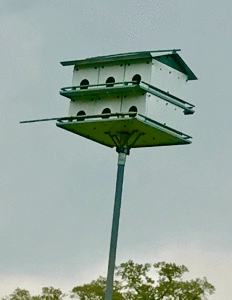
Purple Martin house
You know it’s just about spring when Purple Martin scouts arrive from their southern wintering grounds. Almost every year we received calls at the Gulf Coast Bird Observatory inquiring about Purple Martins, asking when they can be expected and why they send scouts ahead of the soon to arrive hordes.
Perhaps ‘scout’ is not the correct term and this is probably another case of humans and anthropomorphism. Adult Purple Martins arrive first and most often return to the same location as the previous year. These early arrivers have been called ‘scouts’ by some folks. They begin to arrive in our area just about now. We hope to see some soon flying around the Gulf Coast Bird Observatory singing and checking out the new house we put up this winter. The young birds or subadults arrive 6 weeks after the adults. We’ve never had them nest here on the GCBO grounds but we are ever hopeful that someday they will deem our habitat suitable and raise some babies here. They often take a few years of looking at a site before moving in. Purple Martins and humans have a long history of co-habitation. Due to cavity competition with introduced House Sparrows and European Starlings, eastern Purple Martins have been almost entirely dependent on human-made martin houses for nesting since the early 1900’s. Paradoxically, martins west of the Rocky Mountains still nest almost exclusively in old woodpecker holes or natural cavities. Few other species show such a marked geographic difference in nesting habits or have the long-standing relationship with humans that Purple Martins do.
The males are a beautiful glossy purple color all over while the females and young of the year are purplish on their backs and dusky underneath. They are quite entertaining as they glide, dip, and soar in search of flying insects. Although it is often advertised that they eat thousands of mosquitoes a day, there is no evidence that they actually eat them as mosquitoes usually fly lower than the typical foraging altitude of a martin. Still they make good neighbors feeding on other insects and entertaining us with their aerial prowess.
Purple Martins are the largest swallow in North America and should not be confused with our other swallow species. Birds nesting under bridges, especially highway overpasses, are typically Cliff or Cave Swallows which can be identified by the light patch on their upper tail. If you have swallows nesting in your porch eaves, they are most likely Barn Swallows which have long forked tails. All of these species make nests out of mud rather than using human-provided houses like Purple Martins.
There are many places in the area where you can see Purple Martins during the spring and summer including both rural and city environments as they will nest in most areas where the terrain is open enough. Martins show high site fidelity and will return year after year to the same nesting site if it is properly maintained although it may take several years for them to establish a colony in newly installed housing. Martins have very specific aerial space requirements and housing should be placed in the most open spot available with no nearby trees. Generally it needs to be at least 30 to 120 feet from human housing and there should be no trees taller than the housing within 40 feet. As we have learned at GCBO, patience is key to being a successful Purple Martin landlord. If you want more information about Purple Martins, check out the Purple Martin Conservation Association’s webpage. www.purplemartin.org
 Sue Heath is the Director of Conservation Research of the Gulf Coast Bird Observatory. The GCBO is a non-profit organization dedicated to saving the birds and their habitats along the entire Gulf Coast, and beyond into their Central and South America wintering grounds.
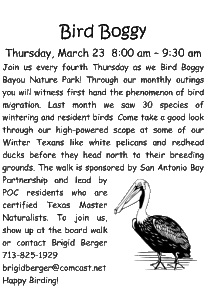
Bird Boggy
Posted by Joyce Rhyne on 16 Mar 17 - 0 Comments