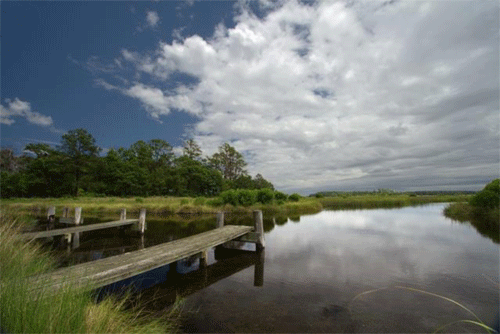
Not far from Palacios there is a very special place for those who love nature and the great outdoors. The Clive Runnells Family Mad Island Marsh is part of an expansive coastal wetlands system. The huge wildlife management system is under the oversight of The Nature Conservancy. In 1989, Clive Runnells donated 3,148 acres of coastal wetlands and upland prairies directly adjacent to Mad Island to The Nature Conservancy. The ranch had been part of the legacy of local legend Shanghai Runnells, and was subdivided in the 1950’s. Through a unique land swap, The Nature Conservancy conserved 5,700 acres of wetlands and coastal prairies that it later turned over to the Texas Parks and Wildlife Department. That acreage was turned into the Mad Island Wildlife Management Area.
The Nature Conservancy plays an important role in wildlife preservation with 37 preserves in Texas, preserves in all 50 states and 54 foreign countries. Their sole purpose as a non-profit group is to protect land and water for nature and people. They have conserved more than 119 million acres, have more than 100 marine projects and practice science based conservatorship in all habitats and regions. They are strong collaborators with 100 private partnerships in Texas alone, and over 838,000 acres under their oversight. In 1990, The Nature Conservancy forged a partnership with Ducks Unlimited to restore the wetlands and tallgrass coastal prairies through four habitat management programs. To learn more about The Nature Conservancy, go to nature.org.
The Mad Island Project is a nearly unbroken stretch along the mid- and upper-Texas Gulf. It is a haven for birds and other wildlife. Situated on the Central Flyway, one of four principal North American migratory bird routes, it allows for birding at its best. Nearly 250 species of birds—including migrating and resident songbirds, shorebirds, wading birds and waterfowl—use the area for nesting, feeding, resting and roosting. The preserve is especially important to wintering waterfowl, which includes 16 species of ducks and 4 species of geese. The endangered whooping crane has also been known to use Mad Island during their winter stay along the Texas Coast.
This protected gulf coast prairie marsh offers access, education, scientific study opportunity and rare glimpses of our coastal world. Bounded on one side by the ICW, it also has freshwater areas, forested areas and some controlled agricultural areas. This shrinking endangered ecosystem is growing smaller annually from Corpus throughout Texas and Louisiana Coast. It is a unique area providing a habitat for diversity of wildlife, but the ecosystem represented is degrading. Growing population, ever expanding development, and other factors are shrinking the coastal wetlands area.
This preserve’s upland prairies represents a portion of the remaining 2 percent of the original tallgrass coastal prairies once found across Texas and Louisiana, and is home to marsh and wetland habitats populated by a variety of aquatic and water-tolerant species, including various cordgrasses, glassworts, rushes and cattails. The preserve’s upland prairies display different grasses such as bluestem, plains bristlegrass and Texas wintergrass.
Alternately, the marsh provides habitat for many different marine organisms, such as red drum, blue crabs, brown shrimp, southern flounder and speckled trout. Mad Island Lake and its surrounding wetlands provide a critical nursery for a variety of marine life from adjacent Matagorda Bay. Other animals found on the preserve include alligators, bobcats, armadillos, rattlesnakes, white-tailed deer and coyotes. Wildlife includes puddle and diver ducks, Sandhill cranes, alligators, mottled duck, raccoon, river otter, mink, armadillo, white-tailed deer, bobcat, gray fox and cottontail, jack and swamp rabbits. Hunting for alligators, feral hogs and waterfowl are permitted through special scheduled hunts including public land hunts.
The conservation program includes many efforts to enhance the ecosystem. Two full time employees Steven Goertz and William Ward manage 7000+ acres including agricultural fields, wetlands, freshwater marshes, tidal flats, coastal prairies and woodlands. Their Conservation tools include: Grazing rotation, Prescribed burn, Invasive species treatment and control, Native Seed Harvest, Restoration work, Vegetation monitoring and wetlands management. They oversee 39 miles of fence, 19 miles of road, wells and water, building and structures, rice and milo production, an impressive educational complex and conservancy planning and programming.
Spring Migratory Bird banding at Mad Island is financed by Runnells daughter, a lover of songbirds, and a small Dow grant; and is overseen annually at Mad Island by the Smithsonian Institute. There are some 8,000 bird species worldwide, and 640 in Texas. Some migrate, some don’t, but bird banders use almost invisible nets to safely catch migrating birds to study and observe breeding and wintering grounds, learn about food, survival and migration.
Migration is driven by changes in their environment like weather, length of days, and breeding needs. When conditions are right they take off and fly, all night many times, and if they have rough winds or weather, they ‘fall out’ when they reach the shore. Our area is a common place for them to stop, rest, fuel up and then take off again for cooler climes north for the summer. Many of the small songbirds and colorful migratory birds we see in our migratory flyway travel 600+ miles nonstop. This is the ‘neotropic migration.’ The numbers and varieties of birds seen at Mad Island are great enough to support a 3-4 large bird banding team and even a Smithsonian Institute Exhibit Artist this year. These scientists measure, weigh, sample feathers and toenails, collect data and information that adds to the knowledge and understanding of bird migration. The artist sketched birds for possible future exhibits and display planning.
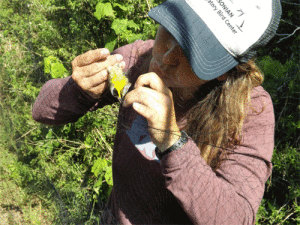
Predator birds, diurnal migrants, migrate in day and night, because they have few enemies and travel safely whenever. Nocturnal or night migrators are the smaller nuts, grass and seed feeders who are eaten by the larger birds if out in the day or small numbers. They flock together for aerodynamics, safety in numbers and travel at the safer times of evening and night. To get a picture of how high these migrators fly, planes travel at 35,000 feet while birds at 15,000 or about 3 miles above the ground. They fly about 30-50 MPH using topographical landmarks, stars and magnetic fields of the earth to navigate their way. They are impeded by weather, our ever-growing population and the structures they build and habitat they destroy with development, natural predators in the wild, domestic cats and community ‘wild’ cats, pesticides, lack of food and even lighting and electronics which interrupt their navigation. Want to help them on their journey? Keep cats inside, provide native plant life for coverage, water and food sources, and avoid pesticides to help increase bird population and migration success. Local Bird Enthusiasts and Master Naturalists Allan or Brigid Berger would be glad to inform you of ways you can volunteer. allanrberger@comcast.net
The migratory bird count has been active in this area for the last 5 years headed up by the Migratory Bird Center of the Smithsonian Institute. They hold volunteer work days and do a volunteer Christmas Bird count, but the bird banding of the migratory songbirds is done by trained technicians they employ. Our area Christmas Bird Count is the #1 count in the country in number of species counted annually 18 of the last 20 years counted. There are a thousand or more bird counts nationwide, so our #1 place is much envied by birders everywhere. These would be native birds and winter birds, not the spring migration population also known as ‘riparian’ bird population. The Christmas Bird Count is always recruiting volunteers to help if you would like to be involved.
The coastal views of Mad Island are impressive and worth the trip. Resident ‘gator Bonnie may greet you, the shore birds will entertain you with their diving and dining, and the scenery will fill you with an appreciation of the beauty of our Texas coast. The observation tower offers unparalleled views of the preserve, and the educational facility offers historic maps, preserved species and fascinating facts and information about the permanent and migratory visiting wild ‘residents’ of Mad Island. It was a treat to be able to visit and especially during the spring Migration Project. If you would like to visit, volunteer or learn more, the preserve is located off F.M. 1095 in Matagorda County, southeast of Collegeport. Visitation is open only for volunteer workdays; an appointment is needed otherwise. For more information, contact Steven Goertz, Preserve Manager of the Clive Runnells Family Mad Island Marsh Preserve, P.O. Box 163, Collegeport, TX, 77428-0163, sgoertz@tnc.org, fax: (361) 972-6426
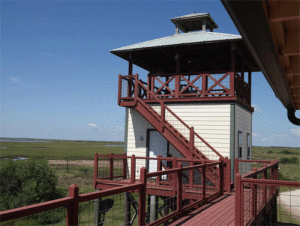
Observation Tower at Mad Island